
The United States was officially neutral regarding World War I when, on July 30, 1916, German agents blew up the Black Tom railyard on land that is now part of Liberty State Park in New Jersey.
A blogger friend of mine, Francisco Cabrera, brought this event to my attention a couple of years ago. I had to admit that the Black Tom Explosion in New York City did not sound familiar to me. That was embarrassing!
In an effort to prevent the U.S. from sending munitions to England, spies and the men they recruited had packed two million pounds of explosives in train cars destined for the depot on Black Tom Island. Germany knew tons of munitions were shipped out of Black Tom Island to the Allies, and they apparently knew security there was lax.
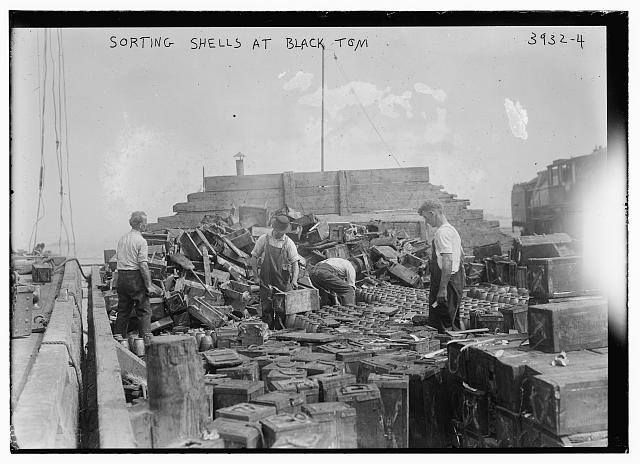
Photo from the Library of Congress.
The 2:08 a.m. explosion and the second one a half hour later shattered thousands of windows in lower Manhattan and Jersey City, New Jersey. I found conflicting casualty reports while researching this post, but at least four people were killed, including an infant.
The Statue of Liberty was pock-marked by shrapnel. The damage to the statue made it necessary to close Lady Liberty’s torch to the public, and it is still closed today.
Property damages in New York and New Jersey were estimated at $20 million, which would be equal to $500 million today. Hundreds of rail cars were destroyed, included 87 filled with dynamite. Thirteen huge warehouses and six piers were destroyed as well as barges tied to the dock.
The explosion registered 5.5 on the Richter scale and was felt in Pennsylvania and Maryland.
As a result of the attack, Congress passed the Espionage Act and in 1917 passed the Sabotage Act. Both Acts gave the Bureau of Investigation oversight jurisdiction.
Although not the only act of sabotage by German upon the United States, the attack on Black Tom Island was instrumental in turning public opinion in the United States against Germany.
It was a different time. For instance, the Bureau of Investigation – the forerunner of the Federal Bureau of Investigation (FBI) only had 260 employees. The FBI website states, “The most successful and experienced anti-sabotage investigators turned out to be the detectives of the New York Police Department’s Bomb Squad. Even so, the German agents who blew up Black Tom were not identified at the time.”
On July 6, 1921, The New York Times reported that Michael Kristoff, a non-citizen and immigrant from Slovakia who served in the U.S. Army in World War I had been arrested and was suspected of taking part in the attack. He had been recruited by a German intelligence operative. Kristoff admitted that he had worked with German agents by carrying suitcases and claimed that two guards at the Black Tom railyard were German agents.
Law enforcement agencies initially dismissed the possibility that it was instigated by Germany. It took lawyers years to pursue the attack for their clients before it was proven before the Mixed Claims Commission at The Hague in 1939 that Germany was behind the attack.
Germany was ordered to pay $50 million in damages but, of course, the Hitler regime did not pay. The case was renegotiated in the early 1950s, but it would be 1979 before the last reparations were made to claimants.
Janet
All history is local, but no history is just local


With a name like Black Tom, I was wondering where this was headed. Didn’t expect a WWI explosion caused by the Germans!
This whole incident is completely new to me! I wonder why it’s not more well known.
That was my reaction when Francisco mentioned it to me a couple of years ago. Who knew?
Liz, I thought maybe I was the only one who had never heard of this. That’s alarming and makes me wonder what else we were never told. And now with the Republicans’ push to take everything sad or negative out of our history books and museums, I fear our civilization is doomed.
I surely did not.
Even after minoring in history in college, this didn’t ring any bells. When I read about the extent of the damage in Manhattan, I really wondered why the story had been left out of all the history books. I didn’t ask Francisco how he knew about it.
Honestly, I don’t know what to think about anything anymore. It’s very disconcerting.
I think we’ve entered the twilight zone minus the narrator to explain what’s going on.
Despite having read quite a lot of WW1 history and the reasons for the US remaining neutral for so long, this has never come up. Very odd! It sounds like something that would never be forgotten, doesn’t it?
It certainly does seem that way. It makes me wonder just how much history has been secreted away from public view. This incident not making the history books is just bizarre.
Thank you for the lesson about this important event. In David Starr Jordan’s The Days of a Man, he talked about the hysteria surrounding World War I. Great find.
Thank you for the book recommendation.