Reading and Writing in January 2018

January is over, so it’s time for me to “fess up” about how I spent the month. Perhaps a better way to say that is “what I accomplished.” In my January 8, 2018 blog post (2018 Reading, Writing, & Living Plans) I felt I needed to be accountable to my blog readers. In order to do that, I said I’d set monthly writing goals. For January, I set a modest goal of adding 2,000 to the scenic plot outline for my historical novel, The Spanish Coin.

My writing

For starters, I failed miserably on reaching my 2,000-word goal. What I did, though, was brainstorm about story location. I continue to wrestle with what direction to take in re-writing my historical novel manuscript. The working title remains The Spanish Coin.

Historical novel progress

In January I settled on a location for the story. At least, I hope I will not change from this latest locale. I did some 1700s research on the place and worked on the story’s timeline. Location plays an important role in historical fiction. The era for the novel is the 1760’s, which is a decade earlier than my original plan.

Spanish Coin location reveal

Curious about the story’s setting?  The Camden District of South Carolina. Choosing a location for the story has freed me to proceed with the outline.

Goal for February

I tend to write detailed outlines, so I’ll go out on a limb and set a goal of 6,000 words for February.

My reading

I got my concentration back and had fun reading in January. I read what I wanted to read instead of tying myself down to any particular reading challenge.

That said, I picked up the rules for the 2018 reading challenges for the public libraries in Harrisburg and Mint Hill (I couldn’t help myself!), but I don’t plan to let them dictate what I read. With 500+ books on my “want to read” list, though, I might meet those two challenges without really trying. Incidentally, even though I read seven books in January, my “want to read” list had a net gain of 39. I realize this is not sustainable. I would have to be a speed reader and live to be a centenarian to finish my ever-growing list.

52 Small Changes: One Year to a Happier, Healthier You, by Brett Blumenthal

The book title says it all. I took note of the suggested change for each week. This week seems like a good week to start, since I didn’t begin in January. This week’s small change:  Drink enough water to stay hydrated. I’m told I should drink approximately 80 ounces of water every day. Since I normally drink less than half that amount, this constitutes more than a “small” change for me.

The Rooster Bar, by John Grisham

This latest John Grisham novel took a little different tack from his earlier books in that The Rooster Bar is about a group of law school dropouts practicing law without licenses. I found it to be more humorous than other Grisham novels I’ve read, but it was still full of suspense.

Perennial Seller: The Art of Making and Marketing Work that Lasts, by Ryan Holiday

I blogged about this book on January 22, 2018, so I direct you to that blog post if you missed it: (Works That Last.)

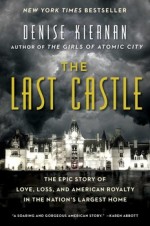
The Last Castle: The Epic Story of Love, Loss, and American Royalty in the Nation’s Largest Home, by Denise Kiernan

the-last-castle-9781476794044_lg
The Last Castle, by Denise Kiernan

I’ve been reading so many novels the last couple of years that I’d forgotten how long nonfiction book titles tend to be. Or maybe it’s just the three I read in January.

I thoroughly enjoyed reading this book about the Vanderbilt family and the Biltmore Estate. Living in North Carolina, I have toured the Biltmore House four times. The first time was on a sixth grade field trip. Motion sickness on the bus as it wound around the endless curves on old US-74 east of Asheville is my main memory from that day, but I digress.

My other visits to the Biltmore Estate have been very enjoyable. Reading this book made me want to plan another trip to Asheville and tour the mansion again. It is a delightful book.

Before We Were Yours, by Lisa Wingate

9780425284681
Before We Were Yours, by Lisa Wingate

This novel was inspired by the shocking history of the Tennessee Children’s Home Society during the first half of the 20th century. It is a gripping story and is expertly written. It is not a happy read, but I highly recommend this book.

The King of Lies, by John Hart

This was the January book choice of the Rocky River Readers Book Club. The novel is set in Salisbury, North Carolina, so I was familiar with some of the streets and buildings referenced in the book. It’s fun sometimes to read a book set in a location you have visited.

I though Mr. Hart could have omitted some of the “woe is me” theme in the first third of the book. The narrator’s whining about the wealthy people in this small town got old after a while. If you’ll hang in there, though, you’ll probably get so involved in trying to identify the killer that you’ll get to the point you can’t put the book down. You’ll think several times that you’ve figured out the villain’s identity but, chances are, you haven’t.

Nightwoods, by Charles Frazier

This novel has been on my “to read” list for several years, so I felt a sense of accomplishment when I finally read it. It is set in the mountains in western North Carolina.

Nightwoods is a tale about a woman who unexpectedly “inherits” her deceased sister’s twin boy and girl. The children give their aunt/new mother a challenge every day – and then her late sister’s widowed husband/killer comes to try to get the large sum of money he thinks the children took with them. The children are wild and uncommunicative. Add to that the fact that the aunt has no idea why her ne’er do well ex-brother-in-law has suddenly shown an interest in his children and has come to hunt them down.

What about December?

I just remembered that I never did blog about the books I read in December. They were a mixed bag of novels:  The Quantum Spy, by David Ignatius; Hardcore Twenty-Four, by Janet Evanovich; and The Secret, Book and Scone Society, by Ellery Adams.

David Ignatius’s political thrillers never disappoint me. The Quantum Spy was no exception.

The last two Stephanie Plum novels by Janet Evanovich disappointed me. I used to eagerly await her annual next installment of these funny novels, but “Twenty-Three” and “Twenty-Four” were too predictable.

The Ellery Adams novel is an entertaining read about four women who want to form a friendship, but each one is required to reveal a secret about herself before they can truly trust one another.

Until my next blog post

I hope you have a good book to read. I’m reading Fighting to Win: Samurai Techniques for Your Work and Life, by my fellow-blogger David J. Rogers; The Salt House, by Lisa Duffy, which was recommended by my friend Karen; Beartown, by Frekrik Backman, which is the February pick for The Apostrophe S Coffee Chat online book community; and The Woman in the Window, by A.J. Finn. That’s about one book too many for me to read at the same time, but they are different enough that I’m not getting the story lines confused.

If you’re a writer, I hope you have productive writing time.

If you subscribed to my mailing list last week, you renewed my faith in mankind. Thank you, Vicki, Colby, Katrina, and Glen!

In case you haven’t signed up for my mailing list, you have another opportunity to do so using the fill-in form below. I appreciate it!

Janet

← Back

Thank you for your response. ✨

Works That Last

You’ve heard the saying, “A job worth doing is worth doing well.” That’s one of those old sayings that will always ring true. I was reminded of that saying a couple of weeks ago as I read Perennial Seller:  The Art of Making and Marketing Work That Lasts, by Ryan Holiday.

9780143109013
Perennial Seller: The Art of Making and Marketing Work that Lasts, by Ryan Holiday

As a writer, the book spoke to me, but it can be applied to any walk of life. By “work that lasts,” Mr. Holiday refers to a creative work or product that isn’t a “flash in the pan.” It is a work that might not be an overnight sensation, but it steadily draws an audience or buyers. It is a book that you want to read again. You recommend it to friends. It does not depend on hype or fancy advertising, but rather builds a fan base via word of mouth.

Part 1 – The Creative Process

Mr. Holiday quotes his mentor, Robert Greene, as saying, “ʻIt starts by wanting to create a classic.’” Mr. Holiday maintains that this doesn’t happen by accident. It happens when you study the classics in your field, and it demands that you know your purpose in creating the book, the painting, or a gadget that will someday make people wonder how they lived without it.

While creating your work, Mr. Holiday says you must ask yourself, “What am I willing to sacrifice in order to do it?”

He also writes about identifying your audience, and the importance of aiming at that target audience instead of the masses. For instance, in my case, I need to be able to say, “I am writing The Spanish Coin for these people. I can’t wait until I have finished writing the novel (or even the outline) before knowing for whom I am writing. I would love to think that everyone will want to read my book, but if I write it with that in mind, Mr. Holiday says I will have written it for no one.

“Who is this for?” is just one of the questions you must ask yourself during the creative process. Another question you must answer is, “How will it improve the lives of the people who buy it?”

Mr. Holiday takes it another step as he offers a list of four more questions that go deeper. They are along the lines of, “What sacred cows am I slaying?” The writers of classics don’t play it safe!

Part 2

The second part of Perennial Seller:  The Art of Making and Marketing Work That Lasts addresses “Positioning:  From Polishing to Perfecting to Packaging.” This cannot be left to chance. If not positioned for success by making it the best you can make it and packaging it in the best possible light, your hard work of creating will be for naught.

For a writer, this means that the editing of your book will take a long time. Your manuscript means a lot to you. You have to make sure it will also mean a lot to others – for years to come. You want it to stand out.

Mr. Holiday talks about the importance of a writer finding a good editor and being able to take constructive criticism. He writes, “Only you know how to fix it – but you’ll only find out what’s wrong if you open yourself up to collaboration and input.”

I should make a sign that features that quote and put it by the computer where I do my writing. Along with that, I need a sign with the following quote from Mr. Holiday’s book:  “Nobody creates flawless first drafts. And nobody creates better second drafts without the intervention of someone else. Nobody.”

The book goes on to address the writer or inventor being able to succinctly fill in the blanks in the following sentence:  “This is a ______ that does _______. This helps people ______.” You must know into which genre your book falls. If you aren’t clear in your own mind how to fill in these blanks about your manuscript, you need to “adjust either the audience or the product until there’s a perfect match. The intended audience is the final blank” in the above two-sentence exercise.

Until you determine who your book is for and what it will do for them, you are aiming at a target you can’t see. Chances are, you won’t hit the target.

Once you identify your target audience, you need to find them and quantify them. I found Mr. Holiday’s personal example for this a bit off-putting. He wrote, “Who is buying the first one thousand copies of this thing?” It’s daunting to think of 1,000 people who will want to buy my novel, but I read on and it got worse.

Mr. Holiday wrote, “For books the superagent and publishing entrepreneur Shawn Coyne (Robert McKee, Jon Krakauer, Michael Connelly) likes to use ten thousand readers as his benchmark. That’s what it takes, in his experience, for a book to successfully break through and for the ideas in it to take hold.”

With those numbers in the back of my mind, I will continue to work on the scenic plot outline for the rewriting of my manuscript titled The Spanish Coin. Another important point Mr. Holiday makes is that the book you write is not only competing with every other book that’s ever been written but with every book that will be written in the future. It’s enough to make me want to throw away my keyboard and concentrate on reading, sleeping, eating, and sewing.

Today’s blog post has hit just a few highlights of Perennial Seller:  The Art of Making and Marketing Work That Lasts, by Ryan Holiday. If you aspire to be a writer, artist, or an inventor, I recommend you read this book. (Disclaimer:  I have not been compensated in any way for endorsing this book. I read it and got a lot out of it. Come to think of it, word of mouth is important!)

There’s a Part 3?

In this blog post I didn’t even get to Part 3 of the book. Part 3 is about marketing, where he says people do actually judge a book by its cover and the writer must put as much energy into marketing or they do in creating the book. Most writers would rather spend their time writing and leave the marketing to salespeople, but that’s not the way it works. Even bestselling authors have to make personal appearances and pitch their latest books.

And Part 4?

I didn’t get to write about Part 4 of Perennial Seller:  The Art of Making and Marketing Work That Lasts, by Ryan Holiday in today’s blog. It’s about “Platform: From Fans to Friends and a Full-Fledged Career.”

Ryan Holiday packs a lot into a relatively small (231-page) book — far too much for me to cover in a blog post.

Until my next blog post

I hope you have a good book to read. I’m finishing The King of Lies, by John Hart, for tonight’s meeting of the Rocky River Readers Book Club. If you’re in the Harrisburg/Concord area, you are welcome to join us for our discussion tonight at 7pm at Rocky River Presbyterian Church at 7940 Rocky River Road, Concord, North Carolina  28025.

If you’re a writer, I hope you have quality writing time.

I’m told that I need to start building a mailing list. If my blog disappears, I want to be able to communicate with you. I promise not to burden you with a bunch of e-mail. In the event I have an announcement to make or I start writing a newsletter, I want to be able to send it to you. Please fill out the contact form found below. At least, I hope it appears below. (You know I’m not computer savvy!)

Janet

← Back

Thank you for your response. ✨

Anne Lamott’s Gems for Novelists

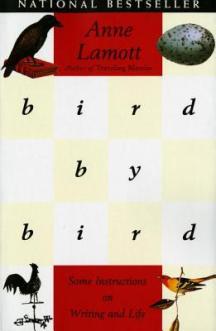
My blog post on August 7, 2017 (Late July Reading) was about the three books I read during the second half of July. I wanted to share more words of wisdom I gleaned from Anne Lamott’s book, Bird-by-Bird: Some Instructions on Writing and Life.

12543
Bird-by-Bird: Some Instructions on Writing and Life, by Anne Lamott

As I stated in that post, as someone learning the art and craft of writing, I enjoyed Bird-by-Bird, by Anne Lamott. The following quote from the book also sums up how I feel about good novelists.

“Ever since I was a little kid, I’ve thought that there was something noble and mysterious about writing, about the people who could do it well, who could create a world as if they were little gods or sorcerers. All my life I’ve felt that there was something magical about people who could get into other people’s minds and skin, who could take people like me out of ourselves and then take us back to ourselves. And you know what? I still do.”  ~  Anne Lamott

Ms. Lamott waxes poetic about what makes a book a good book. I cannot say it any better than she does in the first chapter. She writes about all the things books do for us.

She has some words of wisdom for people like me. One takeaway I took from the book was that I need to get over being a perfectionist.

Ms. Lamott talks about characters and gives tips about how to get acquainted with a character before you write about him or her. However, she cautions that you won’t really get to know your characters until “you’ve started working with them.”

My interpretation of one of her recommendations is for writers to focus on character and the plot will fall into place. You have to know what means the most to your protagonist so you’ll understand and can convey to the reader what is at stake in your novel. To quote her again:

“That’s what plot is:  what people up and do in spite of everything that tells them they shouldn’t,….” ~ Anne Lamott

Ms. Lamott writes about the parts of a novel and the importance of the writer paying attention to those details. If no one is changed in the course of the novel, it has no point. She writes about dialogue and how it must be written as real people talk. It’s essential to get voice right in order to get character right.

She writes, “We start out with stock characters, and our unconscious provides us with real, flesh-and-blood, believable people.” (I hope she’s right. I hope the unconscious part of my brain kicks in as I rewrite my manuscript for The Spanish Coin!)

All this is just the tip of the iceberg. She writes about a writer’s self-confidence and the importance of a novelist deeply knowing the setting for their novel. She says that a writer needs to recapture the intuition they had as a child and let that lead their opinions.

I could go on and on, but I’ll leave you with two more quotes from the book:

“Don’t look at your feet to see if you are doing it right. Just dance.” ~ Anne Lamott

“Risk being unliked. Tell the truth as you understand it. If you are a writer, you have a moral obligation to do this. And it is a revolutionary act –  truth is always subversive.” ~ Anne Lamott

Until my next blog post

I hope you have a good book to read. If you’re a writer, I hope you have productive writing time. I also recommend that you read Bird-by-Bird: Some Instructions on Writing and Life, by Anne Lamott.

Janet

Where My Blog and Novel Stand

Photo by Kari Shea on Unsplash


Janet’s Writing Blog

Since writing Friday’s blog post (Getting Blog Traffic in 2017,) I’ve decided to change my routine and just blog on Mondays. When I read that blogging once-a-week was ideal for someone trying to establish their brand, I thought, “That’s not for me. I like blogging twice-a-week.” I couldn’t get the theory out of my head. By late Friday night I had decided to start blogging just once-a-week.

I’ve chosen Mondays. I wanted to choose Tuesdays, but for those of us who manage the WordPress.com blogs we read by getting them in a weekly format, they arrive on Monday. If I wait until Tuesday to blog, some readers won’t receive my post until the following Monday. That’s not good. I’ll try early Mondays (right after midnight on Sundays) for a while and see how that works. The great thing about a blog is that the blogger makes up her own rules. My kind of activity!

The Spanish Coin

Something happened on Saturday that told me I’d made the right decision about my blog. Or, perhaps what happened on Saturday came about as the result of the stress relief Friday night’s decision gave me. Follow?

If you’ve been following my blog for very long, you know I’ve been working on a novel manuscript with the working title of The Spanish Coin for more than a decade. (I’m not only a slow reader, I’m a slow writer!) Several months ago I discovered some facts that made it clear that I needed to make major changes in my historical novel. Another name for that is REWRITE, as in START OVER! After 10 years of work, this realization knocked the wind out of my sails. I have struggled over this for about three months – maybe longer. (It feels like three years.)

I knew I had to change the names and location of my novel. I believed I could keep the working title, The Spanish Coin, but many of the details of the story and perhaps most importantly, the climax, had to change. After kicking around ideas for weeks, on Saturday I finally settled on a new location for the story. I changed the names of most of the characters, and I changed the year it happened. Those decisions freed me up to start writing the new outline. By the time I turned off the computer at 2:30 a.m. on Sunday, June 25, I had written 300 words of backstory, more than 2,500 words of outline, and 250 words of character sketches. I felt like a weight had been lifted from my shoulders!

Saturday was just the beginning, but I can’t tell you how invigorated I feel knowing that I have started the rewrite. I’m optimistic about what I will get accomplished this week!

Until my next blog post on July 3

I hope you have a good book to read. I’m reading The Secret Speech, by Tom Rob Smith.

If you’re a writer, I hope you have productive writing time and feel as optimistic about your work in progress as I do mine.

Janet

Getting Blog Traffic in 2017

Tomorrow is my blog’s 7th blogaversary. My first blog post was on June 24, 2010. It doesn’t seem like I’ve been blogging for seven years. There’s a good reason for that. In 2010 I only blogged four times. I blogged once in 2011. In 2011 I blogged only seven times. It wasn’t until July 7, 2014 that I started blogging on a regular basis. That was the month before the publication of my vintage postcard book, The Blue Ridge Mountains of North Carolina. I finally felt like I had something to write about!


annie-spratt-96527
Happy 7th Blogaversary to Janet’s Writing Blog!

Photo by Annie Spratt on Unsplash

I am constantly learning more about blogging. You may have noticed that I’ve started trying to write catchier blog post titles. I’m also trying to limit my post titles to five words. I read somewhere that’s ideal, but now I don’t remember why. Seems like it has something to do with showing up in a Google search.

MostlyBlogging.com

Janice Wald’s blog post on June 10, 2017 (http://www.mostlyblogging.com/generate-better-traffic) said something that made me stop in my tracks and reread a couple of paragraphs. The post was written by Raymond Crain, who works for E2M, a social media marketing agency based in San Diego.

In a nutshell, Mr. Crain said that blogging daily is out and blogging good content is in. Yay! I don’t have to feel guilty for only blogging twice-a-week!

He said Google now puts more emphasis on the “intent” of the searcher and the “quality” of the blog post. If you’re blogging for your own enjoyment, posting daily is fine, but if you’re trying to get your brand out there and drive more traffic to your blog you might want to read Mr. Crain’s article. This was just one of his five recommendations.

A Writer’s Path blog

Guest post contributor Shelley Widhalm said on Ryan Lanz’s A Writer’s Path blog on June 13, 2017 (https://ryanlanz.com/2017/06/13/why-blogging-is-important-for-writers/) that blogs are here to stay, but that it is quality and not quantity that’s important when establishing your brand and your credentials as a blogger worth reading. Therefore, there is more to blogging than attaining high search engine optimization (SEO.)

Ms. Widhalm stated, “Research shows that blogs should be posted once a week on the same day of the week . . . .”

She did not cite that specific research, but I will take the statement under consideration and continue to watch to see what becomes standard practice. Blogging is a creative outlet for me, so I won’t promise to conform to recommended schedules.

What do you think?

Would you prefer that I only blog once-a-week? I might give that some thought.

Until my next blog post

I hope you have good book to read. I’ve just finished reading Camino Island, by John Grisham and Put the Cat in the Oven Before You Describe the Kitchen, by Jake Vander Ark. (More on that in July when I blog about the books I read in June.)

If you’re a writer, I hope you have productive writing time.

Janet

A Different Perspective on Storytelling

I read a guest blog post by storyteller E.M. Welsh on May 8, 2017. It was posted on Kristen Kieffer’s Well-Storied.com blog [https://www.well-storied.com] and addressed writer’s ego. I was interested in the topic, so I read the entire blog post. The post prompted me to go to Ms. Welsh’s website. I signed up for her weekly e-mails because what she had written gave me a different perspective on storytelling.

A-Different-Perspective

Quoting from an e-mail I received from E.M. Welsh a few minutes later:

“You might think you know what a “storyteller” is, but over at emwelsh.com we have a different idea about the definition, and that idea is the core of my website.

“A storyteller is someone who loves storytelling in all forms. This means not just novel writing, like what Kristen [Kieffer] teaches, but screenwriting, playwriting, and even video game writing as well.

Ms. Welsh continued, “Because of this love of all mediums, the storyteller always thinks in terms of what they can do to tell the best story possible, not to do what is considered comfortable. So, if that means writing a screenplay instead of a novel, even though they’re more familiar with prose, they’ll do it if it means telling a better story.”

I must admit that, although I wrote two historical plays for my church’s 250th anniversary in 2001, since then I have thought of myself as an aspiring novelist. Ms. Welsh’s e-mail statements and additional information on her website and in her free downloadables made me stop and consider how limiting that mindset (the “aspiring novelist” one) can be.

In a nutshell

Ms. Welsh’s theory is that the story dictates the format. I had never looked at it that way, so it is interesting and enlightening to consider. What this boils down to is the fact that the story is the important thing. Not the writer, but the story.

The story tells the writer whether it is a novel, a screenplay, a play, or a video game.

Looking at a story from this perspective is both challenging and freeing for a writer.

Am I writing because I want to be a writer, or am I writing because I am a writer?

In other words, am I in love with the dream of what it would be like to see my name as author of a book, or am I compelled to write because that is what I am driven to do?

Kristen Kieffer and E.M. Welsh warn us not to let ego get in the way of writing.

Until my next blog post

I hope you have a good book to read. I finished reading The Nightingale, by Kristin Hannah (excellent!) and am currently reading Homegoing, by Yaa  Gyasi.

If you’re a writer, I hope you have productive writing time.

Janet

Extreme Abbreviation


overwhelmed

Today I’m giving you a glimpse of what I deal with on a daily basis while I attempt to be a writer. No one told me I would have days like this back in 2001 when I took that fiction writing course.

Bots

I received an e-mail from LinkedIn. It mentioned “productivity bots.” I Googled that, since I didn’t know what it was. In addition to being the larva of the botfly, a bot can be an app that performs an automated task. I even heard bots mentioned in a recent U.S. Senate hearing. They’re everywhere! They’re everywhere!

ROI

On May 9 I received an e-mail from Hootsuite’s Global Webinar Team. The headline was, “Prove the ROI of Your Social Strategy Tuesday, May 23, 2017 11am PT/2pm ET.” Nowhere did the e-mail explain what ROI is, so I “Googled” it and learned that ROI is Return on Investment.

I suppose anyone who didn’t already know that didn’t need to register for the webinar. Or perhaps I should register. Maybe I would learn how my minimal financial investment in social media is translating into readers and followers. Or maybe not.

Lead Gen Tips

Someone followed me on Twitter. His profile said he offers “lead gen tips.” I had to Google that, too, because I didn’t have clue what it meant. Since my search brought up 10,800,000 results, I must be the last person on Earth to know that “lead gen tips” is short for “lead generation tips.” With that knowledge, I knew a little more than I had before, but not much.

The “lead gen tips” Google results had titles that contained words and phrases such as “The Best,” “A Complete Guide,” “30 Actionable,” and “63 Lead Generation Strategies.”

That last one came from a person or company called Marketing Wizdom. I don’t know about you, but I’m leery of people who deliberately misspell words in a company’s name or elsewhere. I became aware of the dangers in this years ago when my sister was a literacy tutor. It’s inconsiderate to people who are struggling to learn English or who are learning to read to misspell words. But I digress.

Other search results included the following:  “30 … Tips & Tricks,” “32 Clever,” “Best… Tips and Tricks,” “4 Tips,” “5 … Tips,” and “10 Tips.”

That was just on the first screen. I stopped there.

I couldn’t help but notice that all the websites listed above got the memo but the last one. That was the memo saying you’ll get more hits if you don’t put “10” in your blog post title.

When I got to the bottom of the screen, I noticed that one of the “Searches related to lead gen tips” was “lead generation definition.” Now we’re getting somewhere! I clicked on that and the definition that appeared in the little box on the screen stated, “the action or process of identifying and cultivating potential customers for a business’s products or services.” Okay. Now I understand “lead gen tips.”

Extreme Abbreviation

Something else I understand is that I will never be able to keep up with today’s business and computer jargon. I’ll keep trying, though. Just like taking shorthand in high school (yes, I’m that old!) ruined my handwriting, I’m afraid texting has resulted in extreme abbreviation in all forms of communication. (Is “extreme abbreviation” a term, or did I just coin it?)

If you liked today’s blog post, I invite you to read my May 9, 2017 post, What is a Conversion Habit and Do I Need One?

Until my next blog post

I hope you have a good book to read. I’m reading The Nightingale, by Kristin Hannah, for Monday’s book club meeting while I’m trying to finish reading Peter Wohlleben’s The Hidden Life of Trees. I’m also reading World of Toil and Strife, by Peter N. Moore, for research purposes. I’m also still reading The Source, by James A. Michener, when I have time. At this rate, it will take me a year to read the entire book!

If you’re a writer, I hope you have productive writing time and don’t have to spend as much time as I do using search engines to translate abbreviations and jargon.

Janet

P.S.  I think all the images I’ve included in my blog posts until today were photographs I had taken. I discovered a free stock photo website, Unsplash.com, a couple of days ago. Today’s image is from that site and was taken by Pim Chu of Thailand.

What is a Conversion Habit and Do I Need One?

I received an e-mail on May 4 from ProBlogger.com with a link to a blog post about conversion habits. I’m not a theology student. I didn’t have a clue what “conversion habits” were or if I needed to try to work them into my life. I didn’t know if a conversion habit was a good habit or a bad habit. ProBlogger.com is a trusted source, so I clicked on the link to learn more.

https://problogger.com/the-9-conversion-habits-of-the-worlds-most-successful-bloggers/

The blog was written by a guest blogger, John Stevens. Mr. Stevens, according to the blog, “is the CEO of Hosting Facts, a startup that helps consumers make data-backed decisions when choosing web hosts. He is also a frequent contributor to WebsiteSetup where he helps businesses set up their website.”

Used by the world’s greatest bloggers

The best I could tell, conversion habits are practices the world’s greatest bloggers use to convert a blog reader into a customer. Since I have nothing to sell at the moment, other than copies of my vintage postcard book, The Blue Ridge Mountains of North Carolina, three Morrison genealogies compiled by my sister and me, and several privately-printed-on-demand booklets I wrote about Rocky River Presbyterian Church history, I don’t think I need to expend my limited energy working on conversion habits. It’s not like I’m trying to get my books on the New York Times Bestseller List!

I didn’t really need anything to add to my “to-do” list, so I was relieved that I don’t need to be bothered with conversion habits – at least for now.

(Warning:  shameless plug — Incidentally, if you’re interested in purchasing one of my books, visit https://www.janetmorrisonbooks.com or visit your favorite independent bookstore.)

Mt. trip Dec.11-14,2014 031
The Blue Ridge Mountains of North Carolina on the shelf at Lake Junaluska Bookstore.

That didn’t mean I didn’t keep reading the blog post, though. I am a curious person, and the post’s title promised me nine conversion habits. I got down to the ninth habit, thinking I was almost finished. I could delete the e-mail and go to bed. But no. The ninth conversion habit was, “They use prominent CTAs.”

What the heck is a prominent CTA?

Turn the light back on. There will be no sleeping tonight until I figure out what a prominent CTA is. I read on. The first sentence asked me what color my CTAs were. That sounded like a personal question to me, and I felt myself blush. Never fear! I surmised that you want your CTA to be a contrasting color to that of your logo.

The blog post went on to talk about the Von Restorff effect, which is also called the “isolation effect.” Not being a student of marketing, I wasn’t familiar with that effect. Mr. Stevens explained it as follows:  “this principle states that when confronted with multiple stimuli (in our case, CTAs), the stimuli that stand out the most wins our attention.”

Regaining my composure, I kept reading. The next sentence informed me that “your CTAs have a big impact on your conversion rates.” Since I don’t feel the need for conversion rates, I’m once again tempted to delete the e-mail and call it a night. I keep reading, though, because I still don’t have a clue what a CTA is, and I try to learn something new every day – even if it appears to be useless information. I read on.

Higher CTR

Mr. Stevens continued with, “Since your CTAs lead visitors to subscribe to your newsletter, download your eBooks or buy your courses, it makes sense to optimize it for higher CTR.” I don’t know what a CTR is, but it’s far too late in the evening to chase after that rabbit. After all, I need something to do tomorrow, right? (No – I’m too curious. Google search. CTR is currency transaction report. That’s all I need to know about that.)

Study results

I learned that a study revealed that changing the color of CTAs resulted in an increase of 21% in a blog’s conversion rate. That sounded impressive, so I looked at the illustrations. The best I could tell, a CTA is a clickable button that says something like, “Get started now!”

But what is a CTA?

A search on Google, “What is a CTA?” brought up the definition of a computed tomography angiography. I wasn’t just in the wrong pew, I was in the wrong church! Another search choice was “What is a CTA on a website?” Bingo!

The answer that popped up when I clicked on that option was, “In web design, a CTA may be a banner, button, or some type of graphic or text on a website meant to prompt a user to click it, and continue down a conversion funnel.”

That’s all?

My response to that explanation was, “That’s all?” (Peggy Lee should be singing, “Is That All There Is?” right about now! For those of you who don’t know who Peggy Lee was, that song was a big hit for her in 1969.) I just spent 10 minutes trying to learn what a CTA is and it’s just a button? I can see why they call it a CTA. That’s a lot more impressive than “button.”

The letdown

I feel like I’ve been on a wild goose chase. Tomorrow will I still remember what conversion habits and CTAs are? It makes me wonder if universities now offer a Bachelor of Science degree in Blogging. Are such courses as Conversion Habits 101 and CTAs 101 included in the required curriculum? Can one minor in CTR?

This stuff gives me a headache. All I want to do is write my novel and finish reading my current library book so I can start reading the next one.

All jokes aside, Mr. Stevens received wonderful comments and praise for his blog post. It was well-written, well-illustrated, and apparently contained useful information for people who are in the business of selling a product through their blog. I’m just not there yet. I highly recommend the blog post to anyone who is marketing a tangible product or something intangible such as a writing course.

Until my next blog post

I hope you have a good book to read. If you’re a writer, I hope you have productive writing time.

Janet

Z is for Zilch!

Zilch is what I’ve accomplished toward starting over to write my first historical novel. I have successfully completed the 2017 A to Z Blog Challenge by writing a post today that has something to do with the letter “Z.” I enjoyed parts of the challenge, but I’m glad English only has 26 letters! It was interesting and I picked up some new followers, but I don’t think I’ll do it again. Beginning on Tuesday, May 2, I plan to return to my former routine of blogging on Tuesdays and Fridays.

2017 A to Z Challenge Badge
Blogging from A to Z Challenge Badge 2017

With this blog challenge finished

I look forward to having more time to delve back into the various resources available to me as I keep researching the facts surrounding the core event in The Spanish Coin manuscript. Several more books are coming from two public library systems, so you know what I’ll be doing next week.

What happened to The Spanish Coin?

I revealed in my “H is for Historical Fiction” blog post on April 10, 2017 (H is for Historical Fiction) that I had discovered some pertinent information about the core of my story that necessitated my starting over. Several years (actually a decade) and 96,000 words later, I’m back to having a blank page.

My options

Since April 10 I have done a lot of thinking and reading. I’ll need to do a little more work on the research end of things and then determine how to rewrite The Spanish Coin. It might not survive with that working title. Or I might be able to salvage that title and change the circumstances of its importance. Or I might just take the spark of the true story as my inspiration and write a totally new story.

When I figure out which option to settle on, I’ll let you know.

With the A to Z Blog Challenge Finished

I look forward to having time to read more books. My current “Books I Want to Read” list is so long I fear I won’t live long enough to read all of them. With new books being released every month, the list just keeps growing.

Until my next blog (which should be on May 2)

I hope you have a good book to read. I’m enjoying Small Great Things, by Jodi Picoult, World of Toil and Strife: Community Transformation in Backcountry South Carolina, 1750-1805, by Peter N. Moore, and The Art and Craft of Writing Historical Fiction, by James Alexander Thom. I have to take note and reread parts of Mr. Thom’s book occasionally. The bibliography in Mr. Moore’s book has already led me to more books I need to read before I figure out the verdict for The Spanish Coin.

If you’re a writer, I hope you have productive writing time. I hope you’ve gotten past the blank page stage on your first novel.

Janet

W is for Wufoo.com

I’m feeling my age today, after going up into the attic on Tuesday. Not a good idea for someone of my age with CFS/ME and fibromyalgia. That said, Wednesday wasn’t a good day for me to try to figure out something new on the computer. There’s really not a good day for me to do that. I should only attempt such tasks when I’m at the top of my game. With no such days on the horizon and needing to blog about something starting with the letter “W,” I forged ahead.

What starts with W?

On the 23rd day of the 2017 A to Z Blog Challenge, the featured letter is “W.” I’ve struggled over what to write about today. There are so many possibilities, including Why I Write, Writing, Webinars I’ve Attended, Wufoo.com, or the Where Writers Win website.

W is for Wufoo.com

Wednesday was the day I could finally sit down at the computer and try to figure out how Wufoo.com could integrate with MailChimp on WordPress.com so I could have a mailing list. In the event I ever want to announce something to my readers before or without making a public announcement, I need an e-mail mailing list.

Other bloggers have such lists, so how difficult can it be, right?

I spent a couple of hours on Wednesday afternoon working my way through the simple instructions on Wufoo.com trying to set up a way for me to add a sign-up form on my blog for a mailing list. As often happens, the list of “do this and you will see that” suckered me into thinking I could do. I improvised when I “did this and I didn’t see that.” I set up an account. I created a form. I filled in blanks. I wrote little notes to my readers telling them I would never share their information with anyone. I marked the parts of the form that are not optional. I went to WordPress.com and cut and pasted the Wufoo code so it would show up as the third widget down in my blog’s sidebar. I thought I had everything accomplished, but on Wednesday night as I schedule this blog post for 6:50 a.m. Eastern Time on Thursday, April 27, no such sign-up form has appeared on my blog.

It’s my fault

I in no way blame Wufoo.com for this. It is obviously an error on my part. It has been another frustrating day in the life of someone who is technologically-challenged and just wants to be a writer.

“I’d rather do it myself!”

One day I will have to give up on setting this mailing list up myself, but I will not give up on the mailing list. I’m trying not to bother my niece’s husband with this request. He set up my website, and I’m sure he can do this for me, too. I am reminded that as a very small child, one of my favorite things to say was, “I’d rather do it myself!” Apparently, that’s still true.

A to Z Blog Challenge

I’m delighted to note that there are only three days remaining in the A to Z Blog Challenge. Topics for “Y” and “Z” are still up for grabs, in case anyone has any suggestions for me. I’m looking for words starting with “Y” and “Z” that have something to do with writing for my blog on April 29 and 30, 2017.

Until my next blog post

I hope you have a good book to read. If you’re a writer, I hope you have productive writing time.

Janet