Have you signed up for my newsletter?

May will be here in a few days, and that means it’s time for my second newsletter. The last two months have flown by!

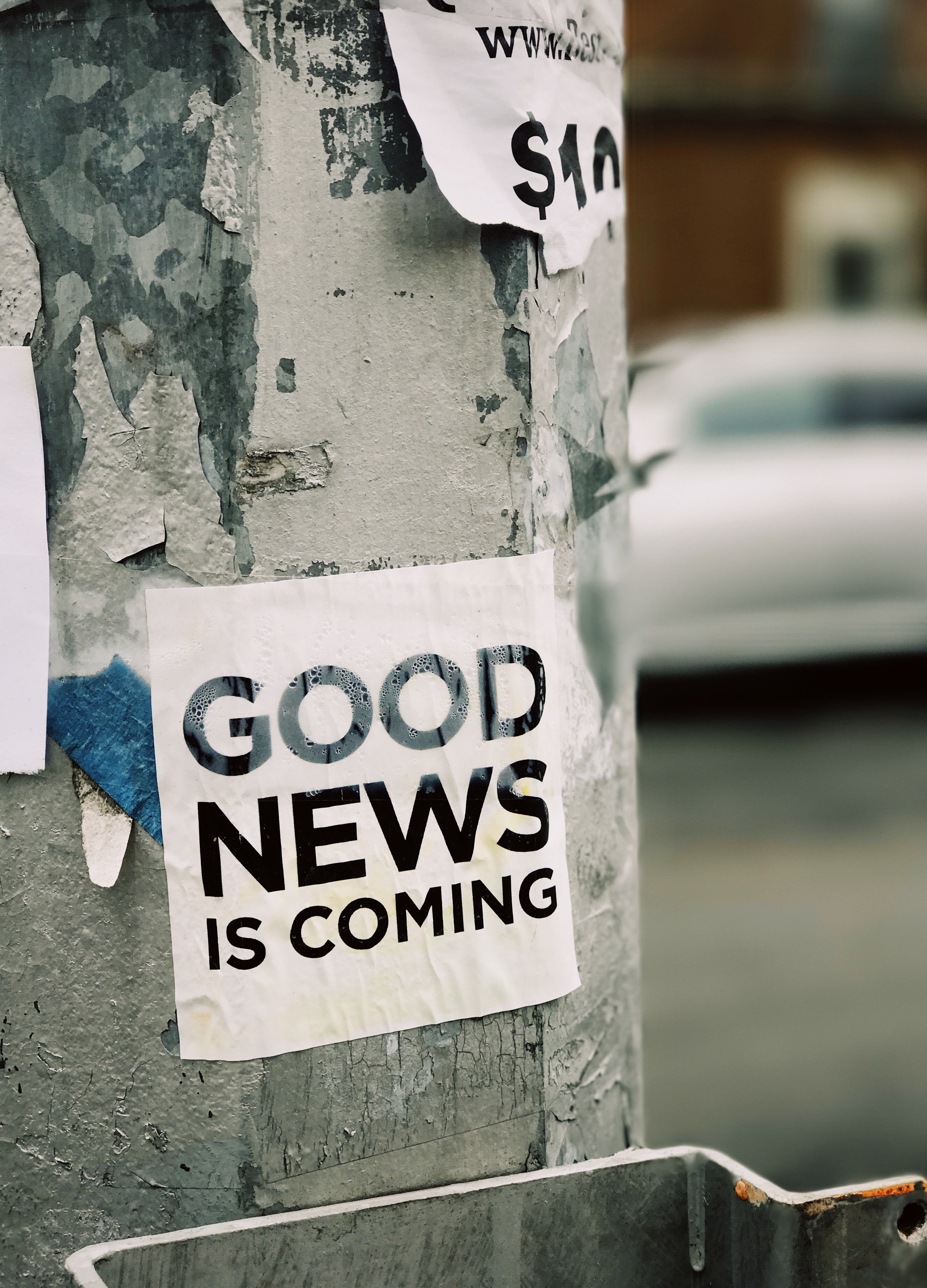
Photo by Jon Tyson on Unsplash

In case you haven’t signed up for my newsletter yet, it only takes a minute. Go to my website, https://www.janetmorrisonbooks.com, and click on the “Subscribe” button on any page on the site. Verify that you are a human being, and fill in your name and email address. That’s all there is to it.


What’s in it for you?

In return for signing up for my newsletter, you will receive an email from me containing a link for you to use to download a copy of my short story, “Slip Sliding Away: A Southern Historical Short Story.”

Then, every other month you will receive my newsletter in your email inbox.


Why in the world would I have a newsletter?

Come on. Admit it. That question is bouncing around in your head along with, “What could Janet Morrison have to put in a newsletter?”

I’ll address that in a minute, but first let’s discuss the “Why?”

In an effort to get my name out there as a legitimate writer, I’ve spent a good amount of time reading up on author websites and author newsletters. All the writing craft books, free webinars, and courses I’ve taken emphasize the importance of a writer being able to communicate with her audience.

I’m early in the process of finding my audience. My website was redesigned a couple of months ago. In conjunction with the development of the website I now have a way to compile an email list of people who are interested in my books.

I will never send you spam and I will never give away or sell my email list. It is my intention to only email you six times a year to deliver my newsletters to you.


“What could Janet Morrison have to put in a newsletter?”

I primarily want to keep you up-to-date on my writing projects. I’ll include the titles of books my subscribers have recommended, field trips I go on – some for research for my writing and others just for fun or information, my author events, reviews my books have received, and trivia questions that can be answered by reading my books.

I will tell you about short stories and books I’m working on, so you’ll be the first to know how those are coming along and when you can expect them to be published.

You’ll find out that I don’t tell everything I know in my blog posts!


I’m a work in progress…

and so is my author’s platform. I blogged about an author’s platform way back on April 15, 2016 in Update on sorting out social media. I blogged about this subject again on November 29, 2016 in My Author Brand Progress Report – Part 1 (with CORRECTION). The list goes on and on. You’ve seen me struggle with various forms of social media and failing at most of them.

I’m still trying to find my niche. I’ve invested time in Twitter and other social media platforms. I’ve found a few kindred spirits out there, but not a big following.

I’m committing myself to this newsletter. I much prefer that to social media I’m expected to spend hours on each day. I’d rather be writing or reading or a host of other things, so let’s plan to continue with the blog every Monday and then in May, July, September, November, January, March, etc. let’s get together over my newsletter to dig a little deeper into what I’m writing and reading and what you’re reading. And, if you’re also writing, please share that so I can include it. Let’s have some fun with a trivia question in each newsletter. Hint: you’ll probably need to read my books or short stories to find the answers.


What have you been reading lately that you’d recommend?

I want to share your reading recommendations with others on my newsletter list. Join the list and then send me your book recommendations. With your permission, I’ll add your name and recommendations to my next newsletter.


Until my next blog post

I hope you have at least one good book to read.

Make time for family and friends. Fellowship does a body good.

Remember the people of Ukraine.

Janet

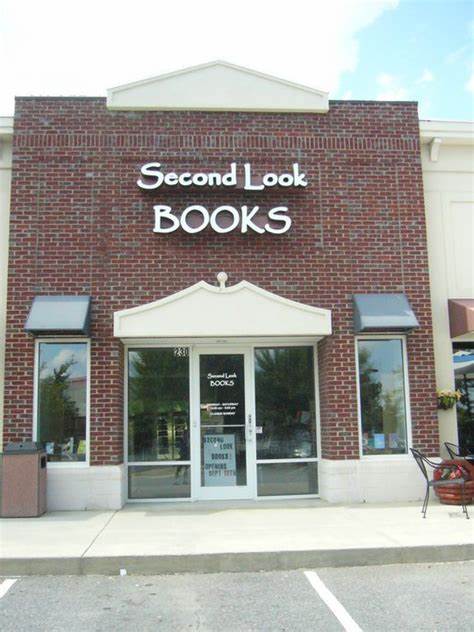
Meet & Greet at Second Look Books, April 15th

What?        Author Meet & Greet

Where?      Second Look Books, 4519 School House Commons in Harrisburg

When?       Saturday, April 15, 2023

What Time?         2:00 – 4:00 p.m.

Second Look Books, 4519 School House Commons, Harrisburg, NC

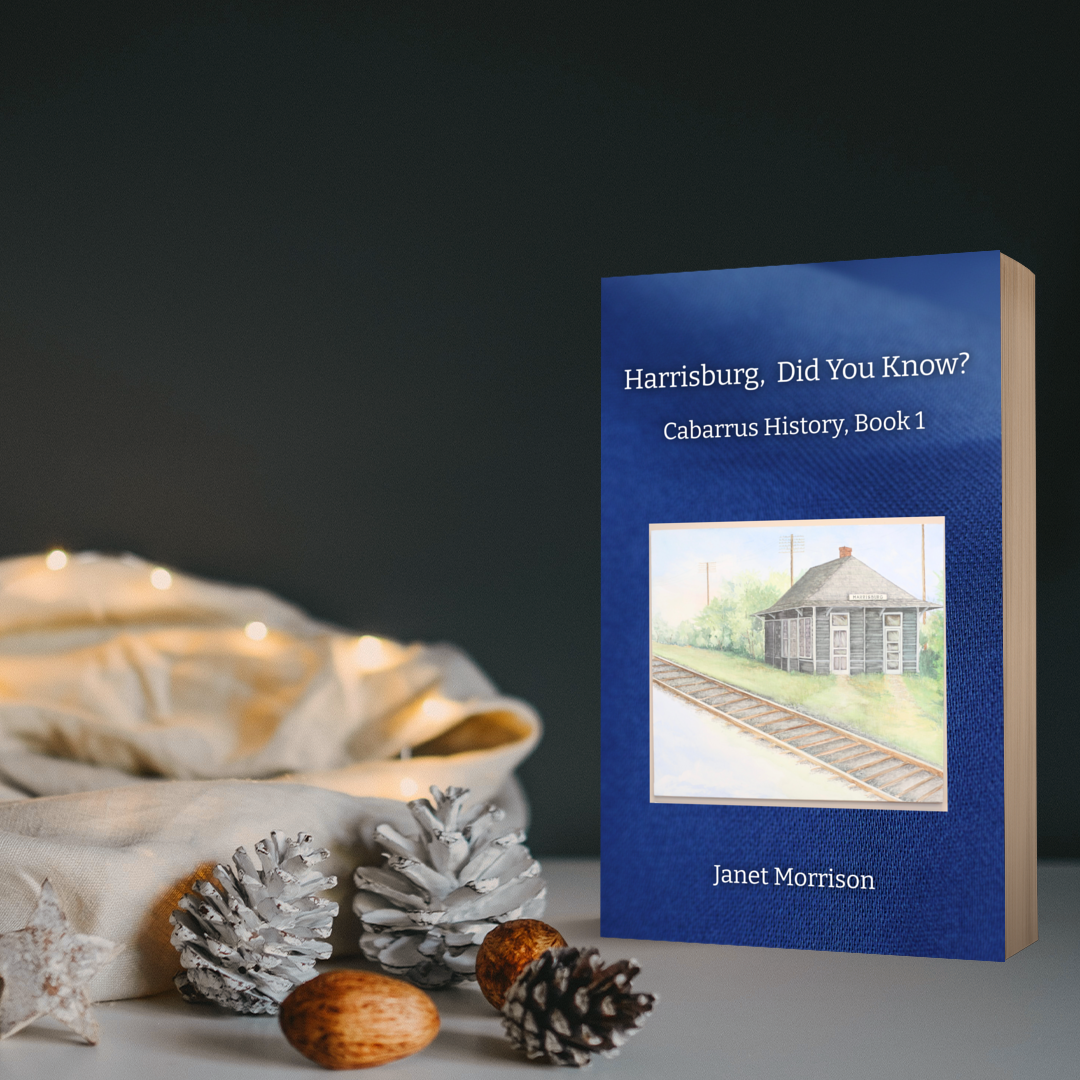
Copies of Harrisburg, Did You Know? Cabarrus History, Book 1 and Book 2 have arrived and been autographed.

Photocopies of my 11×14-inch “Harrisburg in the 1900s” two-map sets have been made.

Business cards and bookmarks are printed.

Saturday, April 15 is the big day for my Meet & Greet at Second Look Books in Harrisburg, North Carolina! I’ll be there from 2:00 p.m. until 4:00 p.m.

Please drop by, even if you’ve already purchased both books.

The bookmarks and Harrisburg maps are free while supplies last.

What maps?

I drew the maps based on detailed memories that Mr. Ira Lee Taylor shared with me while I was writing the “Did You Know? local history column for Harrisburg Horizons newspaper (2006-2012.)

One map covers from along NC-49 to Back Creek. The other map covers from Back Creek to Reedy Creek and where McKee Creek flows into Reedy Creek.

Mr. Taylor told me where such things as the telephone switchboard, spoke factory, two cotton gins, railroad houses, corn fields, cotton fields, and livery stable were in the early 1900s.

He told me where the various stores and post offices were. Being the town’s only mail carrier for several decades, he knew where everybody lived, so I included much of that information The map show where the roads were (and were not) before the coming of the high-speed rail.

In case you arrived in Harrisburg after the two-story red brick old Harrisburg School was torn down, this set of maps will show you the layout of the school grounds. The school property is where School House Commons Shopping Center is now.

The maps also show the locations of the Oak Grove Rosenwald School and the Bellefonte Rosenwald School that you read about in Harrisburg, Did You Know? Cabarrus History, Book 1.

Some things you’ll learn about in my two books

There are stories of local heroism from 1771 and the detailed memories of a World War II US Army veteran who told me about his training for D-Day through to the end of the war.

There are stories about the original Hickory Ridge School, which was a one-room school on Hickory Ridge Road.

There are stories about the Rosenwald Schools that served the black students in the early 1900s.

There are stories about the man from Russia (actually, Ukraine) who settled in Harrisburg in the 1920s to practice medicine until his death in 1960. He was a country doctor who made house calls

There are stories about the construction of the Charlotte Motor Speedway and the first World 600 Race when the track was in such bad shape that chunks of asphalt broke the windshields out of some of the race cars.

There is information about the 22-mile syenite ring-dike that Harrisburg sits in. It’s what remains of an ancient volcano.

Until my next blog post

Remember the people of Ukraine – where Dr. Nicholas E. Lubchenko was born and lived until young adulthood.

I hope to see you on Saturday!

In case you don’t have a good book to read, please consider purchasing my local history books. They’re available in paperback at Second Look Books. They’re also available in paperback and for Kindle from Amazon.

Even if you don’t live or have never lived in Harrisburg, North Carolina, I think you’ll find some interesting stories that you can probably relate to if you are of a certain age. And if you a child, teen, or young adult I think you’ll find it interesting to read about how life used to be in our sleepy little farm village of a couple hundred people in the early 1900s that has grown to nearly 20,000 people in 2023.

What?        Author Meet & Greet

Where?      Second Look Books, 4519 School House Commons in Harrisburg

When?       Saturday, April 15, 2023

What Time?         2:00 – 4:00 p.m.

I hope to see you there!

Janet

Local History is Revealed in National Archives Holdings

The first documented gold discovery in the United States was here in present-day Cabarrus County, North Carolina in 1799. The discovery by a little boy playing in Little Meadow Creek led to gold fever in the area. Numerous gold mines were dug and mined to various levels of success.

In fact, there was enough gold found in the southern piedmont of North Carolina that a branch of the United States Mint was built in Charlotte in 1836 and 1837. It opened for the production of gold coins in 1837.

A trip to the National Archives at Atlanta (which is in the Atlanta suburb of Morrow, Georgia) a few years ago gave me the opportunity to look at ledger books from the Mint in Charlotte. Within those pages I recognized names from my community.

Register of Gold – Branch Mint – Charlotte

I’m blogging about some of that information today to give you an example of the type of documented local history I included in Harrisburg, Did You Know? Cabarrus History, Book 2. Although the book (and Harrisburg, Did You Know? Cabarrus History, Book 1) concentrate on Harrisburg, both books do include articles about other communities in Township One.

One of the communities rich in history in the township is Pioneer Mills. Little more than a quiet crossroads now, it was a center of activity in the mid-1800s after the discovery of gold and the opening of Pioneer Mills Gold Mine.

I recognized names such as John C. Barnhardt from the Pioneer Mills community as taking 123 ounces of amalgam to the Charlotte Mint on August 31, 1843, for which he was paid $2,340.33. That was no small sum of money in 1843!

Robert Harvey Morrison, on whose land the Pioneer Mills Gold Mine was located, was paid more than $4,000 for the gold bars and amalgam he took to the Mint from late in 1846 into early 1850.

Other names I recognized in the Mint ledgers included two other Barnhardts,  Robert R. King, three men with the surname Treloar, and R.B. Northrop.

Comparing US Census records, Charlotte Mint records, and various years of Branson Business Directories helped me get a better idea of what the Pioneer Mills Community must have looked like 150 to 180 years ago. There was a general store, a dry goods store, a blacksmith, a school, and a post office, In 1869, Pioneer Mills Community had three physicians.

Gold mining brought people from Canada, Great Britain, and New York to Pioneer Mills. Gold mining, no doubt, brought some undesirable people into the community, which led the wife of the pastor of Rocky River Presbyterian Church to say in the early 1870s that Pioneer Mills “is no place for a preacher’s son!”

If you’d like to read more about the history and people of Cabarrus County, North Carolina, you might enjoy Harrisburg, Did You Know? Cabarrus History, Books 1 and 2. They are available in paperback at Second Look Books in Harrisburg and in paperback and for Kindle from Amazon.

By the way, you can visit the research room at the National Archives at Atlanta (in Morrow, Georgia) by appointment only. Visit the website for more information:  https://www.archives.gov/atlanta.

Until my next blog post

I hope you have a good book to read.

I hope you spend time with family and good friends.

And, as always, remember the people of Ukraine and count your blessings.

Thank you for taking the time to read my blog.

Janet

#OnThisDay: 8 Valley Forge facts that will actually surprise you on this 245th anniversary

The encampment of the Continental Army at Valley Forge began 245 years ago today. We’re all familiar with the image of George Washington leading his troops across the frigid Delaware River. We know that it was a bitterly cold winter, but there are some interesting facts I hope to surprise you with today.

            1,700 to 2,000 soldiers died of disease at the six-month encampment.

            Food for the troops was scarce. The Oneida delegation, allies of the Patriots, arrived in May 1778 with white corn. Polly Cooper of the delegation instructed them on how to safely prepare the corn for consumption and stayed after most of her fellow Oneidans had left. She received a shawl from Martha Washington in thanks for her assistance.

            In December it went down to 6 degrees F., 12 degrees F. in January, 12 degrees F. in February, and 8 degrees F. in March.

            It was the last time United States soldiers served in a racially-integrated army until the Korean War in the 1950s.

            The volunteer drill master was Baron von Steubon, a Prussian military commander. The Prussian military drills and tactics he taught the troops were used by the United States military for the next 30 years.

            It is thought that 250 to 400 women were in the encampment, serving as cooks, nurses, laundresses, and menders of clothing.

            Mary Ludwig Hayes, a.k.a., Molly Pitcher, was at Valley Forge with her husband. She is remembered for jumping into service to help load a cannon at the Battle of Monmouth Courthouse after her husband was wounded.

            Hannah Till was an enslaved cook for George Washington at Valley Forge. She purchased her freedom a few years later and became a salaried cook.

            We hear a lot about our “forefathers” but not enough about our “foremothers!”


Since my last blog post

Look who’s reading my book! He must have found it on Amazon or in Harrisburg, NC at Second Look Books or Gift Innovations! It’s in short supply in Harrisburg until I get my next shipment. If you prefer an e-book, remember it’s available for e-book and in paperback from Amazon.

Until my next blog post

I hope you have a wonderful Christmas or whatever holidays you are celebrating.

I hope you enjoy time with family and friends.

Remember the suffering people of Ukraine.

I’ll see you again here at my blog on December 26 – the last Monday in 2022!

Janet

My Book is Published!

When I posted my blog on November 28, I didn’t expect to be able to submit my local history book, Harrisburg, Did You Know? Cabarrus History, Book 1 to Amazon for publication that afternoon!

I’m thrilled to announce in today’s blog post that Harrisburg, Did You Know?  Cabarrus History, Book 1 is now available as an e-book and in paperback on Amazon! It contains the first 91 local history columns I wrote for Harrisburg Horizons newspaper. The paperback is indexed and the e-book, of course, is word searchable on your electronic device.

Many of my blog readers live in other parts of the United States, as well as in other countries around the world. You might not think you’d be interested in reading a book about Harrisburg, a town in Cabarrus County, North Carolina. You might be surprised, though.

Topics covered in the book include newspaper article series I wrote about the cotton economy, early mail service, the coming of the North Carolina Railroad in 1854, early telephone service, and the memories of a World War II US Army veteran who shared his memories from being trained for D-Day through the end of the war in Europe. Those series, as well as other articles should be of much wider interest than Cabarrus County or even North Carolina.

For instance, any railroad enthusiast or World War II history buff will enjoy reading those two series of articles. For Revolutionary War history buffs there’s an article about a local man who was a Minuteman and there’s a series of articles about a group of local young men and teenage boys who disguised themselves and blew up a shipment of the Royal Governor’s ammunition that was on its way from Charlotte to Rowan County, NC to put down the Regulator Movement in 1771.

There are articles about the one-room schools of the 1800s and early 1900s, as well as the three Rosenwald Schools that served the black students in this area in the early 20th century.

The Harrisburg area was served for decades until 1960 by a physician from Russia. Anyone who likes to read about the days of the country doctors who made house calls will enjoy the series of articles I wrote about Dr. Nicholas E. Lubchenko.

NASCAR fans will enjoy the articles I wrote about the first World 600 stockcar race held at Charlotte Motor Speedway, which is actually in the Harrisburg community. Some articles on other subjects have a connection with the property where the speedway is, including a visit by George Washington in 1791.

I had the pleasure of interviewing some of my community’s oldest residents and preserving their memories through the local weekly newspaper (which ceased publication a decade ago) and now I’m happy to see their memories in this book. I also drew from old newspapers in Charlotte and Concord, genealogies, US Census records, and other sources.

There are sad stories and there are funny stories. Isn’t that what life is like? Some of our local history and our history as a nation and as human beings in general is sad. Some of it is embarrassing to future generations. What one generation knew as cutting-edge technology makes the 21st century reader laugh.

Something that comes through all the articles is how we’re all alike. Everyone is doing the best they can with what they have. There are people who overcame tremendous odds to accomplish the things they did.

The people I had the privilege to interview were all “salt of the earth” people. They didn’t brag about anything they’d done in their lives. They were all just good, hard-working people who quietly did what they could to make our little corner of North Carolina a great place to live.

Since my last blog post

In addition to getting Harrisburg, Did You Know? Cabarrus History, Book 1 published, I continues to format Book 2 for publication in 2023. So, if you like Book 1, you can start looking forward to Book 2 in a couple of months if all goes as planned.

By the way, I noticed on Saturday that Amazon had dropped the price of the e-book version of my vintage postcard book, The Blue Ridge Mountains of North Carolina from $12.99 to $2.99. I’m not sure what’s going on there, but I have no control over the price of that book since I wasn’t the publisher. For all I know, they’ll change the price again by the time you’re reading this.

Until my next blog post

Thank you for indulging me today for blowing my own horn. This is really exciting for me!

Happy reading!

Remember the brave people of Ukraine as they suffer from the war and bitter cold.

Janet
Harrisburg, Did You Know? Cabarrus History, Books 1 & 2

By Thursday I usually have the next Monday’s blog post well in hand. The operative word is “usually.”

Last Thursday, I not only didn’t have a post well in hand for today. I didn’t even have a topic.

Here’s the thing. I’ve been burning the candle at both ends lately, trying to meet a number of self-imposed writing deadlines and goals. Therefore, today I’ll just catch you up on two writing projects I’ve been working on lately.


Harrisburg, Did You Know? Cabarrus History, Book 1

I wrote a local history column for Harrisburg Horizons weekly newspaper from May 2006 through 2012. It’s been my desire ever since to publish those articles in a book. The time has come!

I’ve formatted the first 91 articles, the introduction, and the back matter for Book 1. My sister is helping me with the indexing. With the index, it looks like the paperback book will be about 500 pages.

Formatting and proofreading of the first 91 articles were tedious tasks. My sister is a fantastic proofreader and has been a tremendous help.

A photographer friend of mine took the photograph for the cover on Friday. By Friday night I had created the cover for the e-book. Creating a book cover was a new experience for me and gave me an unbelievable sense of accomplishment. Technology doesn’t come easy for me.

There are still a few details to finish, including the creation of the paperback book cover. I expect that task to be more challenging than the e-book cover, but I’m excited to start on that today.

I hope to be able to announce a publication date in the next couple of weeks I’ll announce on my blog and on Facebook when the e-book and the paperback are available. I hope that’s before Christmas!

Be on the lookout for that surprise blog post!

Photo by Nick Morrison on Unsplash

Harrisburg, Did You Know? Cabarrus History, Book 2

I’m formatting and proofreading the second book of local history newspaper columns, which will not only include the last 84 history articles.

I hope to include some of my research done about topics I didn’t get to write about when the newspaper suddenly ceased publication. It depends on how many pages Book 2 is after a get the 84 articles formatted.

It’s been fun rereading the columns because I’ve forgotten some of the details. I anticipate this book will also be available in paperback as well as for Kindle, perhaps in March 2023.


My Website

My website, http://www.janetmorrisonbooks.com is being redesigned. I’ll make an announcement on my blog when the new site is up and running. It will have the same address with the addition of that important “s” after “http” to indicate my site has SSL certification.


Until my next blog post

Thank you for dropping by my blog and lending moral support to this struggling writer.

Keep reading books.

Give thanks for all you have.

Remember the people of Ukraine.

Janet

One Historical Fiction Misconception that Keeps You from Reading It

Not everyone wants to read historical fiction. I understand that. There are several fiction genres that I don’t enjoy, so I avoid them. There are too many books I want to read to take time to read genres that don’t appeal to me. For instance, horror.

I happen to like historical fiction, but there is one big misconception that might be keeping you from reading novels that fall in that category.

Okay, what is that misconception?

Since the word “fiction” is part of the name of the historical fiction genre, there is a misconception that novels in the genre are not historically accurate. If you read reputable historical fiction writers, you know that couldn’t be further from the truth.

The Ballad of Tom Dooley: A Ballad Novel, by Sharyn McCrumb

I had the privilege of hearing Sharyn McCrumb speak in conjunction with the publication of the ninth novel in her ballad series, The Ballad of Tom Dooley. Ms. McCrumb is a meticulous historical researcher. In her speech that day, she adamantly pointed out that some historical fiction books are better researched than history books.

That has really stayed with me more than a decade after hearing Ms. McCrumb speak.

When considering to read a historical novel, I suggest you turn to the back of the book and read the Author Notes. Very often there are several pages after the last chapter in the book in which the author explains her inspiration for the book and a bit of the research involved in writing the book.

The topic of literary license is often addressed in the Author Notes. Good historical fiction writers are transparent and quick to point out any instances in which they adjusted the time or place of an event to make the story flow more smoothly.

You might not be convinced yet to read historical fiction. You might think that just because historical novels contain conversations that cannot be documented, the book cannot be trusted as being true. If written by a conscientious writer, conversations and narrative in the novel will be true to the time and place to the best of the author’s ability. Keep in mind that it’s a work of fiction, and don’t get bent out of shape if some of the dialogue doesn’t ring true to you.

I write history and I write historical fiction. The research I do for the writing of historical fiction is just as detailed and important as the research I do for the writing of history.

English Through the Ages, by William Brohaugh

You might be surprised to know that in the 1760s historical fiction I’m writing, I’m careful not to use words that were not in general use during that time. I keep English Through the Ages, by William Brohaugh within arm’s reach while I’m writing. Sometimes there is a perfect word I want a character to say but then I discover it wasn’t in general usage until later. I have to find another word.

And you thought I spent all my time just gazing out the window and eating bonbons!

Next week’s blog post topic

Next week I plan to blog about something that happened on October 31, 1849 in Cabarrus County, North Carolina. I wrote about it for a newspaper article a few years ago. I look forward to sharing a bit of that well-researched article with you on my blog.

Since my last blog

I’ve worked on my novel, The Heirloom, every day except yesterday. (I really try to set aside Sunday as a day of rest.) I feel great about how the manuscript is coming along. I’m really having fun with it, imagining myself on The Great Wagon Road in 1766.

I’ve made progress toward getting my website redesigned. I’m excited about that and will keep you posted.

I finished formatting Harrisburg, Did You Know?—Book 1 on Saturday. The proofreading will take another couple of weeks. By then, I hope to have a photograph to use for the cover. Everything seems to be falling in place within the publication schedule I set for myself. By this time next month, I hope to be close to it being available as an e-book.

A word about my blog

You might have noticed on my blog where it says “Join ___ other followers,” the number plummeted this week. I spent the better part of an hour in chat with WordPress tech support before they identified the cause.

The verdict was that the widget that enables me to show the number of followers on my blog changed last week without bloggers (or apparently tech support) being told.

On Wednesday it said, “Join 2,104 other followers,” but on Thursday night it said, “Join 988 other followers.” My heart sank! Tech support stayed on the case until it was determined that now the widget only displays the number of email and WordPress bloggers who follow me. It no longer includes the 1,000+ people who follow my blog on social media.

If you have a WordPress blog, did you notice this change?

Until my next blog

I hope you have a good book to read – and time to read it!

Remember the brave people of Ukraine.

Janet

4 Popular Book Bloggers Who Will Give You Book Suggestions

In case you want to know about more book bloggers than I’ve written about in the last weeks, I’m suggesting a few more for you to check out. These are listed in random order.


Photo credit: Ugur Akdemir on Unsplash

The Chocolate Lady’s Book Review Blog

I must admit, I was attracted to this blog by the word “chocolate” being in the title. What can I say?

Davida Chazan is originally from Illinois but moved to Israel at the age of 21. She writes this blog from her home in Jerusalem. She covers a variety of books, and you can always count on an honest review from her.

Here’s the link to Davida’s website: https://tcl-bookreviews.com/. By clicking on “A-Z Index of Book Reviews By Title” at the top of her website, you can bring up an extensive alphabetical list of the books she has reviewed. By “extensive,” I mean extensive!

Also, she has a fun drop-down list of authors you can access by clicking on “Countdown Questions Author Index.” You can really have some fun with this. Click on a book listed under the author’s name and it brings her Davida’s review of that book. Click on the author’s name, though, and it brings up a delightful list of questions Davida asked the author along with the author’s answers. The last time I checked, there are more than 40 authors on that particular list.

The website also has a clickable “Women in Translation” button at the top. Click on it to see the authors who write in a language other than English. They are celebrated in the month of August.


Photo by James Barker on Unsplash

The Reading Ladies Book Club

Carol, a retired fifth-grade teacher is the brains behind this book blog. Her favorite genres are historical fiction, literary fiction, and contemporary fiction. She is an ardent reader and enjoys sharing her thoughts about the books she reads.

Here’s the link to The Reading Ladies Book Club website: http://Reading Ladies – Book Club. On the home page, you can easily peruse and click on the titles and covers of the books Carol has recently reviewed.

Click on “Blogging Resources for Bloggers” at the top of her website for blog posts in which Carol has shared advice for bloggers.

If you’re in a book club (or if you aren’t in a book club), I highly recommend you click on “Book Club Recommendations” at the top of her website. As you might guess, it brings up a list of books by genre and how many stars Carol gave each one.

To see a list of the books Carol has reviewed, click on “Book Reviews A-Z & Book Lists.” After the alphabetical list of books is a list of her blog posts that were about more than one book.

There is a section to click on if you’re just interested in nonfiction books, and she has a special section that harkens back to her days as a teacher: “My Newberry Award Project.” Click on that button to bring up a list of the annual winner of The John Newberry Medal every year4 since 1922! That award is given by the American Library Association to the author deemed to have made the best contribution to American books for children.

As you can see, there’s something for everyone in The Reading Ladies Book Club Blog.


Photo credit: Gülfer ERGİN on Unsplash

Steph’s Book Blog

I love the subtitle of Steph’s Book Blog:  “Read a Book – Be Amazed – Tell the World.” How great is that?

Steph says she is a lifelong reader who also dabbles in genealogy, local history, and photography. (Sounds a lot like me!)

By clicking on “Blog Posts” at the top of her website, https://stephsbookblog.com, you can scroll through her recent book reviews. Or, if you’re looking for her review of a book by a particular author, you can click on “Authors” for a drop-down menu of authors by alphabet.

There’s also a search box in which you can type a book title or author’s name.

Some authors participate in a “Blog Tour” in which various book bloggers read and review a specific book of theirs (usually a new release) on an organized schedule. Steph has a clickable “Blog Tours” button through which you can find a list of the books she has reviewed as part of a blog tour.


Photo by Eliabe Costa on Unsplash

Bonnie Reads and Writes

I just recently found this book blog via Twitter. Bonnie says she’s “lucky enough to live in the Smoky Mountains.” I’d say she is, therefore, “lucky enough.” I love the Great Smoky Mountains! But I digress.

Here’s the link to her blog: https://bonniereadsandwrites.com/. Bonnie blogs throughout the week. One thing I really appreciate is that she sometimes has “Indie Weekend” blog posts in which she reviews indie-published books. For instance, on October 8, 2022, her “Indie Weekend” blog post highlighted Distant Flickers, a new collection of short stories by eight authors, including Elizabeth Gauffreau. That link is http://Indie Weekend: Distant Flickers #shortstorycollections #choices #crossroads – Bonnie Reads and Writes.

In addition to reviewing books on her blog, Bonnie reviews books for Historical Novels Review Magazine, the magazine of the Historical Novel Society.

On Tuesdays, Bonnie blogs a ‘Top 10” list. A recent one was about her 10 favorite bookstores or bookstores she’d like to visit.


In case you missed my earlier posts about book bloggers

Two of my last four blog posts were about book bloggers I enjoy following. In case you missed those posts, here are the links: Do you know about these 5 book bloggers? and This Week: An Additional 5 Book Bloggers.


Since my last blog post

The ”Launch a Bestseller” course by Tim Grahl is going great! I have learned so much already and have gotten back on track with my writing.

I continue to format my “Did You Know?” local history newspaper articles for publication as a couple of Kindle books.


Until my next blog post

I hope you have a good book to read – and time to read it!

Remember the brave people of Ukraine, the grieving people of Uvalde, the Floridians who lost so much to Hurricane Ian, and the people grieving last week’s mass murder in Raleigh.

Janet

Spy Thriller, WWI Novel, Nonfiction, and Historical Mystery Read Last Month

In addition to the three novels I blogged about last week, in September I read three other novels and one nonfiction book. It’s my pleasure today to blog about those four books. I hope at least one of them will appeal to you enough that you’ll decide to read it. Support your local public library and your local independent bookstore!


The New Neighbor, by Karen Cleveland

The New Neighbor, by Karen Cleveland

I read Need to Know, by Karen Cleveland in March 2018 and blogged about it in my April 2, 2018 blog post, More March 2018 Reading. I really enjoyed that novel, so I don’t know what it took me more than four years (has it really been four years since 2018?) to read another of her books.

The New Neighbor is a spy thriller. The main character and most of her neighbors on a quiet cul-de-sac work for the CIA. She’s been trying to identify and take down a spy who is working against the United States for 18 years of her career. The code name for this person is “The New Neighbor,” so it’s a constant play on words throughout the book – Is the new neighbor the actual new neighbor on the cul-de-sac, or is it one of her long-time neighbors and friends on the cul-de-sac, or is it someone who lives who knows where, or is it …?

I look forward to reading another of Karen Cleveland’s novels as soon as I pare down my current reading list. She is a former CIA Analyst.


Switchboard Soldiers: A Novel of the Heroic Women Who Served in the US Signal Corps in World War I, by Jennifer Chiaverini

Switchboard Soldiers, by Jennifer Chiaverini

This historical novel made me aware of the first women to serve in the United States Army. It was World War I and General John Pershing needed efficient telephone operators who were fluent in both English and French to serve throughout France – including the front lines.

It was taking male soldiers one minute to connect a call. That was unacceptable, so General Pershing did a radical thing. He put out a call for qualified female telephone operators. More than 7,600 women responded. The women could connect a phone call in ten seconds.

They proved themselves just as qualified and dedicated as any male American soldiers and were credited in helping the Allies win World War I. It’s a shame their story hasn’t been told for more than a century, but author Jennifer Chiaverini has down a wonderful job telling us their story now.

I learned in the Author Notes at the end of the book that, although they were considered soldiers in the US Army during World War I, took the oath of office, were issued uniforms, had to go through the rigorous gas mask training, had to obey all rules and regulations of the US Army, etc. – after the war they were not considered military veterans and were not eligible for any veterans’ benefits until 1977 when President Jimmy Carter proclaimed them to be veterans. Of course, by then fewer than 60 of the 7,600 women were still alive to enjoy any of the benefits.

The other novels by Ms. Chiaverini that I’ve enjoyed are Mrs. Lincoln’s Dressmaker (which I read in April 2013 before I started regularly blogging about the books I read); Resistance Women (see my September 2, 2019 blog post, 3.5 of the 5.5 Books I Read in August 2019; and Mrs. Lincoln’s Sisters (see my August 10, 2020 blog post, Two Other Books I Read in July 2020.)


Listening Well: Bringing Stories of Hope to Life, by Heather Morris

Listening Well, by Heather Morris

If you’ve been reading my blog for a while, you know I’ve read three excellent novels by Heather Morris.

To refresh your memory, I blogged about her first novel, The Tattooist of Auschwitz in my November 15, 2018 blog post, Many Good Books Read in October!; I blogged about her second novel, Cilka’s Journey, in my December 2, 2019 blog post, I stretched my reading horizons in November; and I blogged about her third novel, Three Sisters, in my January 3, 2022 blog post, Books Read in December 2021.

In Listening Well, Ms. Morris writes a lot about her life. She grew up in New Zealand and now lives in Melbourne, Australia. She writes about her growing up years as a way to tell us about the elders in her family and how they – especially her great-grandfather – taught her to listen.     

She recommends that we all practice listening actively and then she sets about to give practical tips of how to listen to elders and how to listen to children. She also encourages us to listen to ourselves and trust ourselves because if we can trust ourselves and be a friend to ourselves, we can be a good friend to someone else.

She writes about listening to Lale Sokolov, the tattooist of Auschwitz, and what an honor it was to listen to him.

Ms. Morris says that all too often we listen to someone only to think of what we can say and how we can turn the conversation about us and not the other person.

This is a good read. I imagine most of us can learn something from it.


Second Street Station: A Mary Handley Mystery, by Lawrence H. Levy

Second Street Station, by Lawrence H. Levy

I wanted to read this book because it is a categorized as historical mystery. I read about 60% of it. It was a bit of stretch for there to be a female detective in the 1890s, but I was willing to suspend disbelief and go along with it.

It was a bit of a stretch to think of Thomas A. Edison being a criminal, but I kept reading. Where the wheels fell off the wagon for me, though, was when Mary Handley was able to watch the trajectory of ricocheting bullets and roll out of their way.

Since there had been no reference to Mary Handley having such superpowers, I felt completely pulled out of the story at that point. I read a few more pages and decided to move on to other library books that were needing my attention. It suddenly felt like historical fiction meets sci-fi.

If the book had been publicized as such, that would have been fine – and probably would make an interesting genre; however, that wasn’t a direction I expected “historical mystery” to take. I’ve since read several reviews online that were also thrown off by this part of the novel.

All that being said, though, I hesitate to be critical of a novel since I’ve yet to publish one of my own. I have much to learn about writing historical fiction. If you enjoy historical mysteries, give Second Street Station a try and let me know what you think of it. I’d like to be proven wrong in my assessment.


Since my last blog post

I took a free 3-Day online “How to Write a Series” course offered by Carissa Andrews of The Author Revolution. It was very helpful. And did you hear me say it was free? It will probably be offered again next year, so if you aspire to write a book series, I recommend you check out The Author Revolution online.

The historical fiction series I’m working on just might be five books instead of four. Book 2, The Doubloon is written and put away. Book 1, The Heirloom is my work in progress. Books 3-5, The Betrayal, The Revolution, and The Banjo are in various states of being outlined. My body is telling me I should have started this project decades ago.

I continued to format the local history newspaper articles I wrote from 2006 through 2012 for publication as two Kindle books. Look for future announcements about Harrisburg, Did You Know?- Book 1 and Harrisburg, Did You Know? – Book 2.

I started working through the video modules in Tim Grahl’s “Launch a Bestseller” course last week. The modules have already helped me understand the marketing tasks I need to do beginning seven to nine months before I publish my first novel.

In terms of marketing, I’ll have to condense some of those early tasks into just a couple of months or so for Harrisburg, Did You Know? – Book 1 and The Aunts in the Kitchen.

Me thinks I have too many irons in the fire!


Until my next blog post

Today I start taking the five-week online “Sticky Blogging – Master Class: “Attract Your True Fans” Course. Who knows? Perhaps in the coming weeks and months I’ll write better blog posts. Maybe I’ll come up with more interesting and eye-catching post titles.

I hope you have a good book to read.

Remember the brave people of Ukraine, the grieving people of Uvalde, and the devastated people of Florida.

Janet

Four of Eight Books Read in August 2022

August turned out to be one of those months when many books I’d been on the waitlist for at the public library all became available at the same time. I had to scramble to read and listen to so many books in a month. I guess it was a good thing August had 31 days.

Today’s blog post is about four of the eight books I read last month. I’ll blog about the other four next Monday.


The German Wife, by Kelly Rimmer

The German Wife, by Kelly Rimmer

The basis of this novel is “Operation Paperclip,” although that secret US intelligence program isn’t mentioned by name until the author’s note at the end of the book.

I listened to this historical novel on CD. I almost gave up on it after the second of 11 discs because I felt like as soon as I became invested in Sofie’s story, I was yanked into Lizzie’s story. I found the random switching from Lizzie’s 1930s in the Dust Bowl days in Texas to Sofie’s 1950s in Huntsville, Alabama to Sofie’s 1930s in Berlin to Lizzie’s 1950s in Huntsville, Alabama more than a bit disorienting.

That said, a couple more discs into the book, I couldn’t stop listening.

One thread that runs throughout the novel is how people can justify their actions (or inactions) in the name of keeping themselves or their families safe. How many times in history and perhaps in our own lives does the excuse, “I was just following orders” come into play?

Another thread in the book is prejudice and discrimination. Family dynamics play heavily in the book. One of the characters is a World War II veteran suffering from what was then called battle fatigue but is now known as posttraumatic stress disorder. His sister, Lizzie, tries her best to help him, but in the process she enables him.

I found the book’s description of the horrors of the dust storms in the US during the 1930s to be so realistic that I felt like I was choking as Lizzie’s family tried in vain to keep the dust out of their house.

Sofie’s abiding friendship with Mayim, a Jewish woman, is a part of the story that will stay with me. It reminds us that there were Germans who were friends with Jews and whose hearts were broken by what the Nazis did to them. I’d like to think I wouldn’t have turned my back on Jewish friends – and Jewish strangers – if I’d been in Sofie’s place. But how easily humans can be brainwashed! We’re seeing it in our own country now.

The book shines a light on how German rocket scientists were brought to the United States after World War II to help develop NASA’s space program. I was aware of this, of course, but I’d never stopped to think about the interpersonal logistics of the Germans’ being accepted by the Americans so soon after the war.  The fact that some of those German scientists had been complicit in Nazi war crimes was swept under the rug, as their pasts were erased by the US government to make it possible for them to work for the US space program.

In Ms. Rimmer’s author’s note at the end of the book, she explains how she, an Australian, learned about this piece of history in a roundabout way in a park in New South Wales. The fact that she learned about “Operation Paperclip” in 2019 and has already researched and written this novel, is amazing.

This is the fourth novel of Kelly Rimmer’s that I’ve read. In case you’re interested in reading or re-reading what I blogged about the other three books, please visit my September 9, 2019 post, #BringBackOurGirls, my October 7, 2019 post, Thrillers and a Dark Novel I Read Last Month, and my July 12, 2021 post, 4 Other Books I Read in June 2021.

If you want to learn more about “Operation Paperclip” – the secret US intelligence program that brought more than 1,600 German scientists and engineers to America between 1945 and 1959 so they could work for the US government, do an online search for it and then follow up at your local public library.


The Lord is My Shepherd: Healing Wisdom of the Twenty-Third Psalm, by Harold S. Kushner

The Lord is My Shepherd: Healing Wisdom of the Twenty-Third Psalm, by Harold S. Kushner

Many years ago I read Rabbi Harold S. Kushner’s book, When Bad Things Happen to Good People. Although Rabbi Kushner is Jewish and I’m a Christian, I found that book insightful and reassuring. It echoed many of my core beliefs. God didn’t promise us a carefree life. He promised to be with us.

When I found Rabbi Kushner’s book, The Lord is My Shepherd: Healing Wisdom of the Twenty-Third Psalm on CD for sale at a book sale at the public library, I was sad that it had been weeded from the collection. I had myself to blame, though. I’d never checked it out. Perhaps no one had checked it out in years and, therefore, it needed to be removed from the library shelf to make room for a new book. I was eager to read it, so I bought it – probably for fifty cents.

That was months ago, and I finally got around to listening to it. I enjoyed hearing the book read by the author. It was only four discs. I listened to the entire book over a two-day period.

In the book, Rabbi Kushner wrote about the Twenty-Third Psalm, line by line. He is a student of the Psalms and I appreciated his perspective. I like it when a Bible scholar tells me the nuances of the original Hebrew in which the Old Testament books were written. Rabbi Kushner did that numerous times throughout this book.

Being a Christian, I didn’t agree with what Rabbi Kushner had to say about the coming of the Messiah, but it was interesting to hear his Jewish perspective. Also, I believe that God created everything from nothing. Rabbi Kushner believes that everything already existed and God created order out of the chaos.

In The Lord is My Shepherd: Healing Wisdom of the Twenty-Third Psalm, Rabbi Kushner repeatedly revisits the theme that God doesn’t promise us a carefree life; He promises to be with us. On that, Rabbi Kushner and I agree.

Now that I’ve listened to this book, I plan to donate it to Goodwill where someone else can acquire it and ponder the Twenty-Third Psalm along with Rabbi Kushner.


Cold, Cold Bones, by Kathy Reichs

Cold, Cold Bones: A Temperance Brennan Novel, by Kathy Reichs

I really enjoyed listening to Cold, Cold Bones, by Kathy Reichs. It had the suspense we’ve come to expect in her novels with the added bonus of references to many locations in and around Charlotte.

Concord, the Appalachian Trail, and even Robeson County got mentioned. Of course, they were all mispronounced on the CD audio recording of the book, but that’s to be expected. I’m sure the reader wasn’t from North Carolina.

There were numerous clues given, and each one took me down another rabbit hole. All the time, though, I knew in the end Ms. Reichs would connect the dots and show how each thread came together.

The layers of this novel were revealed much like one peels layer after layer from an onion. Ms. Reichs certainly has pacing down pat. It kept me guessing who the chief villain was and what the common thread of each incident was until the very end.

This was a very entertaining read, and makes me eager to read another Kathy Reichs novel. The last novel of hers that I’d read was way back in May 2020. In my June 1, 2020 blog post, Books Read in May 2020, I wrote about her novel, A Conspiracy of Bones.

I don’t know why I waited two years to read another of her books. In case you aren’t familiar with Kathy Reichs, she is an adjunct professor of anthropology at the University of North Carolina at Charlotte. She is a highly-regarded forensic anthropologist who splits her time between Charlotte and Montreal. The television series, “Bones” was loosely-based on her life and ran for 11 seasons from 2005 until 2016.


The Many Daughters of Afong Moy: A Novel, by Jamie Ford

The Many Daughters of Afong Moy, by Jamie Ford

I’ve enjoyed the other novels I’ve read by Jamie Ford, but I found this one difficult to follow. It’s received rave reviews. The writing is outstanding, but I found the jumping back and forth between centuries (past, present, and future) and the five points-of-view hard to follow.

I listened to nine of the 11 discs of this book on CD. I found the voice of one of the readers very irritating to my southern ears and the range in volume from soft to yelling was equally irritating to me as I have hearing loss and I was often listening to the book after I’d gone to bed.

All that said, the basis of the novel is a fascinating topic: epigenetics. It began with the first Chinese woman who came to America and how she became a spectacle due to her bound feet. She suffered physical and emotional pain as a result of this ancient Chinese tradition that crippled girls and women and kept them under the thumb of male society. The novel follows generations of her female descendants who carried her emotional scars.

Epigenetics is an interesting topic of study. There is debate about whether emotional traits and emotional traumas are passed from generation to generation through DNA or through a family’s traditions and oral history.

If you want to read my comments about one of Jamie Ford’s earlier books, Love and Other Consolation Prizes, go to my July 17, 2017 blog post, Reading South Africa and South Carolina Novels. I must have read Hotel on the Corner of Bitter and Sweet before I started blogging about the books I read. It was good, too.

It was the format and not the prose in which The Many Daughters of Afong Moy was presented that didn’t appeal to me. I’ll still look forward to Jamie Ford’s next novel.


Since my last blog post

It’s been a strange week with some unexpected tasks and distractions. I continue to read more than write because those library books are still piling up. It’s a nice problem to have and I’m grateful to live in a country and a region with such vast free public library resources.

The arrival of September was a rude awakening. How is it that summer flies by and winter drags on and on? My Seasonal Affective Disorder is already rearing its ugly head, so I must strive to get and keep a positive attitude.


Until my next blog post

I hope you have so many books at your fingertips that you can’t decide what to read next.

Life is short. Spend time with family and friends, and make time for a hobby.

Don’t forget the people of Ukraine, Uvalde, and Highland Park, etc

Janet