New nonfiction book about Regulator Movement in NC

This weekend I finished reading and taking copious notes from an excellent new nonfiction book, The Regulator Movement in North Carolina: Prelude to the Revolution, by Marcia D. Phillips.

Today is National Tell a Story Day, and this nonfiction book tells quite a story!
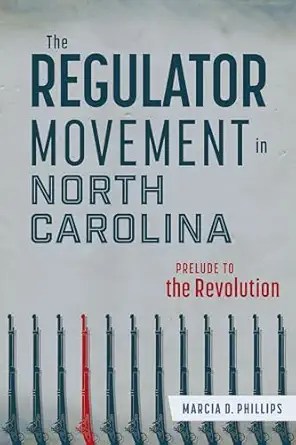
The Regulator Movement in North Carolina: Prelude to the Revolution,
by Marcia D. Phillips

If you want to know some of the little-known background leading up to the American Revolution, I highly recommend this book. As a native North Carolinian, I learned about the Regulators in North Carolina History classes; however, to read the details of it as an adult is to better grasp the terror that many residents of my state were living under in the late 1760s and early 1770s.

The author did an amazing job, like no one else I’ve read, of giving hundreds of years of history leading up to the Regulator Movement in North Carolina. She wrote about how the feudal system in Europe and even the Magna Carta laid the groundwork for what happened here in the mid-1700s!

I had never connected some of the dots that Ms. Phillips connected, but it all fits together now in my mind.

The book also does a great job of explaining the differences between the Regulator Movement in North Carolina and the Regulator Movement in South Carolina. That’s something important for me to keep in mind as I write my historical novels in progress.

Quoting from The Regulator Movement in North Carolina: Prelude to the Revolution, by Marcia D. Phillips,

“In a nutshell, the North Carolina Regulators were not attempting to overthrow the colonial government, just convince it to be the same one they had for years and true to British common law. Their actions were not intended to disrupt the law but to ensure the government’s actions were regulated, to promote uniformity and fairness. The issues of the day – excessive taxation and fees with limited recourse in the assembly, lack of justice in court rulings, and forced taxation for the Anglican Church, which none of the Regulators attended – were the sticking points but also indicative of underlying principles being violated. These discontented farmers were even willing to self-regulate if the colonial government would allow it.”

The Regulators signed petitions in an effort to get Governor Tryon to address their grievances. His appointed officials in the North Carolina Piedmont – particularly in the northern Piedmont part of the province owned by Lord Granville – were robbing the citizens blind and pocketing the money they collected.

They were sick and tired of paying tax to support the Anglican Church. They were Presbyterians and Baptists, and they wanted the right to pay their own clergy. Their clergy were not allowed to officiate over marriages or funerals. For people who had left Europe for religious freedom, this was unacceptable.

The Regulator Movement in North Carolina came to a head in Alamance County on May 16, 1771, when Governor Tryon ordered eight cannons to fire upon a group of Regulators who had asked to be heard. Under the Johnston Riot Act, Tryon gave them until noon to disperse; however, instead of arresting them at noon when they did not disperse, he turned eight cannons on them. It is called the Battle of Alamance, but it was really an ambush.

As the book gives in detail, that was not the end of Tryon’s reign of terror. He had a number of Regulators hanged and had many of their farms burned to the ground.

The book includes an extensive bibliography for readers wanting to do additional research. Thank you, Ms. Phillips, for giving us such a concise and well-researched account of the Regulator Movement in North Carolina.

Perhaps it is partly because of our current political environment that, but while reading this book, it struck me how similar Governor William Tryon of North Carolina was to Donald Trump. I’m not just referring to the fact that he built an extravagant palace for himself while in office.

Some leaders build palaces. Others build ballrooms and triumphal arches.

But it is the pattern of retribution demonstrated by Tryon and by Trump that hit me as an undeniable and frightening similarity between the two men.

Janet

The government should be afraid of its citizens, not the other way around.

How Can Genealogy Influence Historical Fiction?

Since I have published very little historical fiction, you probably haven’t read anything yet that was influenced or inspired by my genealogy; however, I hope to remedy that with the publication of a collection of my short stories in 2024.

I’ll give you an example. People often ask fiction writers where they get their ideas. The answers run the gamut, but I have drawn on research into my family history for at least one historical short story.

Many people like to brag about their Scottish ancestors living in castles. Folks, why would someone leave a castle in Scotland in the 1700s and come to America to start life over as a farmer? Just sayin.’

Eilean Donan Castle in Scotland (Photo credit: Nicholad Beel on Unsplash.com
Eilean Donan Castle in Scotland (Photo credit: Nicholas Beel on Unsplash.com

I brag on most of my ancestors because they were farmers. They were farmers in Scotland and Ireland, and they bought land to farm when they got to America.

Cornfield. Photo Credit: Steven Weeks on Unsplash.com
Photo Credit: Steven Weeks on Unsplash.com

After having grown up out in the country and worked a vegetable garden, I have immense respect and admiration for anyone who is able to support a family and make a living by farming – especially back in the days before tractors and other mass-produced farm equipment.

Today I’m blogging about one of my immigrant ancestors who inspired me to write a short story.

He left Ireland (we think) and came to Virginia in the early 1700s. He had obviously not lived in a castle. Doing research on him in coastal Virginia was an eye-opening adventure. By following all the government records I could find about him, I learned a great deal of early Virginia history.

His court records made the fact that in colonial Virginia there was no separation of church and state very real to me. When said ancestor found himself on the wrong side of the law, he was fined a certain poundage of tobacco (or “tobo”) to be paid to the Anglican church.

Tobacco hanging in a barn to cure. Photo Credit: Rusty Watson on Unsplash.com
Photo Credit: Rusty Watson on Unsplash.com

I learned that tobacco was as good as money in colonial Virginia. My g-g-g-g-g-grandfather was on the wrong side of the law more than once, and he was always fined a certain number of pounds of tobacco.

Just so you’ll know, he wasn’t a terrible or dangerous person. He was fined for such offenses as playing cards on the Sabbath. You can read what I think will be an entertaining story about him in my (hopefully) upcoming book in 2024, Traveling through History: A Collection of Historical Short Stories.

You might want to subscribe to my every-other-month e-Newsletter so you can learn more about the research I do. One thing I love about writing historical fiction is the research it requires.

Visit my website, https://www.janetmorrisonbooks.com and click on the “Subscribe” button. You’ll immediately receive a free downloaded copy of my short story, “Slip Sliding Away” – a Southern historical short story set in the Appalachian Mountains in the 1870s.

Since my last blog post

Drumroll! Main Street Books in Davidson, North Carolina has accepted The Aunts in the Kitchen: Southern Family Recipes on consignment for the next six months. Marie and I are excited about this new opportunity.

I appreciate the comments some of you let after reading my blog last Monday about book banning – specifically, Sold, by Patricia McCormick. I’m glad I introduced the book to some of you.

In last Monday’s blog, I indicated that I had submitted a request to the Cabarrus County Public Library for Sold to be ordered. One of the librarians thanked me for bringing it to her attention. It seems that the system used to have a copy. After it was lost, they failed to order a replacement copy. That is now being rectified.

See? Sometimes all you need to do is ask your local library system to consider adding a book to the collection. In a time when too many people do nothing but criticize “the government” and express their disrespect for government employees, I’m giving a shout-out for the Cabarrus County Public Library System and its dedicated employees

Until my next blog post

I wish my fellow Americans a wonderful Thanksgiving holiday this week. It’s good that we set aside a day every year to stop and think about all we have to be thankful for.

I hope you have a good book and time to read it. If there’s a book you wish you can check out of your local public library but it’s not in the system, request that it be purchased. Your request might be turned down due to monetary restraints or another reason, but you won’t know until you try.

Remember the people of Ukraine and other parts of the world where innocent citizens are suffering due to the actions of dictators and terrorists.

Janet