
This weekend I finished reading and taking copious notes from an excellent new nonfiction book, The Regulator Movement in North Carolina: Prelude to the Revolution, by Marcia D. Phillips.
Today is National Tell a Story Day, and this nonfiction book tells quite a story!
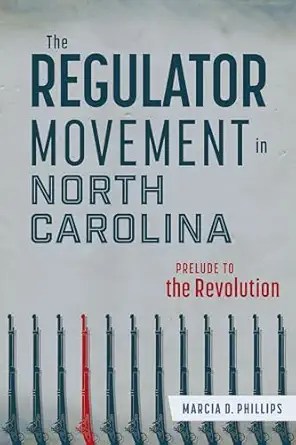
by Marcia D. Phillips
If you want to know some of the little-known background leading up to the American Revolution, I highly recommend this book. As a native North Carolinian, I learned about the Regulators in North Carolina History classes; however, to read the details of it as an adult is to better grasp the terror that many residents of my state were living under in the late 1760s and early 1770s.
The author did an amazing job, like no one else I’ve read, of giving hundreds of years of history leading up to the Regulator Movement in North Carolina. She wrote about how the feudal system in Europe and even the Magna Carta laid the groundwork for what happened here in the mid-1700s!
I had never connected some of the dots that Ms. Phillips connected, but it all fits together now in my mind.
The book also does a great job of explaining the differences between the Regulator Movement in North Carolina and the Regulator Movement in South Carolina. That’s something important for me to keep in mind as I write my historical novels in progress.
Quoting from The Regulator Movement in North Carolina: Prelude to the Revolution, by Marcia D. Phillips,
“In a nutshell, the North Carolina Regulators were not attempting to overthrow the colonial government, just convince it to be the same one they had for years and true to British common law. Their actions were not intended to disrupt the law but to ensure the government’s actions were regulated, to promote uniformity and fairness. The issues of the day – excessive taxation and fees with limited recourse in the assembly, lack of justice in court rulings, and forced taxation for the Anglican Church, which none of the Regulators attended – were the sticking points but also indicative of underlying principles being violated. These discontented farmers were even willing to self-regulate if the colonial government would allow it.”
The Regulators signed petitions in an effort to get Governor Tryon to address their grievances. His appointed officials in the North Carolina Piedmont – particularly in the northern Piedmont part of the province owned by Lord Granville – were robbing the citizens blind and pocketing the money they collected.
They were sick and tired of paying tax to support the Anglican Church. They were Presbyterians and Baptists, and they wanted the right to pay their own clergy. Their clergy were not allowed to officiate over marriages or funerals. For people who had left Europe for religious freedom, this was unacceptable.
The Regulator Movement in North Carolina came to a head in Alamance County on May 16, 1771, when Governor Tryon ordered eight cannons to fire upon a group of Regulators who had asked to be heard. Under the Johnston Riot Act, Tryon gave them until noon to disperse; however, instead of arresting them at noon when they did not disperse, he turned eight cannons on them. It is called the Battle of Alamance, but it was really an ambush.
As the book gives in detail, that was not the end of Tryon’s reign of terror. He had a number of Regulators hanged and had many of their farms burned to the ground.
The book includes an extensive bibliography for readers wanting to do additional research. Thank you, Ms. Phillips, for giving us such a concise and well-researched account of the Regulator Movement in North Carolina.
Perhaps it is partly because of our current political environment that, but while reading this book, it struck me how similar Governor William Tryon of North Carolina was to Donald Trump. I’m not just referring to the fact that he built an extravagant palace for himself while in office.
Some leaders build palaces. Others build ballrooms and triumphal arches.
But it is the pattern of retribution demonstrated by Tryon and by Trump that hit me as an undeniable and frightening similarity between the two men.
Janet
The government should be afraid of its citizens, not the other way around.


I read this post with a great deal of interest. I hadn’t heard of the Regulator movement before. It seems to me that what they were asking for from their government was very reasonable.
It was reasonable. They were not trying to overthrow the government; they just wanted to be treated fairly in the taxation system. Occasionally, they did things like loot and ransack the home of the Governor’s agent in Hillsborough (while the agent was not there), but they were basically farmers. They weren’t an armed mob. The political power was in the eastern part of the state, but as the population grew in the Piedmont the new settlers were not represented. The provincial assembly didn’t want to give up their power. Residents in the eastern counties he one representative per 1,600 citizens while the residents in the Piedmont had one representative per 7,300 people! They essentially had no voice and the sheriffs — appointed by appointed governor — were blatantly corrupt. There were essentially no Anglicans in the Piedmont, but their taxes supported the Anglican Church. In my own family, we don’t know when between 1763 and 1766 our 4th-great-grandparents came down from Pennsylvania because Presbyterians were encouraged to not register their land deeds because those Presbyterians from Scotland did not want their real property fees and taxes going to support the royal government. They were in PA in 1763, but our earliest deed here in NC is in 1766, but we think they arrived here perhaps a couple of years prior. A group of teens and young men from our church ambushed a shipment of munitions that was being transported north on the Great Wagon Road to be used by the governor against the Regulators. They blew up three wagons of munitions in the middle of the night on May 2, 1771, just 14 days before the slaughter of Regulators in Alamance County. The nine young men had sworn secrecy, but after lots of pressure and a manhunt by the governor’s supporters, a few weeks later two of the nine spilled their guts and named names. Gov. Tryon eventually offered a pardon and several of the guys headed toward Hillsborough to take him up on his offer. Along the way, they were warned that it was a ruse and they would be hanged. Some of them fled to Georgia, while others went into hiding here in the community. The women in our church kept them fed and clothed as the government officials assumed that the women were oblivious of political things and would have no involvement. The women would never be questioned about the whereabouts of the boys and young men because… they were just women! It is said that Rev. James H. Balch prayed for the safety of the gunpowder plot participants from the pulpit at our church. My 4th-great-grandfather signed a petition to the Governor asking for a pardon for the boys… to no avail. At one point the Governor issued a pardon for some of the rebels but pointed out that the pardon did not include the rebels who had blown up the munitions wagons. One of my long-term projects has been to write a novel about that incident. It is my favorite local history story. And just think… there are, no doubt, thousands of little-known stories like this throughout the 13 colonies, but they are relegated to “local history” and never get publicized. I was disappointed that Ken Burns recent mini-series about the American Revolution did not mention the blowing up on the King’s munitions here in 1771. Likewise, the May 20, 1775 Mecklenburg Declaration of Independence is now poo-poo’d because the document was lost in a house fire. The fact that is was referenced in newspapers and by Thomas Jefferson is not good enough for historians today who demand paper documentation for things that happened on the wild frontier in colonial times. Don’t get me started! (Ooops! I think you already did.) By the way, the young men here blacked their faces to disguise themselves before blowing up the munitions wagons. Unfortunately, they are now known as the Cabarrus Black Boys — which is a cause of embarrassing confusion in the 21st century! That also contributes to the problems I encounter when attempting to write about them.
You make a very good argument for a more inclusive approach to colonial history. After all, these local uprisings all took place within a larger context and thereby were connected.
Glad you are finding good comparisons from history. We just finished the American Revolution series by Ken Burns on PBS. I bet you’ve already seen it!
Those smaller uprisings and the part women played in the entire Revolution have been brushed aside for too long.
Yes, I watched it. I love Ken Burns’ work!
Absolutely they have.
Excellent point. Bears watching how something centuries old is new again.
Great review, Janet. I was talking with another blogger about taxation during that time. It’s interesting to know that most of those conflicts could have been resolved if people in power had simply sat down with citizens to discuss the purpose of those taxes and given them an opportunity to vote for or against them. Similar to today, it seems that every problem is solved by raising taxes, with little discussion about closing tax loopholes or reducing spending.
Thank you, Edward. It seems this century is looking more and more like the 18th century, with citizens’ concerns falling on deaf ears.
You’re welcome. It seems that way. We’ll see what happens in November. It’s going to be an ugly election.
Different tack than others have followed: I always thought it was important to understand that patriarchy of the 1770s came from British law, which the colonies inherited. Source: Strong, Beret E., “Books: We the Founding Fathers,” California Lawyer,January 1999, pp.66.
“In revolutionary times, ‘coverture,’ the English common law doctrine that women are ‘covered’ by their husbands’ civic identities, became a basis for American law. Under the law of baron et feme (lord and woman) women’s bodies and property belonged to their husbands. Women were citizens, but legally they were often categorized with children.”
My understanding is that family members were essentially like livestock. They were owned by the patriarch of the household.
Some people appear to be pushing for a return of this 1700s view. I’m not one of them.
With best regards.
Yes, the Republican Party seems to want to drag us back to the 1700s.