Who says you can’t go home again? Revisiting a university campus

When I was a freshman at Appalachian State University in 1971, there were 7,800 students. Before I graduated four years later, the university chancellor had announced that enrollment would be permanently capped at 10,000.

Fast forward to the 2024-2025 academic year, and Appalachian has more than 21,000 students. I visited the campus last week, and I can testify to that!

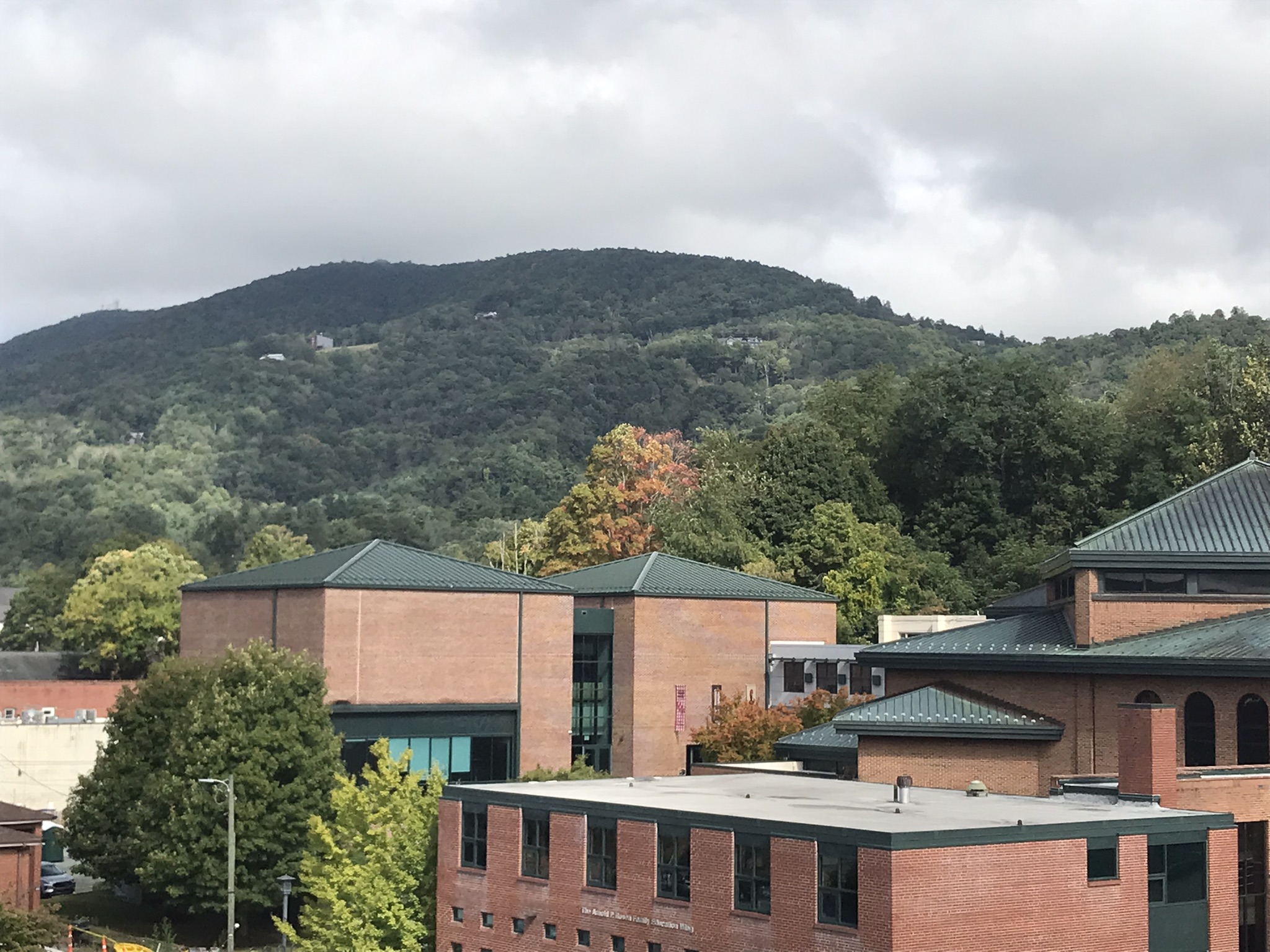
View of Rich Mountain from Appalachian State University Campus

The campus is in a valley at the foot of beautiful Rich Mountain and Howard’s Knob. It’s where Daniel Boone camped sometimes and the mountain is supposedly named for one of his friends with the surname Rich.

Photo of outside of Belk Library and Information Commons
A view of Belk Library and Information Commons

My sister and I were treated to a tour of Belk Library and Information Commons during our visit last week. Marie, being a Library Science major alum of ASU, she was particularly interested to see the great leaps in technology the library offers since her student days there in the mid-1960s.

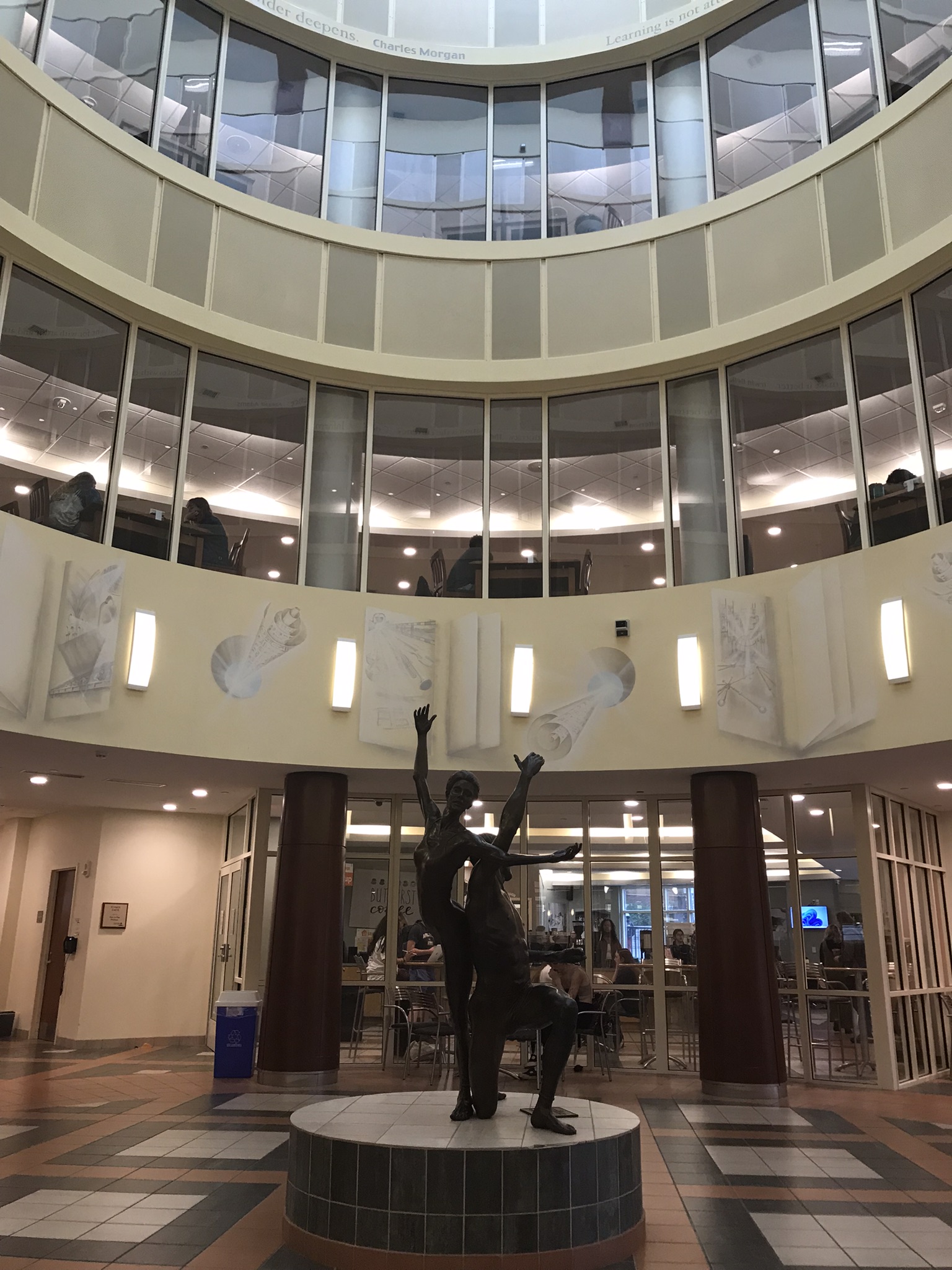
Photo of lobby at main entrance to Belk Library and Information Center
Lobby at main entrance to Belk Library and Information Center

3-D printers in the library’s Makerspace

One of the statues outside the library

Photo of statue of little boy lying on his stomach and reading Jack Tales
Statue outside library. The little boy is reading Jack Tales.

The library where I spent many hours reading materials that various professors would put on reserve there for on-site-only reading has been converted to classrooms.

Anne Belk Hall (formerly, Belk Library in the 1970s

The building where I majored in Political Science in the 1970s has been replaced by one of many parking decks on campus. Parking decks weren’t needed when my sister and I were students. Very few students could afford to have a car. We walked everywhere we went and thought nothing of it, since none of our friends had a car.

All four of the dormitories I lived in while a student are still there – even East Residence Hall, which I suppose is now the oldest dormitory on campus.

Whereas almost all students back in the day lived in dormitories, most of them now live in apartments. The town of Boone is covered in apartments and restaurants, and much of the old charm of the college town is gone. In the 1960s and 1970s, all the students were on a meal plan and ate in the cafeteria. There was no money for eating out except for the occasional going in together in the dorm on a Saturday night and ordering a pizza.

When someone in the dorm had a birthday, their friends would chip in and buy a square Pepperidge Farms cake at the Winn-Dixie just off campus.

The downtown Boone business district hasn’t changed as much as the campus and the rest of the town in 50 years. Mast General Store still beckons shoppers and The Appalachian movie theater has been refurbished and still offers students and the public the latest in movies as well as other cultural programs. I doubt admission is still 50 cents, though.

My favorite memory of The Appalachian Theater was going to see “Dr. Zhivago” there for 50 cents and having to sit on the front row. Talk about feeling like you are in the middle of the action! (And in the middle of a blizzard in Russia!)

The student infirmary where I worked the night shift on Fridays and Saturdays my last three months on campus was in the former hospital. The nurse I worked with was very compassionate. We were rarely very busy. If we had no patients coming in by around 2:00 or 3:00 a.m., she would let me take a nap. It wasn’t easy to sleep, though, because the pipes carrying the heat from the campus heat plant to the radiators were constantly banging above my head.

When my shift ended 7:00 a.m. I would trudge through the snow to my dorm where I would immediately fall into bed. Minimum wage was around $2.00 an hour then, but that $32 I made on those 10 to 12 weekends was a Godsend and helped me start socking away money to pay for graduate school.

The Daniel Boone Inn still draws crowds of repeat diners for family-style old-time country and mountain cooking. I couldn’t afford to eat there as a student, but my friends took me out for dinner there on my last Saturday on campus at the end of winter quarter in 1975. We enjoyed a huge meal of fried chicken, mashed potatoes and gravy, country ham, green beans, corn, slaw, stewed apples, and cornbread as we watched snow falling outside.

I wrapped up all the leftover fried chicken on the serving platter and took it to the student infirmary when I went there to work at 11:00 that night. It was, of course, my last night to work there. The nurse I worked with and I would drool over the Kentucky Fried Chicken commercials on our little black-and-white TV every weekend night, so I thought it was apropos for me to take fried chicken for the two of us to munch on that night. The joke was on both of us, as she showed up that night with a bucket of Kentucky Fried Chicken! We ate chicken until we were about to explode! What memories!

I didn’t get to eat at the Daniel Boone Inn last week. At this point in my life, I just don’t need to pig-out on so much food. But I have the memories of that night in 1975 with my friends, the nurse at the infirmary, and all that fried chicken!

Until my next blog post

I hope you have a good book to read. I’ve read some good ones already this month!

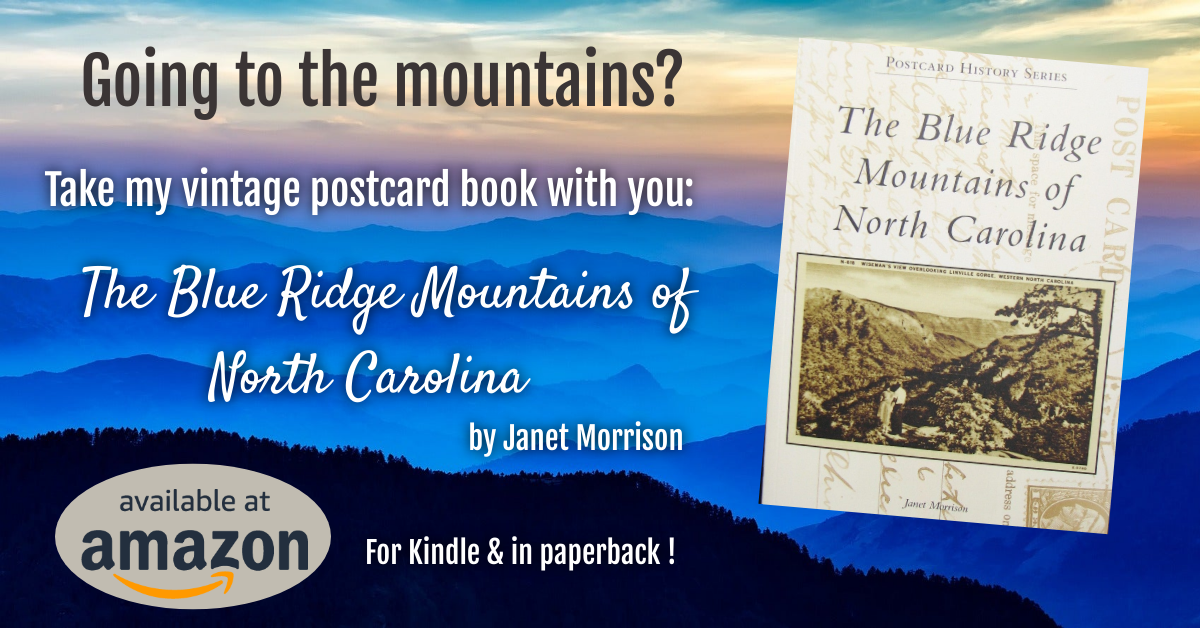
If you haven’t already purchased a copy, I invite you to buy The Blue Ridge Mountains of North Carolina, the vintage postcard book I wrote for Arcadia Publishing. If you’ve spent time in the Appalachian mountains, no doubt these postcards will trigger some memories for you. The book is available as an e-book and in paperback from Amazon.

Make time for friends and family, and make sure they all have a copy of my book!

Don’t forget the people of Ukraine.

Janet

The Other Two Books I Read in May 2023

I love the months in which I get to read so many books that it takes me more than one blog post to tell about them! May was one of those months. Today’s post is about the last two books I read in May. I hope at least one of them will appeal to you.


One Thought Scares Me, by Richard Dreyfuss

In One Thought Scares Me, Richard Dreyfuss presents his thoughts about how democracy has been eroded in the United States by the removal of the study of government (or civics) in our public schools. He pinpoints this quiet removal as happening 50 years ago, so it was after I graduated from high school.

One Thought Scares Me, by Richard Dreyfuss

I remember hearing a few years ago that in North Carolina the high school American History curriculum would begin with the Presidency of George Washington. I’ve wondered since then how the Presidency of George Washington would make any sense to a student who didn’t know that it followed an American Revolution.

If an American knows nothing about the Declaration of Independence – why it was written, who wrote it, when it was written, who we were declaring our independence from — and most importantly, how the signers of it risked their very lives by signing it – then they will not know what political conditions the early American settlers lived under.

If an American knows nothing about the American Revolution – why it happened, when it happened, who we were rebelling against, etc., then that American will not value what it means to be an American citizen. If they don’t know what those who came before us suffered through just to gain the right to vote, they will not value their right to vote. They will feel no obligation to vote.

If an American knows nothing about the Bill of Rights – why those ten rights were spelled out in the United States Constitution and what they are – then they won’t know when a US President or the US Congress or their State Legislature is taking away one or more of those rights.

If an American knows nothing about US history, they won’t know that July 4th is more than just a day off from work when you eat burgers and hotdogs and shoot off fireworks.

In order to be a good citizen of the United States of America, you must know the history of the country. As Mr. Dreyfuss points out in his book, it was the system of public education in the United States in the early 1800s that made it possible for every child to learn to read and write. It made it possible for every child to learn the Pledge of Allegiance, to learn about colonial times, to learn about the American Revolution, to learn about the ugliness of slavery, to learn about the Civil War, and to learn about all the wars American have fought around the world in the name of freedom.

My two-cents’ worth:  If you take that out of the public schools – and if you disrespect public education and public school educators the way the North Carolina General Assembly continues to do – then you lose the level playing field on which our country was built and you lose what binds us together as a nation.


Seeking the Historical Cook: Exploring Eighteenth-Century Southern Foodways, by Kay K. Moss

Reading this book after taking the Open Hearth Cooking Class at Hart Square Village on May 20 was very beneficial. The hands-on class was invaluable to me in writing historical fiction, and the book made a lot more sense to me having had the class.

Seeking the Historical Cook, by Kay K. Moss

The book covers how to interpret historical “receipts” as recipes were called in the American Colonial Era, and the importance of incorporating an 18th century mindset when using the old recipes. Ms. Moss and her books are a goldmine for anyone doing research on frontier life in the Carolinas.

This book is illustrated and very detailed in cooking instructions, including the importance of getting the hot coals just right and judging the heart, cooking/baking time, and always having hot water on-hand.


Cyberspace fiasco since my last blog post

To say it was a frustrating week would be an understatement. My email service was disrupted for about 24 hours Tuesday into Wednesday. My Facebook account was hacked on Thursday. My LinkedIn account was hacked on Saturday. My Evernote account was hacked on Sunday.

Would be writers like me are told we must have a vast social media presence if we want to ever get published. We must have followers in the thousands and tens of thousands.

After what I’ve been through over the last few days, I’ve decided to remove myself from Facebook, LinkedIn, and Evernote. Each of those accounts had unique passwords. It bothers me that hackers can take control of my stuff without any problem; however, when I try to get an account back I must provide all sorts of documentation to prove that I am me. Life is short. I don’t foresee ever having time again for Facebook, LinkedIn, or Evernote. I’ll miss some things about Facebook, but the other two won’t be missed at all. Just for good measure, I’ll no longer be on Twitter either. It was a hassle anyway. I won’t miss it a bit.

If not having 40,000 followers on Facebook, Twitter, LinkedIn, etc. means I’ll never get my novels published, I guess that’s the price I’ll pay.

If you receive notification via Facebook when I’ve posted a blog, you’ll no longer receive those notifications because as of last Thursday, I have no control over my Facebook account. In fact, you won’t be notified about today’s post. Someone else, apparently in Beijing, has control of my account now. Facebook indicated it would take them 48 hours to verify that I am Janet Morrison. It’s been longer than that, so I guess they’re still just playing games with the hacker in Beijing. I regret that I didn’t get to tell my acquaintances on Facebook goodbye.

My blog is protected through a whole different server, etc., so I plan to continue to blog every week and treasure the lifeline it has become.

I envy Harper Lee and her manual typewriter. She got to just hide away in Alabama and write To Kill a Mockingbird with no worries about cyberspace. There’s something appealing about that era.

Speaking of birds… the three neighborhood cats must have miserable home lives because they want to stay in our yard all the time stalking our wild birds. In my spare time last week, I had to construct a barricade to try to prevent the cats from getting to the nest of baby Carolina Wrens in the hanging basket on my porch.

Thank you for the feedback I continue to get since posting To Write or Not To Write Historical Short Stories? What do you think? on May 29. All opinions are welcome!


Until my next blog post

I hope you have at least one good novel or non-fiction book to entertain and educate you.

With the smoke from the wildfires in Canada dissipating, we on the east coast of the US look forward to clear skies and some sunshine.

In case you’re planning a trip to Great Smoky Mountains National Park, Cherokee, or the Blue Ridge Mountains this year, be sure to pick up a copy (paperback or for Kindle) of my vintage postcard book, The Blue Ridge Mountains of North Carolina. I packed as much natural history and human history into the postcard descriptions as Arcadia Publishing would allow. I think you’ll find it entertaining and painlessly educational.

The Blue Ridge Mountains of North Carolina, by Janet Morrison

Don’t forget the people of Ukraine. Believe me… I know my life — even with all my cyberspace problems — is easy compared to their suffering. I truly know that.

Janet

#OnThisDay: Presidential Succession Act of 1947

Today’s topic is somewhat obscure and isn’t given much thought by the average citizen until it comes into play. When it needs to be put into action, it is of monumental importance.

The Presidential Succession Act of 1947 was signed into law by President Harry S. Truman on July 18, 1947. To fully appreciate US Presidential Succession, however, we need to first look at the United States Constitution and the Presidential Succession Acts prior to 1947. Later in this post, we’ll learn about what has happened on this matter since 1947.

My post today is longer than usual, but please read on. You might learn something. I did!

US Constitution, Article II, Section I, Clause 6

Photo by Brett Jordan on Unsplash

The vice president is designated as the first in the presidential line of succession by Clause 6 in Section I, Article II of the US Constitution. That is all many Americans know, since we’ve never lost a sitting president and sitting vice president at the same time… or lost a president who has assumed the office due to the death or incapacity of his predecessor.

Clause 6 also gives Congress the authority to provide for the line of succession after the vice president.

US Presidential Succession Act of 1792

The Presidential Succession Act of 1792 designated the US Senate president pro tempore as next in line after the vice president, followed by the Speaker of the House.

US Senate Practice in the 1800s

During most of the 19th century, the US Senate assumed it could elect a president pro tempore only during the absence of a vice president. With Congress only being in session approximately half the year at that time, concerns were raised over the high mortality rate of the era. What if the president and vice president both died or became incapacitated during Congress’ adjournment?

The solution was for the vice president to voluntarily exit the Senate chamber before the current session of Congress ended. While the vice president was out of the room, the Senate would elect a president pro tempore.

That scheme sort of worked for decades, but then vice presidents from the minority political party started fearing that in their absence from the Senate chamber, someone not from their political party might be elected. To remedy that, some vice presidents refused to leave the chamber while the vote was taken.

Congressional Action in 1886

Photo by Joshua Sukoff on Unsplash

No deed goes unpunished, and it seems that Congressional members are always looking for something they can change and take credit for. In 1886, Congress changed the presidential succession order after the vice president cabinet secretaries in the order in which their federal departments had been created.

No Act of Congress goes uncriticized. Proponents of the 1886 Act maintained that the office Senate pro tempore is filled based on parliamentary skills and not on the person’s executive skills.

The Death of President Franklin D. Roosevelt in 1945

Vice President Harry Truman was in House Speaker Sam Rayburn’s office enjoying a glass of bourbon when they received word that President Roosevelt had died and Truman was to take the oath of office for the Presidency as quickly as possible.

Mr. Truman was friends with Sam Rayburn and had a somewhat strained relationship with Senate President Pro Tempore Kenneth McKellar. It came as no surprise then when President Truman started campaigning for a change in presidential succession.

Arguing that Sam Rayburn had been chosen by his Congressional peers to be their leader in the office of Speaker of the House, Truman pushed for a change in the law.

This was completely political. Although Truman, Rayburn, and McKellar were all Democrats, Truman preferred Rayburn over McKellar and saw his chance to reinstate two elected officials in the line of succession after the vice president and before cabinet members. Cabinet members, of course, are not elected. They are nominated by the sitting US President and reflect the governing philosophy or the President.

The Presidential Succession Act of 1947

President Truman prevailed. The result was the Presidential Succession Act of 1947, which established the line of succession as the vice president, the Speaker of the House, the Senate President Pro Tempore, followed by the cabinet secretaries in the order in which their departments were created.

When House and Senate Leaders are in Opposition to the President

Of the 76 years since the Presidential Succession Act of 1947, the Speaker of the House has not been from the President’s political party 44 years. The President Pro Tempore of the Senate has not been from the President’s political party for 36 of those 76 years.

Photo by Andy Feliciotti on Unsplash

As we have witnessed in recent years, these situations can create stalemates in Congress when it comes to a US President being able to get his legislative issues passed into law. It boils down to the balance of power between the three branches of the federal government and the system of checks and balances. Sometimes it’s a good thing, and sometimes it’s a bad thing. It all depends on which political party or philosophy you align yourself with and how quickly you want to see the laws of the land changed.

The 25th Amendment to the US Constitution in 1967

Until the adoption of the 25th Amendment to the US Constitution in 1967, there was no way to replace a deceased, incapacitate, or resigned US vice president or one who had moved into the office of US president due to an unexpected vacancy in that office.

Prior to the 25th Amendment, therefore, the office of vice president remained vacant until the next presidential election. That meant the Speaker of the House was first in line if something happened to the president.

With the 25th Amendment in place when Vice President Spiro Agnew resigned, President Richard M. Nixon had the authority to nominate Gerald R. Ford on October 12, 1973. Mr. Ford was confirmed by Congress on December 6, 1973. It is ironic, then, that Gerald Ford became the president when Richard Nixon was forced to resign. I was majoring in political science in college at the time. It was a great time to participate in political debates. There was never a dull moment in poli sci class!

When Presidential Succession becomes a concern, it suddenly becomes a big concern

When President John F. Kennedy was assassinated in 1962, Vice President Lyndon B. Johnson became the President. Next in line for the office were 73-year-old Speaker of the House John W. McCormack and 86-year-old Senate President Pro Tempore Carl Hayden.

Photo by History in HD on Unsplash (I couldn’t help but notice there’s not a woman or a person of color in the entire photo. It’s an image that epitomizes government in the US in the early 1960s.)

Our current US president is 79 years old. He might run for reelection in 2024. Regardless of one’s political leanings, age is an issue. That said, though, I would be remiss if I didn’t point out that a 73-year-old and an 86-year-old in the year 1962 were definitely considered elderly. Seventy-three isn’t considered as old as it did in 1962 – and I’m not just saying that because I’m in my late 60s.

Spiro Agnew resigned as vice president in 1973. When that happened, Carl Albert was in line for the presidency. I’ve read that Mr. Albert had an alcohol problem and didn’t want to be president; however, when Gerald R. Ford became president less than a year later, Mr. Albert was still next in line. That was not a good situation for the country.

Think back to the beginning of the Covid-19 pandemic in 2020. “He who shall not be named” was the US president. He was hospitalized with Covid-19. What if he had died and Vice President Mike Pence had also succumbed to the virus? Speaker of the House Nancy Pelosi was next in line and from the other major political party. Even if you’re a Democrat, you must admit such a transition of power would have created political havoc in our country.

This possible scenario, along with the creation of the Department of Homeland Security in 2002 in response to the 9/11 terrorist attacks in 2001, raise the question of presidential succession anew. It has been suggested that the Secretary of Homeland Security should be elevated from last in the line of succession to a higher position in that line

What do you think?

Is it time for Congress to revisit the line of presidential succession?

I think it is, but members of Congress and the American public are too polarized in 2022 for anything of such importance to be considered. Everything today is decided along political party lines – even in the US Supreme Court and perhaps within the US Secret Service.

When the political pendulum swings back to a more moderate place of common sense and an adherence to the philosophy that all elected officials should only work for the common good, perhaps then the issue of Presidential Succession can be revisited.

Since my last blog post

My sister and I enjoyed an overnight trip to the Blue Ridge Mountains of North Carolina. (By the way, I wrote a vintage postcard book by that name a few years ago and it’s still available on Amazon and from Arcadia Publishing. You just might like to read it and see the postcards which all date prior to 1970, with most being from the 1940s and 1950s. Pardon the shameless plug for my book. I must blow my own horn.)

The Blue Ridge Mountains of North Carolina, by Janet Morrison

It poured rain on us most of the way to Boone on Sunday, and then dense fog set in and blocked our views along the Blue Ridge Parkway most of the way to Asheville. Even so, it was good to get away if just for a couple of days.

Upon returning home, I took the plunge and purchased access to Atticus writing software. I’ve started my first book on the platform, which formats one’s writing ready for electronic and print publication. That first book is tentatively called The Aunts in the Kitchen: Tried and True Recipes from the Aunts in Our Family.

I read a book that’s been on my “To Be Read” (TBR) list for several years. One down, 300+ books to go.

It’s been a good week.

Until my next blog post

I hope you have a good book or two to read. I’m listening to and reading books by some authors I’ve not read before.

Take time for family, friends, and a hobby.

Remember the four-year-old little girl in Ukraine who was pushing her baby stroller one minute and was killed by a Russian rocket the next; the surviving children in Uvalde and the parents who lost children in the domestic terrorist attack there; and the orphaned two-year-old boy, the partially-paralyzed little boy, and all the grieving and traumatized people in Highland Park. Unfortunately, the list could go on and on.

Photo by Rux Centea on Unsplash

Value each day you have.

Janet

19 Blue Ridge Mountains Trivia Answers

How many of the Blue Ridge Mountains trivia questions I asked in last week’s blog, https://janetswritingblog.com/2019/08/11/19-blue-ridge-mountains-trivia-questions/, were you able to answer?

#BlueRidgeMtnsOfNC #PostcardBook
The Blue Ridge Mountains of North Carolina by Janet Morrison

I indicated that all the answers could be found in the vintage postcard book I wrote, The Blue Ridge Mountains of North Carolina. These trivia questions (and the answers supplied in today’s blog post) are my way of celebrating the fifth anniversary of the publication of the book by Arcadia Publishing on August 25, 2014.

Here are the questions and answers

1.  Why was Grandfather Mountain named a member of the international network of Biosphere Reserves in 1992?  Because it supported 42 rare and endangered species. Just on that one mountain!

2. What does Linville Falls in North Carolina have in common with Niagara Falls?  They are both caprock waterfalls, meaning the top layer of rock is harder that the underlying stone. Erosion causes the waterfall to migrate upstream over time. It is believed that Linville Falls was once 12 miles downstream from its present location.

3.  How did Edwin Wiley Grove make his fortune which enabled him to build the Grove Park Inn in Ashevile, North Carolina?  He sold Grove’s Tasteless Chill Tonic.

4.  What part did the Civilian Conservation Corps (CCC) play in the construction of the Blue Ridge Parkway during The Great Depression?  The men who were members of the CCC assisted with the paving and landscaping of the Blue Ridge Parkway. What a magnificent gift they left us!

5.  When George W. Vanderbilt purchased Mt. Pisgah in 1897, what grand plan did the mountain become part of temporarily?  The 125,000-acre Biltmore Estate. (It’s no longer part of the estate.)

6.  What groups of people were housed at Assembly Inn in Montreat, North Carolina in 1942?  290 Japanese and German internees.

7.  Jerome Freeman bought 400 acres of land in Rutherford County, North Carolina that included the Chimney Rock around 1870 for $25. How much did the State of North Carolina pay for Chimney Rock Park in 2007?  $24 million.

8.  What new breed of hunting dog was developed by a German pioneer family in the late 1700s in the Plott Balsams subrange of the Blue Ridge Mountains?  The Plott Hound, which just happens to be the official State Dog of North Carolina.

9.  What is an early 20th century feat of engineering on the Newfound Gap Road in Great Smoky Mountains National Park?  The road crosses over itself. This example of a helix is called “The Loop.”

10.  How fast can a black bear run?   30 to 35 miles per hour.

11.  It is illegal in Great Smoky Mountains National Park to willfully get within how many feet of a black bear?  150 feet.

12.  What is the name of the 57,000 acres of land purchased by the Cherokee in the 1800s and held in trust by the United States Government?  Qualla Boundary

13.  Is Qualla Boundary technically a reservation? No, a reservation is land that the United States Government gives to an American Indian tribe. The Cherokees purchased their land.

14.  Did the Cherokee people lived in tipis in the 1700s and 1800s?  No, they lived in houses.

15.  What forest contains one of the largest groves of old-growth trees in the Eastern United States?  Joyce Kilmer Memorial Forest

16.  What hydroelectric dam was used in the 1993 Harrison Ford movie, The Fugitive?  The Cheoah Dam

17.  What is the tallest dam east of the Rocky Mountains in the United States?  Fontana Dam.

18.  One of the oldest postcards in my book is of Cullowhee Normal School in the mid- to late-1920s. What is the name of that school today?  Western Carolina University.

19.  Started in 1935, the Blue Ridge Parkway’s “missing link” was completed in 1987. What is the connecting one-fourth-mile long piece that filled the “missing link” called? The Linn Cove Viaduct.

How did you do?

How many of the 19 questions did you answer correctly? I hope you enjoyed trying to answer the questions and seeing the answers today. If you want to learn more about the mountains of North Carolina and eastern Tennessee, please ask for The Blue Ridge Mountains of North Carolina, by Janet Morrison, at your local bookstore, online at Amazon.com, or purchase it directly from the publisher at https://www.arcadiapublishing.com/. It’s available in paperback and as an ebook.

The contract I signed with Arcadia Publishing was for five years, so you’d better get a copy of the book while it’s still being published. I don’t know if my contract will be extended.

Since my last blog post

I’ve finally gotten into a rhythm for writing the scene outline according to C.S. Lakin’s template. It sounds backward to be writing the scene outline after writing the book, but the questions asked in the template, along with five questions I added after reading a couple of articles by Janice Hardy, are making every scene in the book stronger. It’s slow going, but well worth the time and effort.

Due to technical problems, I was unable to include images of any of the postcards from my book in today’s blog post.

Until my next blog post

If you’d like to follow me on Twitter, @janetmorrisonbk. If you’d like to follow my business page on Facebook, it’s Janet Morrison, Writer.

I hope you have a good book to read. I’m reading The Nickel Boys, by Colson Whitehead and still listening to Resistance Women, by Jennifer Chiaverini.

If you’re a writer, I hope you have quality writing time.

Thank you for taking the time to read my blog. You could have spent the last few minutes doing something else, but you chose to read my blog.

Let’s continue the conversation

Feel free to let me know in the comments section below or on Twitter or Facebook how you did on the trivia questions. If you have any other comments or questions for me about the Blue Ridge and Smoky Mountains, I’ll welcome and try to answer them.

Janet

Change of Scenery Does the Heart Good

I got away this weekend to the Blue Ridge Mountains of North Carolina. It always does my heart good to drive on the Blue Ridge Parkway and be surrounded by forests and views across miles and miles of mountains.

A change in scenery and a change in altitude can clear the head and breathe new life into a person. A change in altitude can create a change in attitude. That’s what this weekend’s trip to Asheville did for me.

The bride’s bouquet

A special cousin of mine who lives in California got married in Asheville on Saturday. It was my first opportunity to meet her husband, and I feel very good about this match. The wedding was beautiful and the associated festivities were wonderful. It was an honor and privilege to witness Melissa and Marty’s exchanging of vows and their happiness and respect for one another.

Asheville is an eclectic city, rich in history and natural beauty. The change in scenery and altitude, along with the blessing of attending the wedding of two such special people, was just what I needed. Driving south on the Blue Ridge Parkway, and then taking US-276 by Looking Glass Falls was a perfect way to end the weekend.

I came home with my batteries recharged, ready to plunge back into my writing and playing the dulcimer.

Until my next blog post

I hope you have a good book to read. I’m reading Montauk, by Nicola Harrison.

If you’re a writer, I hope you have productive writing time and your projects are moving right along.

Thank you for reading my blog. You could have spent the last few minutes doing something else, but you chose to read my blog.

Let’s continue the conversation

What recharges your batteries and refreshes you for the task ahead?

Janet

Cultural Appropriation in Writing

Cultural Appropriation was a term I first encountered one day last week while participating in a writers’ group page on Facebook. Although I was not familiar with the term, I’ve had first-hand experience in wrestling with it in my own writing.

aaron-burden-123584
Photo by Aaron Burden on Unsplash

A definition

The Cambridge Dictionary defines cultural appropriation as

“the act of taking or using things from a culture that is not your own, especially without showing that you understand or respect this culture.”

A raft of articles and video clips

As I started looking for a definition of cultural appropriation, I found a wealth of online references, which proves that I just haven’t been paying attention.

What I discovered is that non-Hispanic individuals were criticized for operating a burrito food cart in Portland, Stella McCartney was criticized for including Ankara prints in her spring fashion collection, a white man was criticized by Koreans for making a Kimchi-making tutorial, in March of this year Bruno Mars was accused of cultural appropriation in his music, and just last week Jamie Oliver was accused of cultural appropriation for calling a dish “punchy jerk rice.”

Author Morgan Jones’ opinion

Author and administrator of the “Writers on the Path to a Page-Turner” Facebook group, Barbara Kyle, started a conversation about cultural appropriation on Facebook on August 20. She shared a link to an October 1, 2016 article in The Guardian ( https://www.theguardian.com/books/2016/oct/01/novelists-cultural-appropriation-literature-lionel-shriver ) and in a follow-up comment she quoted author Morgan Jones. Here’s Ms. Kyle’s comment:

“The move to self-censorship for fear of ‘cultural appropriation’ is a sad state of affairs. Author Morgan Jones eloquently champions the opposite position:  ‘Fiction remains the best means we have of finding connection where there seems to be none; and the novel, of all forms, encourages a search that’s deep and sustained. By reading (or writing) one, you’ve travelled somewhere else. You’ve moved, it only slightly, towards others. In a world that finds and increasingly exploits division and difference, this is an invaluable, precious exercise.”

After you’ve finished reading my blog post today, I invite you to read The Guardian article referenced above. That article includes the following novelists’ views on cultural appropriation: Hari Kunzru, Kamila Shamsie, Aminatta Forna, Chris Cleave, AL Kennedy, Stella Duffy, Linda Grant, Naomi Alderman, Philip Hensher, Maggie Gee, and Nikesh Shukla. These are writers of various ethnic backgrounds, which makes their comments especially poignant.

The article’s introduction reads as follows:

“Jonathan Franzen claimed he won’t write about race because of limited ‘firsthand experience’, while Lionel Shriver hopes objection to ‘cultural appropriation is a passing fad’. So should there be boundaries on what a novelist can write about?”

Another writer in the Facebook group

Another person in the writers’ group on Facebook shared that he had given up on publishing his historical novel based on the life of Etienne Annaotaha, a Canadian First Nations hero after seeing how much flack Joseph Boyden caught for his writing, even though Mr. Boyden is 26% Native American. Imagine how a 100% European ancestry writer would be treated for writing about Native Americans if someone like Mr. Boyden is not accepted?

A quote from Walter Mosley

The following quote from Walter Mosley appeared in an email I received from Writer’s Digest last week:

“Write without restraint. It’s important to not censor yourself. People will censor the sh*t out of you… and there’s more truth in fiction than there is in nonfiction. You have to be committed to that truth.” – Walter Mosley

My challenge

In the historical novel I’m writing, set in the Carolinas in the 1760s, I’m attempting to write from several points-of-view, including that of a male slave and that of a free woman of color. My challenge is to be true to history while writing about fictional characters. I might not get it right.

I found a truck-load of encouragement from the Morgan Jones quote highlighted above! I have typed it and taped it to the bottom of my computer screen so I can read it every time I sit down to work on my novel.

So should there be boundaries on what a novelist can write about?

I say, “No, as long as the writer does her best research and uses her best writing skills to convey a story in a work of fiction.”

Cultural appropriation smacks of censorship, and I’m not for censorship in fiction. I don’t want someone else deciding what I should or should not read. Likewise, I don’t want someone else deciding what I should or should not write.

As a Southerner, I have not appreciated the disingenuous portrayal of Southerners in movies and television programs all my life; however, I uphold the creators’ right to produce that work under the First Amendment of the Constitution of the United States. Censorship is a slippery slope I don’t want to see us go down.

All that said, I will be mindful of my use of dialect in my novel. There are better ways to get across time, place, and social standing than hitting the reader over the head with dialect.

Since my last blog post

I’ve taken some courage from researching cultural appropriation. Although I was ignorant of the term itself, I’ve given a lot of thought to the subject for the years I’ve been working on my own novel.

I was also inspired by a dream I had last Monday night. As far as I can remember, it was the first time I dreamed that I was writing. I was writing my novel, and the words were flowing faster than I could write them down. The odd part was that I was writing in cursive, although in real life I do all my writing on the computer.

Until my next blog post

I hope you have a good book to read. I’m trying to finish reading A Gentleman in Moscow and I’ve started reading The President is Missing, by Bill Clinton and James Patterson.

If you’re a writer, I hope you have quality writing time. I plan to get back to work on my historical novel (working title, The Spanish Coin) with a renewed since of dedication since recharging my batteries in the Blue Ridge Mountains a couple of weeks ago and since reading about cultural appropriation last week.

Thank you for reading my blog. You could have spent the last few minutes doing something else, but you chose to read my blog. I appreciate it! I welcome your comments

I invite your comments below. What are your feelings about cultural appropriation? Have you read any good books lately? What have you been up to? What’s on your mind?

Let’s continue the conversation.

Janet

Recharging My Batteries in Blue Ridge Mountains

Last week my sister and I spent several days in the Blue Ridge Mountains “recharging our batteries.” We had good weather. It was warm, but not hot like it is in the piedmont. It was great to get back to the beautiful Blue Ridge Mountains!

I tend to over-plan a trip. I enjoy planning all the details of a vacation so we won’t miss anything. It tends to drive other people crazy that I do this. They encourage me to lighten up.

Despite my propensity for making plans, I think I did a little better than usual this time. We had three full days to fill. I built in one day with no plans whatsoever. Alarm clocks were not set, and no plans were made for the day. We each enjoyed the day just resting, reading, and watching some TV. I’ve never planned an entire day of rest before on a trip. It felt good. There is hope for me yet!

Waterfalls & Wildflowers!

We both love waterfalls, so our agendas the other days included stops at Looking Glass Falls, Bridal Veil Falls, Dry Falls, and Upper Cullasaja Falls.  Looking Glass is my favorite of the waterfalls I’ve seen in North Carolina.

Raleigh & Mountains 019
Looking Glass Falls in North Carolina

Dry Falls is my sister’s favorite. It is called dry falls because you can walk behind it without getting wet. Since there was more water coming over the fall than other times we’ve visited Dry Falls, it was louder than usual and we did get a bit damp from the mist. It was quite refreshing!

Raleigh & Mountains 054
Dry Falls in North Carolina

Raleigh & Mountains 056
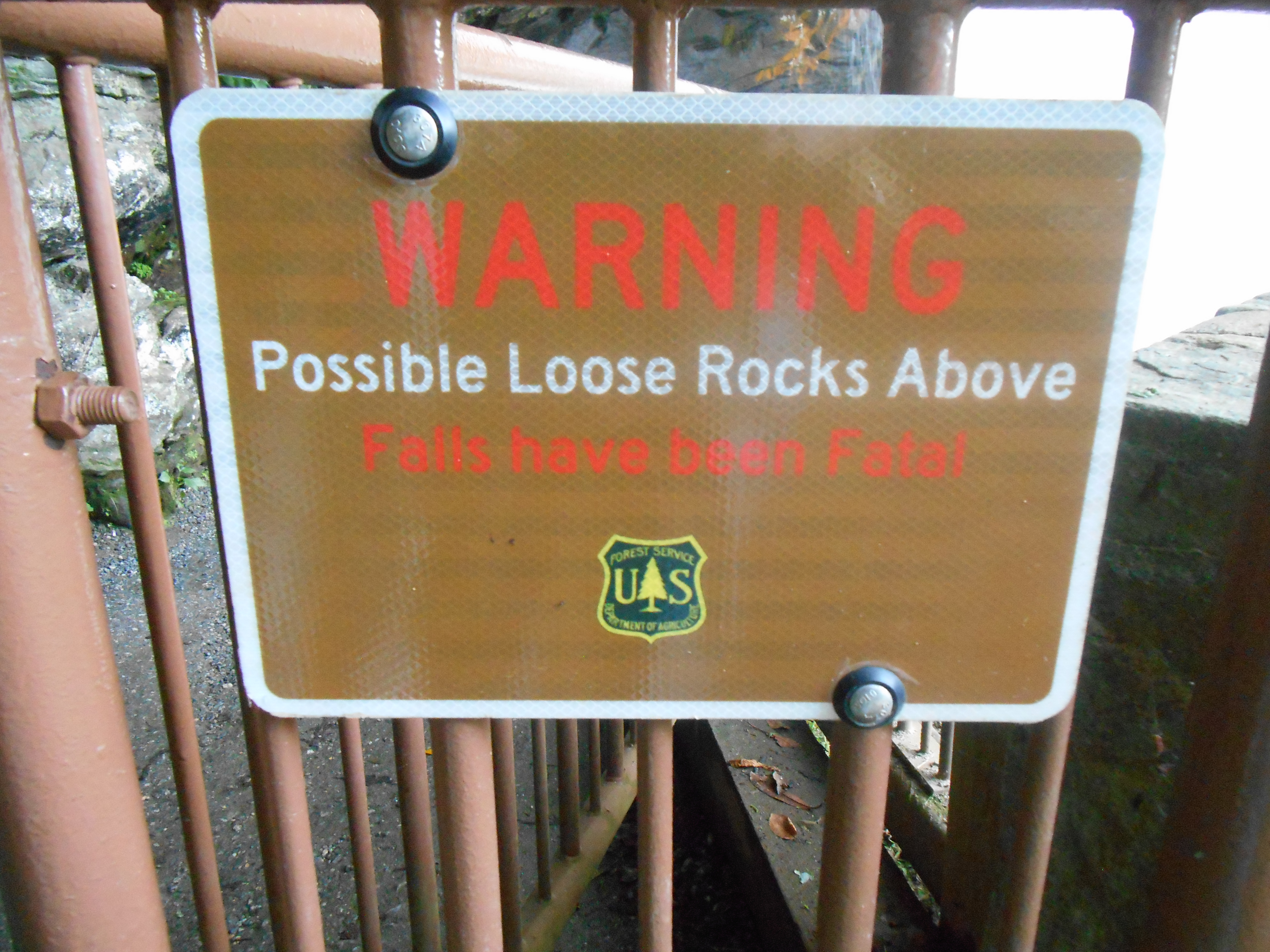
Sign as you start to walk behind Dry Falls.

Raleigh & Mountains 060
Looking out from behind Dry Falls.

Seeing Bridal Veil Falls brought back fond memories of when we were children. At that time, US Highway 64 actually went under the waterfall. It was exciting as a child to ride under a waterfall in the family car. A few hundred feet of the old highway is closed to vehicular traffic now, but this offers an equally enjoyable experience as the ones of my childhood. You can walk a few feet back under the overhanging rock, much like at Dry Falls.

Raleigh & Mountains 022
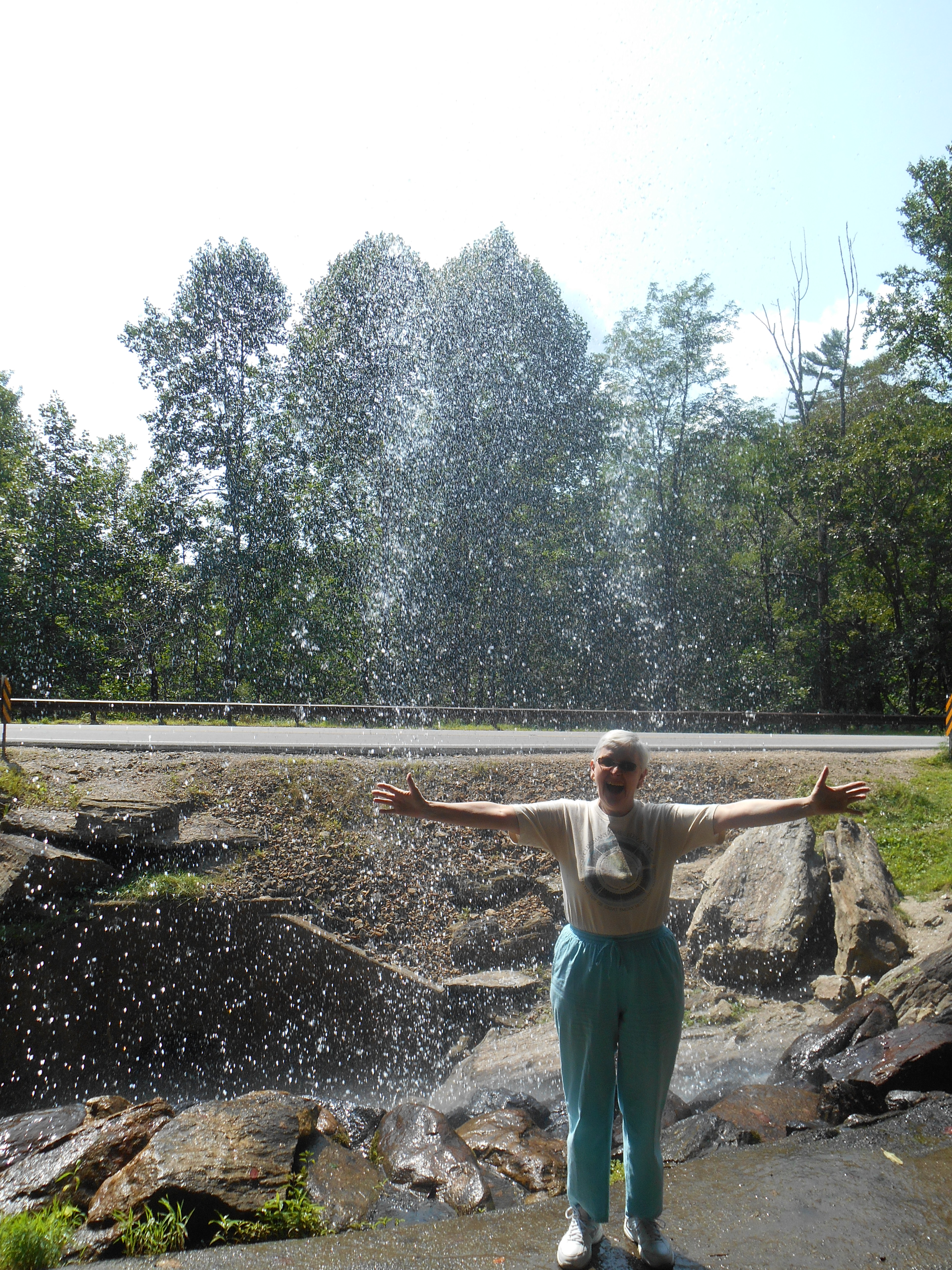
That’s me, standing behind Bridal Veil Falls.


Raleigh & Mountains 020
Looking out from behind Bridal Veil Falls, the water looked like diamonds in the sun.

Upper Cullasaja Falls is easily missed, especially if you’re the driver and can’t take your eyes off the narrow, curvy road in Cullasaja Gorge.

Raleigh & Mountains 036
Upper Cullasaja Falls (also known as Quarry Falls) in Cullasaja Gorge in North Carolina.

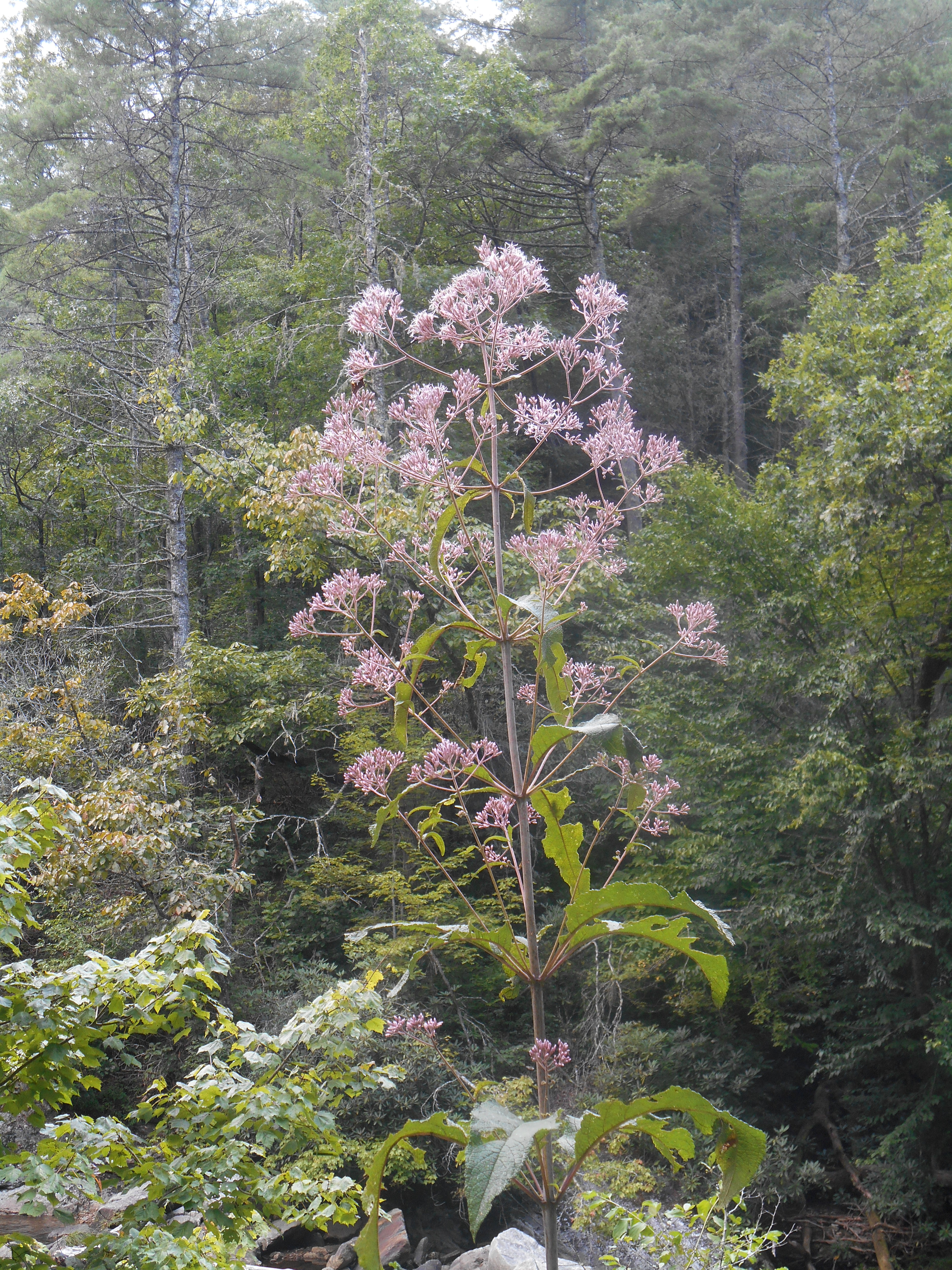
Joe Pye Weed, Coreopsis, and a multitude of other wildflowers were blooming in abundance along the Blue Ridge Parkway. The picture we took of the flowers and the waterfalls don’t do them justice, but I’ll include several here. There were a host of butterflies enjoying the flowers nearly everywhere we stopped.

Raleigh & Mountains 031
Joe Pye Weed along the Blue Ridge Parkway.

Raleigh & Mountains 043
Coreopsis blooming along the Blue Ridge Parkway.

Judaculla Rock

We’d seen the four waterfalls before, but we’d never had the opportunity to see Judaculla Rock, near Cullowhee, North Carolina. There is a wide range of speculation about the history of this petroglyph-covered rock. I’ve seen figures suggesting that the petroglyphs may date back 3,000 to 5,000 years.

The pictures don’t do it justice. Too bad they’re stuck in my cell phone. You’ll probably never see them. I’m as disappointed as you are that I can’t get the photos downloaded.

I love driving the twisty-curvy mountain roads, so getting to do that last week was a wonderful change of pace for me.

Since my last blog post

I hope you have also had some relaxation time and perhaps a change of scenery for a few days.

Thank you for reading my blog post from last Monday, and a special thanks to those of you who left comments. It was a difficult post to write. I probably “stepped on some toes,” but the readers who were offended did not let me know. I didn’t know how the post would be received. It was a bit of a risk for me. By nature I’m not a risk-taker, although I did walk behind Dry Falls just as I have numerous times before.

Until my next blog post

I hope you have a good book to read.

If you’re a writer, I hope you have productive writing time.

Thank you for reading my blog. You could have spent the last few minutes doing something else, but you chose to read my blog. I appreciate it! I welcome your comments.

Janet

How Can a Writer Use Pinterest?

I love to make plans. Ask me to plan a trip, and I’ll get into the minutiae of where you’ll be and what you’ll be doing every minute of the day.

My sister is my traveling buddy, and sometimes my attention to detail drives her crazy! On the other hand, she doesn’t enjoy planning trips so she doesn’t complain too much.

In my Reading Like a Writer blog post (“Reading Like a Writer”) on April 9, 2018, I told you that I had developed a social media plan. Making the plan was easy. The hard part came when I entered the implementation phase. Today’s blog post is about the Pinterest aspect of my plan.

Pinterest Best Practices

In the process of developing the plan, I learned the following from Amy Lynn Andrews’ Userletter Issue No. 234 (https://madmimi.com/p/9af10c/):

Kate Ahl recently noted an addition to Pinterest’s own best practices for success: ‘The first 5 Pins you save each day will be prioritized for distribution. Save to the most relevant board first…that Pin will get distribution priority.’”

That was a revelation for me. No more willy-nilly saving pins to my Recipes: Cheesecake Board! Since reading Amy Lynn Andrews’ Userletter, I’ve made myself save five pins to my writing-related Pinterest boards every day before pinning any recipes, quilts, or Maxine-isms.

Old habits are hard to break, so there is definitely a learning curve involved in this.

Advice from Janice Wald

Along the same lines, I learned the following from Janice Wald’s April 7, 2018, Mostly Blogging blog (https://www.mostlyblogging.com/social-media-manager/):

“When I started deleting my boards, Pinterest’s algorithms better learned the content of my niche, and my traffic grew.”

and

“I deleted my boards about food and entertainment, for example. Pinterest will be more likely to show your pins to people if the algorithms know what your site is about.”

and

“I read you’ll get better visibility at Pinterest if it’s clear to the site what your niche is. This makes sense. Search engines show your blog to people when they’re clear what you specialize in.”

That second quote from Janice Wald is a hard pill for me to swallow. I don’t want to give up my recipe and quilting boards. I could make them secret board that only I can see, but I had hoped that when someone looked at one of those boards they’d also notice I wrote a vintage postcard book (The Blue Ridge Mountains of North Carolina) and I’m writing a historical novel (The Spanish Coin) set in the Carolinas in the 1760s.

I’ll have to give that some thought. For the time being, I have 80 boards on Pinterest.

What I’ve Accomplished on Pinterest since Last Monday

I’ve learned how to create my own pins for Pinterest on Canva.com. Those of you who know me, know that I am technologically challenged, so this was no minor feat for me. I am not getting compensated for mentioning Canva; however, I’ve been able to create some pretty cool graphics for free using that website, http://www.canva.com.

How to move graphics from Canva.com to Pinterest

I soon discovered that I didn’t know how to move the graphics I created on Canva.com and saved to my hard drive. A search on Google quickly brought up the instructions. You simply go to the Pinterest toolbar, click on the red “+” sign, and then click on “Upload an image.” (This just might be the first time I’ve been able to give any technology advice to anyone!)

Want to see what I’ve done on Pinterest?

Please go to my Pinterest page (https://www.pinterest.com/janet5049) and look at the graphics I created this past week for the following boards:  The Spanish Coin – My Novel in Progress; Blue Ridge Mountains; Great Smoky Mountains; Books & Authors; and Rocky River Presbyterian Church.

Here’s a graphic I created about my vintage postcard book, The Blue Ridge Mountains of North Carolina, for my Great Smoky Mountains board on Pinterest:

Cherokee Basket Weaving
One of the first graphics I made on Canva.com.

My mistakes

There are lots of things to keep in mind when making a graphic for social media. Looking at the one shown above, I realize using a color background would have made it more eye-catchy, although I think it shows up better on Pinterest than on my blog.

Also, at the bottom of the graphic, I should have included my blog’s URL, my website’s URL, and my handle on Twitter. I have edited it in light of that, in case I decide to reuse it at a later date.

My social media plan for Pinterest

  • Mondays: Pin link to my weekly blog post to Janet’s Writing Blog board (set up to post automatically by WordPress.com) and a colonial history factoid or A Spanish Coin teaser to The Spanish Coin – My Novel in Progress;
  • Tuesdays: Pin a factoid from my vintage postcard book to my Great Smoky Mountains;
  • Wednesdays: Pin a Rocky River Presbyterian Church history factoid from one of my church history booklets to my Rocky River Presbyterian Church;
  • Thursdays: Pin a factoid from my vintage postcard book to my Blue Ridge Mountains;
  • Fridays: Pin a Rocky River Presbyterian Church women’s history factoid to my Rocky River Presbyterian Church & Cabarrus-Mecklenburg boards; OR Pin a Rocky River Presbyterian Church history factoid to my Rocky River Presbyterian Church & Cabarrus-Mecklenburg boards with a link to the church’s website where a copy of Dr. Thomas Hugh Spence, Jr.’s book, The Presbyterian Congregation on Rocky River, can be ordered.
  • Saturdays: Create factoids/infographics for the following week(s).

This is a grand plan for someone with Chronic Fatigue Syndrome, so I know I will not accomplish this every week. I fell short last week even though I was enthusiastic about starting this new plan. I might miss some weeks altogether. The schedule gives me something to aim for, though.

80/20 Rule of Social Media Marketing

I have read in various sources that 80% of your posts on social media should inform, educate, or entertain and only 20% should promote your business. That rule prompted me to strive to shine a light on a book about the history of Presbyterian Women at Rocky River Presbyterian Church or Dr. Spence’s church history book on Pinterest on Fridays.

I wrote neither of the books, and the proceeds from their sales benefit the ongoing work of the Presbyterian Women at Rocky River and the church’s cemetery fund. (The church dates back to 1751 and has several very old cemeteries that have to be maintained.)

My social media plan for Pinterest looks a little out of whack in light of the 80/20 Rule; however, I hope all the pins I create will fall into the “inform, educate, or entertain” categories.

Since my last blog post

In addition to learning how to create my own Pinterest pins and pinning my creations last week, I have continued to work on the rewrite of my historical novel, The Spanish Coin.

Until my next blog

I hope you have a good book to read.

If you’re an avid reader who has never considered the possibilities of using Pinterest, you might want to check it out. You just might find that your favorite authors have pages there and boards about their books. After looking for your favorite authors on Pinterest, please let me know if this was an enjoyable experience for you and specifically what you liked about it.

If you’re a writer, I hope you have productive writing time. Please let me know what your experience has been on Pinterest. If you haven’t thought about using it as part of your writer’s platform, perhaps you’ll consider it after reading this blog post.

Don’t be shy about spreading the word about my blog. Feel free to use the buttons below to put today’s post on Facebook, Tweet about it, reblog it on your blog, or Pin it on Pinterest. Thank you!

Janet
U is for Unquote

The purpose of my blog is to share my journey as a writer. I share my successes, my discoveries, and my mistakes. I want you to know that I am human. (Those of you who know me personally, stop laughing!) Today I share a discovery about a mistake I have made numerous times.

This is the 21st day of the 2017 A to Z Blog Challenge, which bring us to the letter “U.”

I have always thought it was correct, when speaking, to frame a quote with “quote” and “end quote.” I stand corrected. I saw the word “unquote” in print a few days ago and wondered what it meant. I surprised to find out!

It seems that, although “end quote” sounds right and is still used by many of us, “unquote” has been in use for a century and “end quote” is not considered standard English in the United States. Learning the art and craft of writing has brought me many surprises. It’s amazing how many words I thought I used properly that I have discovered not to be the case when I stopped to look them up.

The next time I’m asked to speak about my vintage postcard book, The Blue Ridge Mountains of North Carolina, or at sometime in the future when I might be asked to speak about my hoped-to-be first novel, I will be well-served to remember to say “unquote” and not “end quote,” when reading a selection from my book.

My computer is making a racket (not a good sign!) so I’ll cut this post short. I hope I’ll be able to blog through the rest of the alphabet this week and successfully complete this A to Z Blog Challenge. It would be a shame if I got this far and had to quit!

Until my next blog post

I hope you have a good book to read. If you’re a writer, I hope you have quality writing time.

Janet

Still catching up on e-mail

After being close to home except for medial appointments and church attendance for most of the spring and summer, I had a weekend in the mountains of North Carolina and several days with family in the Atlanta area earlier this week. It was refreshing to see some different scenery. The Blue Ridge and Smoky Mountains always lift my spirits. It felt good to see my brother’s family for the first time since December.

It is now time for me to start tackling the mountain of e-mails (more than 400) that have accumulated since I got shingles in early May. A few of them are personal, but most are from writing, quilting, or author sites or are notifications about the various blogs I follow.

I would be remiss if I did not comment on the history made last night at the Democratic National Convention in Philadelphia. I was beginning to wonder if I would live to see a woman nominated for US President by one of the two major political parties. Hillary Clinton accepted her party’s nomination last night. It was quite a moment for this old political science major! Our nation is 240 years old. It’s about time!

Until next Friday, happy reading!

Janet