New nonfiction book about Regulator Movement in NC

This weekend I finished reading and taking copious notes from an excellent new nonfiction book, The Regulator Movement in North Carolina: Prelude to the Revolution, by Marcia D. Phillips.

Today is National Tell a Story Day, and this nonfiction book tells quite a story!
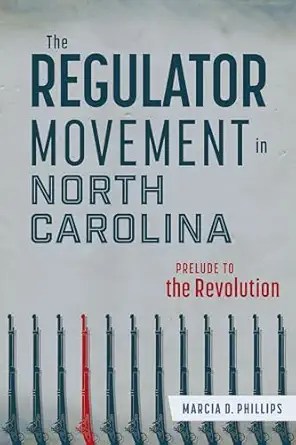
The Regulator Movement in North Carolina: Prelude to the Revolution,
by Marcia D. Phillips

If you want to know some of the little-known background leading up to the American Revolution, I highly recommend this book. As a native North Carolinian, I learned about the Regulators in North Carolina History classes; however, to read the details of it as an adult is to better grasp the terror that many residents of my state were living under in the late 1760s and early 1770s.

The author did an amazing job, like no one else I’ve read, of giving hundreds of years of history leading up to the Regulator Movement in North Carolina. She wrote about how the feudal system in Europe and even the Magna Carta laid the groundwork for what happened here in the mid-1700s!

I had never connected some of the dots that Ms. Phillips connected, but it all fits together now in my mind.

The book also does a great job of explaining the differences between the Regulator Movement in North Carolina and the Regulator Movement in South Carolina. That’s something important for me to keep in mind as I write my historical novels in progress.

Quoting from The Regulator Movement in North Carolina: Prelude to the Revolution, by Marcia D. Phillips,

“In a nutshell, the North Carolina Regulators were not attempting to overthrow the colonial government, just convince it to be the same one they had for years and true to British common law. Their actions were not intended to disrupt the law but to ensure the government’s actions were regulated, to promote uniformity and fairness. The issues of the day – excessive taxation and fees with limited recourse in the assembly, lack of justice in court rulings, and forced taxation for the Anglican Church, which none of the Regulators attended – were the sticking points but also indicative of underlying principles being violated. These discontented farmers were even willing to self-regulate if the colonial government would allow it.”

The Regulators signed petitions in an effort to get Governor Tryon to address their grievances. His appointed officials in the North Carolina Piedmont – particularly in the northern Piedmont part of the province owned by Lord Granville – were robbing the citizens blind and pocketing the money they collected.

They were sick and tired of paying tax to support the Anglican Church. They were Presbyterians and Baptists, and they wanted the right to pay their own clergy. Their clergy were not allowed to officiate over marriages or funerals. For people who had left Europe for religious freedom, this was unacceptable.

The Regulator Movement in North Carolina came to a head in Alamance County on May 16, 1771, when Governor Tryon ordered eight cannons to fire upon a group of Regulators who had asked to be heard. Under the Johnston Riot Act, Tryon gave them until noon to disperse; however, instead of arresting them at noon when they did not disperse, he turned eight cannons on them. It is called the Battle of Alamance, but it was really an ambush.

As the book gives in detail, that was not the end of Tryon’s reign of terror. He had a number of Regulators hanged and had many of their farms burned to the ground.

The book includes an extensive bibliography for readers wanting to do additional research. Thank you, Ms. Phillips, for giving us such a concise and well-researched account of the Regulator Movement in North Carolina.

Perhaps it is partly because of our current political environment that, but while reading this book, it struck me how similar Governor William Tryon of North Carolina was to Donald Trump. I’m not just referring to the fact that he built an extravagant palace for himself while in office.

Some leaders build palaces. Others build ballrooms and triumphal arches.

But it is the pattern of retribution demonstrated by Tryon and by Trump that hit me as an undeniable and frightening similarity between the two men.

Janet

The government should be afraid of its citizens, not the other way around.

Books I Read in April 2024

As you will see from three of the four books I read last month, I chose to concentrate on my writing and historical research in April. Some of the following books might not pique your interest as a reader, but… you never know. I’ll start with the book that falls in a different category.


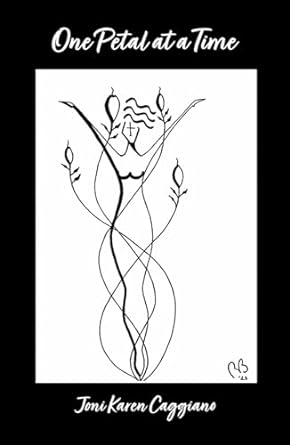
One Petal at a Time, by Joni Karen Caggiano

One Petal at a Time, by Joni Karen Caggiano

This is a book of poetry and prose written from the depths of pain and abuse. The writer bares her soul in her words earned from years of abuse by two alcoholic parents and further abuse from a male relative. It is difficult to read. I cannot identify with the horrors she writes about. I had a good life as a child and teen, and naively assumed everyone else lived in a calm, comfortable home with loving parents.

The silver lining in Ms. Caggiano’s book is that she eventually found love and has, as an adult, established a loving home for her own family. Others who have or are living in an abusive situation should find hope in Part 3 of this book and be inspired by her example, her statement of faith in God, and the fear that is no longer in her life. She is a retired nurse, a survivor, and an environmental advocate.

 The book cover and interior are masterfully illustrated with the exquisite art of Francisco Bravo Cabrera, who is also known as Bodo Vespaciano. Through black line art he captures the essence of Ms. Caggiano’s words.


Historic Shallow Ford in Yadkin Valley: Crossroads Between East and West, by Marcia D. Phillips

Historic Shallow Ford in Yadkin Valley: Crossroads Between East and West,
by Marcia D. Phillips

The Shallow Ford on the Yadkin River in North Carolina plays a role in the historical novel I’m writing, so imagine my excitement when I discovered this book. It was published in 2022 by The History Press.

The Shallow Ford was a natural crossing of the river and was used by thousands of pioneers traveling on the Great Wagon Road and by armies during the American Revolution and the American Civil War. It was, no doubt, used by native Americans for thousands of years before the era of European settlement.

If you are interested in how the piedmont section of North Carolina was settled, then this book is for you. It mentions the various roads and how roads sprang up from the Great Wagon Road to lead to other parts of the state and adjoining states for commerce.

I was most interested in the first sixty percent of the book for its research value for my writing; however, the entire book gives a detailed look at the settlement, cultural development, and industrial development of the Yadkin Valley, which is more of less the area of present-day Davie, Yadkin, and Rowan counties for the purposes of this book.

The Yadkin River is one of the major rivers in North Carolina. It drains the area from the Blue Ridge Mountains in the northwestern part of the state, through the lower piedmont – including where I live. At its confluence with the Uwharrie River it becomes the Pee Dee River, which is fed by the Rocky River and the Lumber River as it eventually flows into the Atlantic Ocean at Georgetown, South Carolina.

Written by “the keeper of the treasures in the Martin-Wall History Room at the Davie County Public Library,” the book is well-documented. In her work, Marcia D. Phillips had access to a wealth of local history sources as well as having the advantages of living in the area about which she wrote.

This book was a God-send for my research of the Shallow Ford of the Yadkin River.


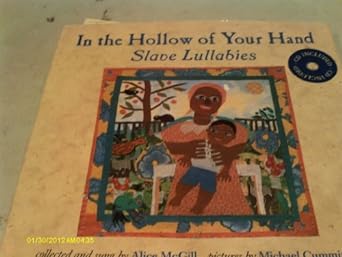
 In the Hollow of Your Hand: Slave Lullabies, collected and sung by Alice McGill, pictures by Michael Cummings; musical accompaniment on enclosed CD by Nancy Krebs

In the Hollow of Your Hand: Slave Lullabies,
collected by Alice McGill

This is a juvenile picture book that I happened upon at the public library in Charlotte while looking for documented American slavery songs as a part of my research for the historical novels I am writing.

Although it is classified as a Juvenile book, I thoroughly enjoyed it.

The fact that it includes a musical CD with the author giving some narrative and singing the songs that have been passed down through the generations of her North Carolina family is the icing on the cake!

The book and CD include thirteen lullabies endemic to the families of slaves. Each lullaby is beautifully illustrated in the African-American tradition by the artwork of Michael Cummings. The banjo having its roots in the Africans who were brought to the American colonies and states as slaves, it is fitting that Nancy Krebs accompanies Alice McGill’s singing by playing the banjo.

There is pain, sorrow, familial separation, the threat of being sold to another slaveholder, and even death in these lullabies. If not for writers like Alice McGill, these wonderful nuggets from American history would be lost forever.


Painting the Past: A Guide for Writing Historical Fiction, by Meredith Allard.

Painting the Past: A Guide for Writing Historical Fiction,
by Meredith Allard

My sister happened upon this book at the public library and brought it to my attention. It is a good book for someone beginning their journey as a writer of historical fiction and, at the same time, is a good book to remind a veteran historical fiction writer of why they do what they do.

Each chapter is introduced by a quote from a writer. I copied most of those quotes so I’ll have them as reminders when I question what I’m attempting to do as a writer.

The book talks about the joys and challenges faced by historical fiction writers, as well as our responsibilities. It addresses what constitutes historical fiction and how much leeway a writer has in sticking to the truth. A writer of historical fiction should always disclose what is fiction and what is fact.

The author talks about the importance of using trusted sources and how just because something is presented as a fact in a nonfiction book does not mean it is true. (That reminded me of something Sharyn McCrumb said in a speech I heard her make in Wilkes County, North Carolina many years ago. She said something like – and I must paraphrase here — some historical fiction is better-researched than some history books.)

The book addresses what historical fiction has in common with general fiction and how it differs. Lovers of historical fiction expect certain things in the novels they read, and it is incumbent upon the author to meet those expectations. If they don’t deliver, they lose all credibility.

I’ll close with a couple of quotes the author shared in her book. She quotes Guy Vanderhaeghe as follows: “History tells us what people do; historical fiction helps us imagine how they felt.”

And she quotes Isabel Allende as follows: “People have this nostalgic idea that the past was better, but the truth is most folks had very hard lives.”

Until my next blog post

I hope you always have a book that you can’t wait to get back to reading.

Appreciate friends and family.

Remember the people of Ukraine.

Janet