A rare author event

The title of today’s blog post might be misleading. I am not writing about rare authors but rather a rare event for this author.

I could look back through prior years’ records to determine when my last author event was, but let it suffice to say it has been quite a while.

I was delighted to participate in a “Local Author Showcase” at Thornwell Books in Morganton, North Carolina this past Saturday! Being a fan and cheerleaders for independent bookstores, I jumped at the chance to be included in this third annual event at Thornwell Books.

Ad for Third Annual Local Author Showcase at Thornwell Books, Morganton, NC

I had contacted Thornwell Books last year when I published my devotional book and its companion journal. I contacted the store’s owner again in November 2025, when I published Traveling Through History: A Collection of Historical Short Stories. I did not know if the store had any of my books in stock, but I thought it wise to participate on Saturday and meet Ashley Ewing, Thornwell’s Bookseller and Socia Media & Events Coordinator.

Thornwell Books was on my list of bookstores to visit the next time I got to travel in the Hickory to Asheville area, but I had not made it there yet. Even though I am not technically “local” to Morganton, I was invited to take part in the bookstore’s three-hour event last Saturday.

It turned out there were 11 authors there from all over North Carolina and one from Columbia, South Carolina, so I was not the only one who traveled 100 miles or so to the event.
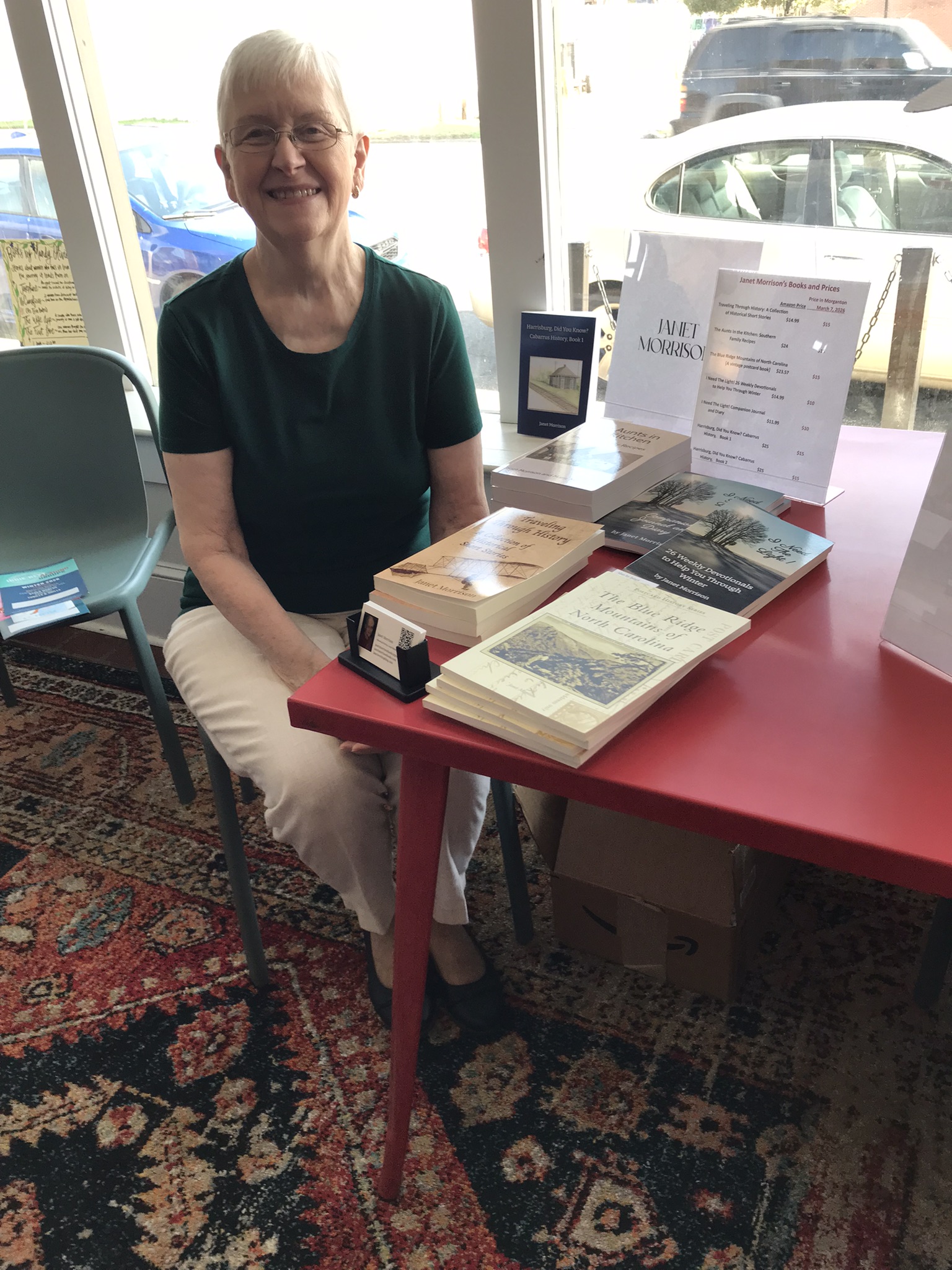
Janet and her half-table display space at Local Author Showcase March 7, 2026, at Thornwell Books, Morganton, NC

It was fun to get acquainted with other writers from the region and see what they writer. There were several children’s books authors, a fantasy author, an author of LGBTQ romance, a couple of self-help/inspirational authors, two non-fiction history authors, and the founder of the Spoken Word Society in Mt. Airy, North Carolina. If Mt. Airy sounds familiar, that’s because it is the hometown of Andy Griffin, one of North Carolina’s favorite sons.
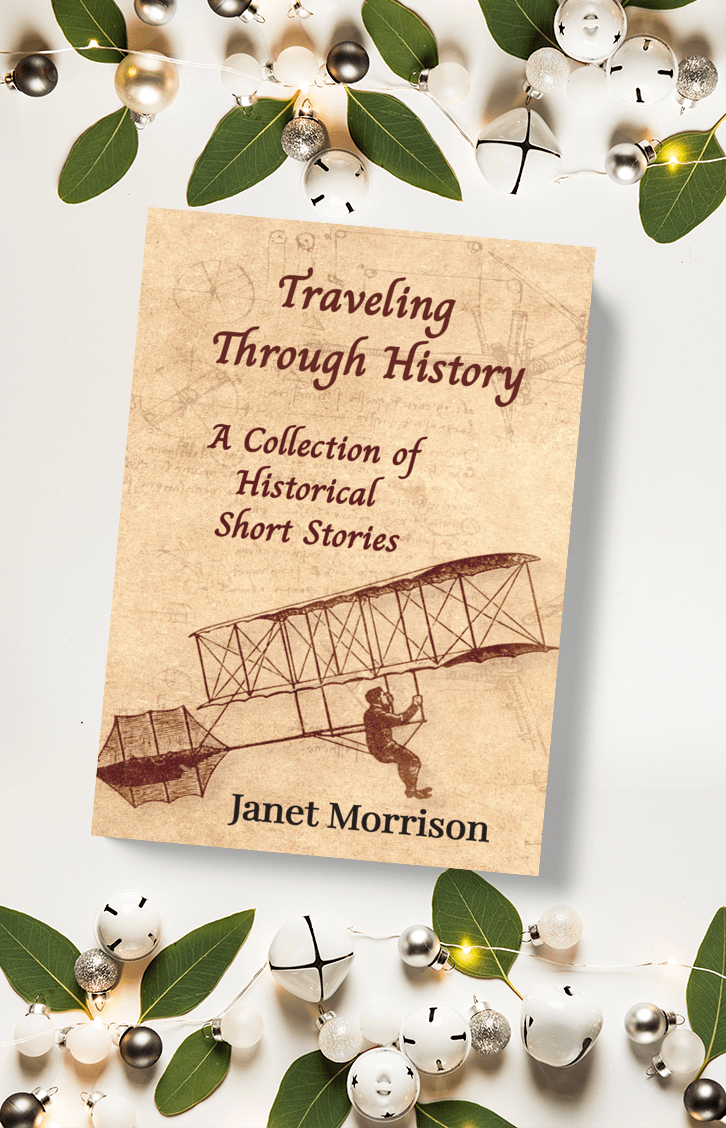
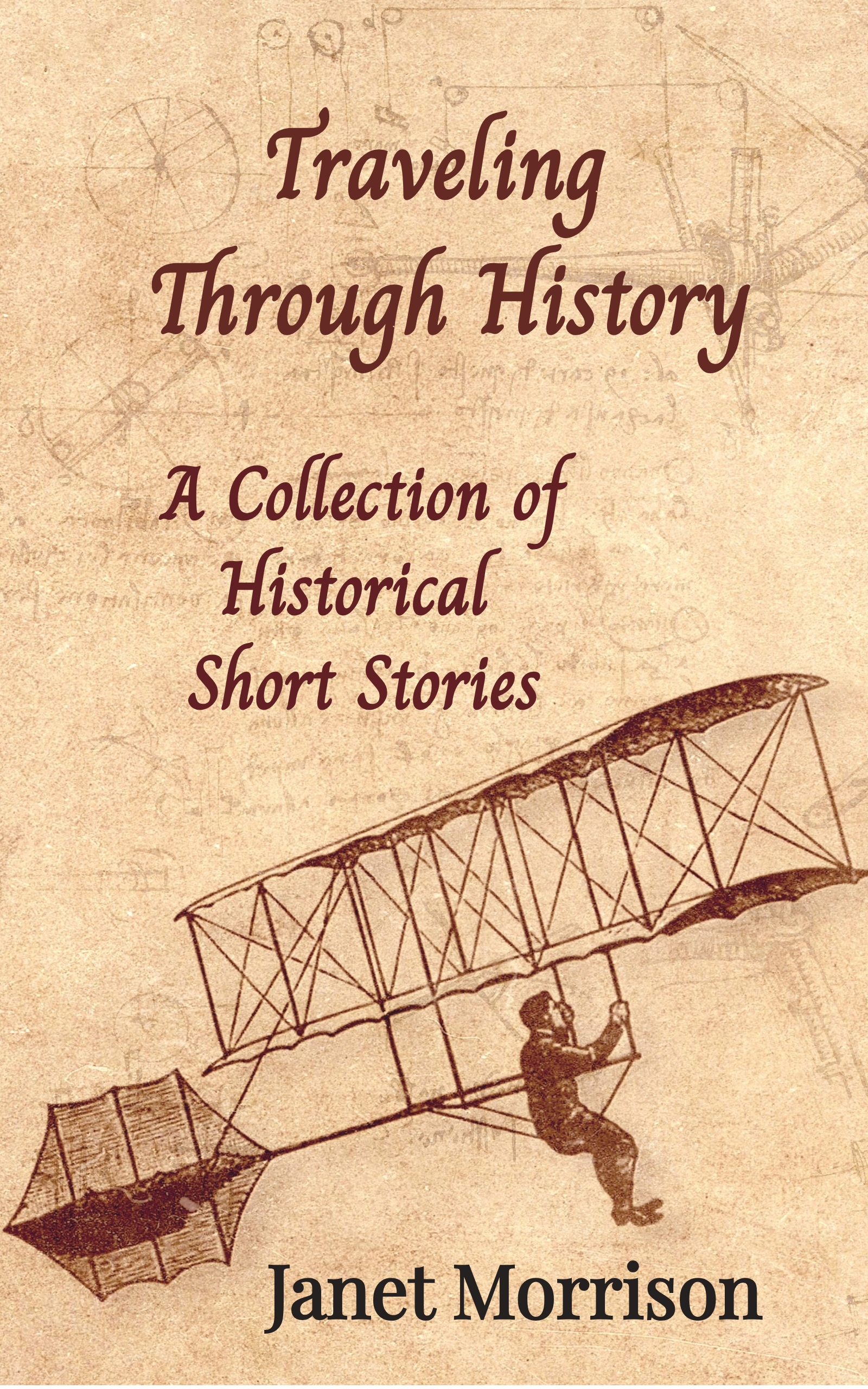
Photo of the front cover of Traveling Through History: A Collection of Historical Short Stories, by Janet Morrison
Traveling Through History: A Collection of Historical Short Stories, by Janet Morrison

Two or three of the authors made more sales than the rest of us. I only sold one copy of Traveling Through History: A Collection of Historical Short Stories, but I knew going in that it might not be a lucrative financial venture. You just never know how author events will be received, and it was a beautiful and uncommonly warm late winter day that felt more like late April or May. It was more of a networking opportunity.

It was interesting to see how other authors displayed their books, and during slow times we had the opportunity to commiserate about the pitfalls of being a writer such as looking for publishers, the various routes to self-publishing, and how different writers structure (or don’t structure) their writing time. Some of us are outliners and others are “pantsers.” (Pantsers write by the seat of their pants, with no idea where their book’s plot is going. Yikes!)

Thornwell Books

Front entrance to Thornwell Books

Thornwell Books is located at 202 S. Sterling Street in Morganton, NC. Morganton is the county seat of a very old county (Burke) in the foothills of the Blue Ridge Mountains, some 60 miles east of Asheville and sits along I-40. The population is around 18,000.
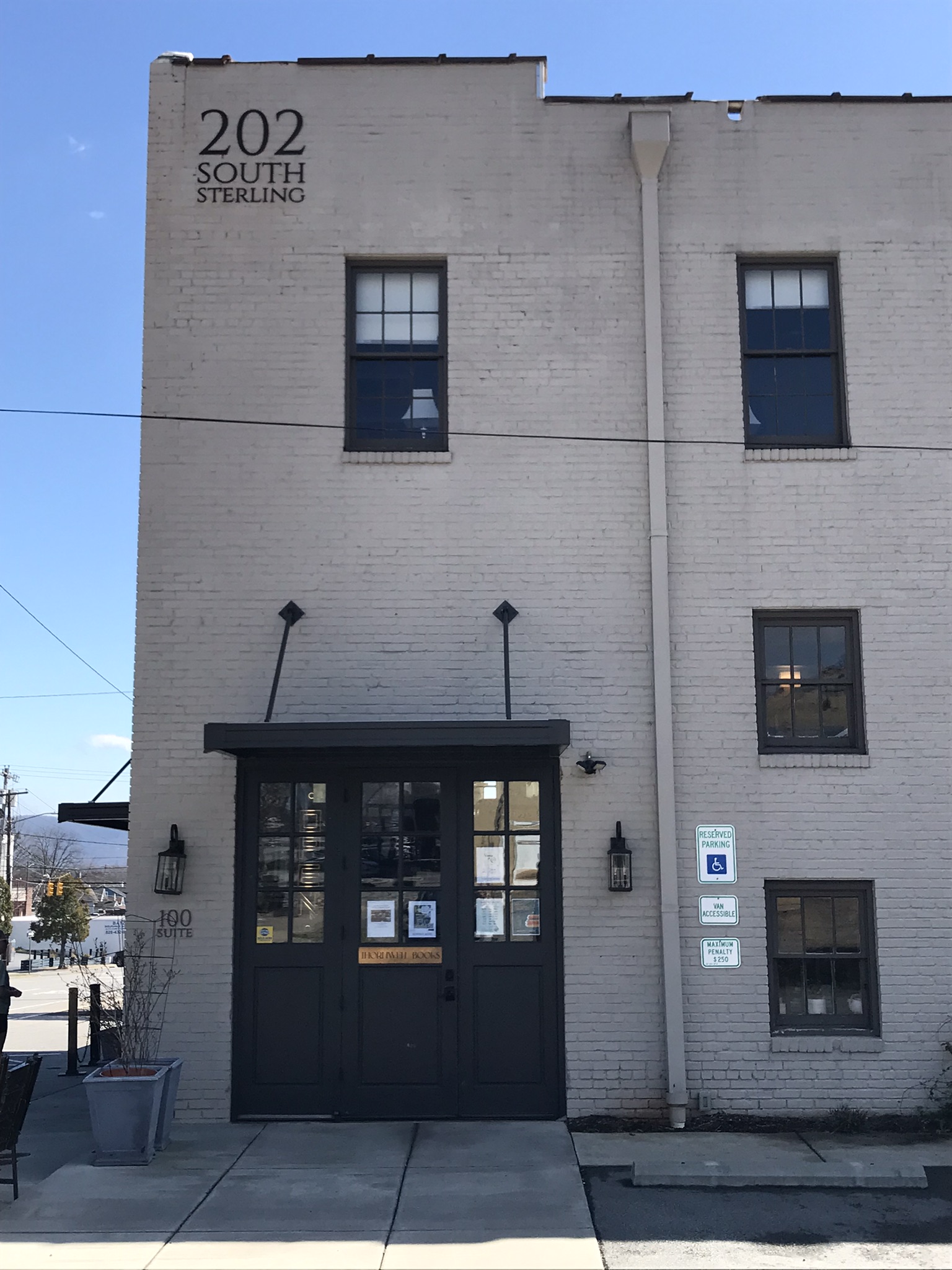
Side entrance to Thornwell Books

The bookstore is in a former Ford car dealership. The architecture is unique and quite interesting. The shop includes a coffee and pastry bar. There are numerous tables in the second-floor loft to accommodate students wanting a place to work on their laptops and study. That area was extremely busy on Saturday, as was the coffee shop. Many locals popped in to get a coffee and buy a newspaper.
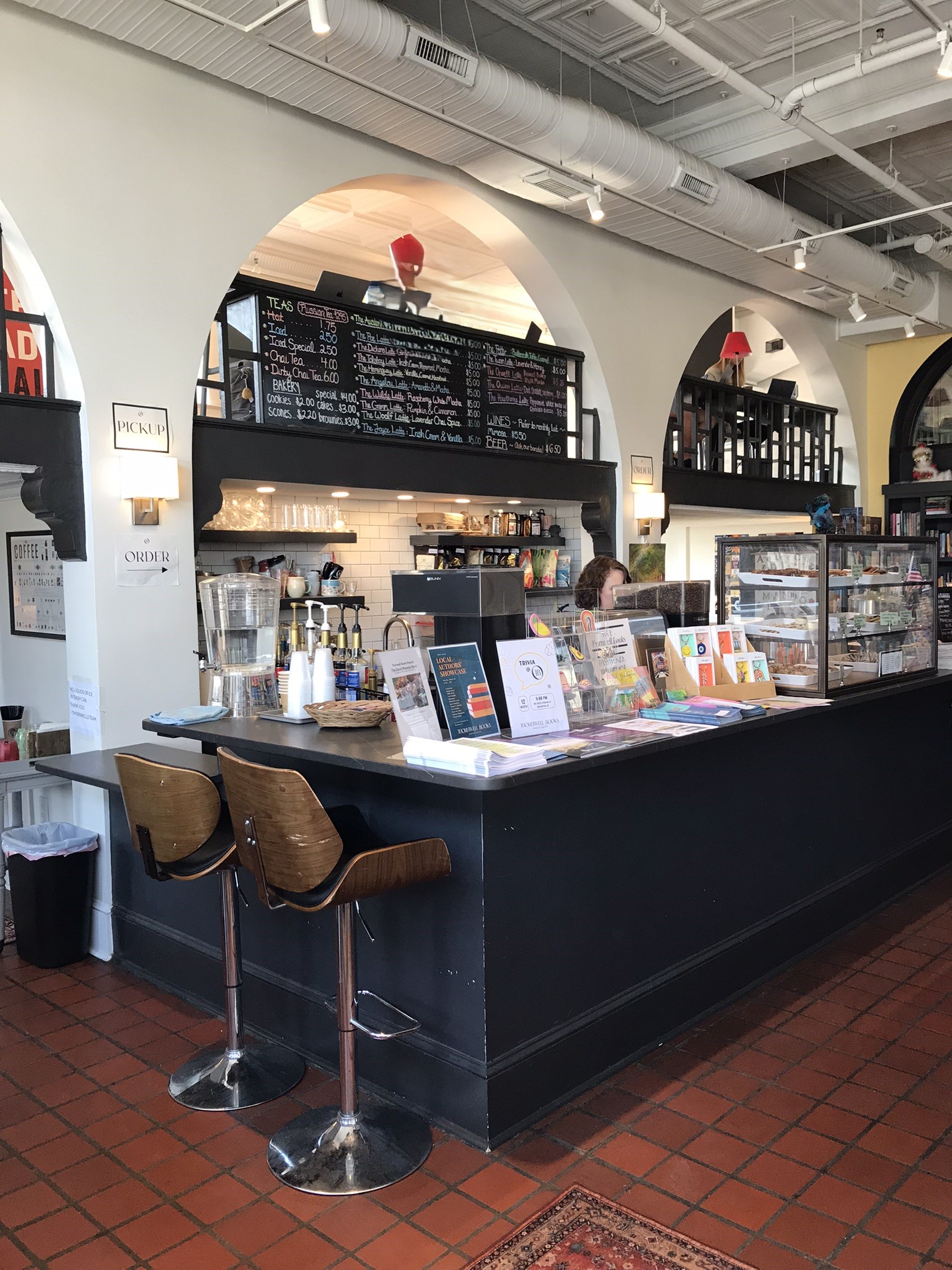
Coffee Bar at Thornwell Books and view of part of the reading and study loft

It is the kind of independent bookstore that every town needs. It’s a shame there are so few independent bookstores in existence.

Morganton, North Carolina

If you are ever in Morganton or simply passing through on I-40 on your way to somewhere else, take time to get off the busy interstate and drive into the town. Sterling Street is one of the main streets in the town and easy to find. Thornwell Books is just a couple of blocks from the old courthouse. There is on-street parking and parking on both sides of the store.

There is a downtown shopping district, an old courthouse to drive around in the center of town which features a wonderful statue of the late U.S. Senator Sam Ervin who was born and lived there, a local history museum, Western Piedmont Community College, a building that houses branches of several colleges including Appalachian State University, the North Carolina School for the Deaf, and a state-operated mental hospital.
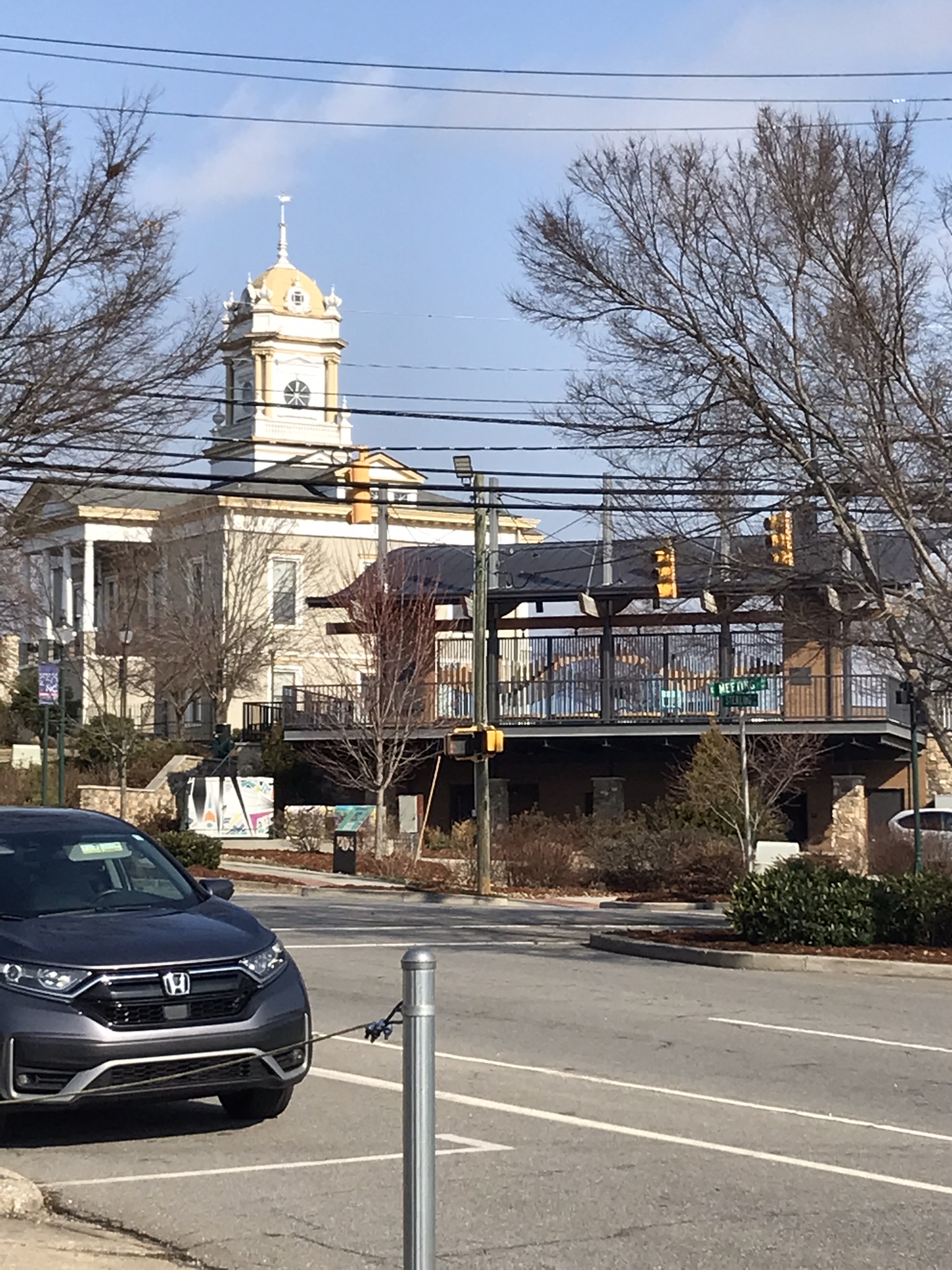
Burke County Old Courthouse, Morganton, NC, as seen from Thornwell Books

The City of Morganton Municipal Center for the Arts (COMMA) is a beautiful facility that hosts various performances. “The Jazz Legacy Project – Billie Holiday: God Bless the Child” is scheduled for April 17, and the website says the tickets are selling fast. It sounds like a delightful event!

Big cities tend to look down their noses at small cities like Morganton but, as you can see, many of them offer wonderful cultural opportunities and great independent bookstore!
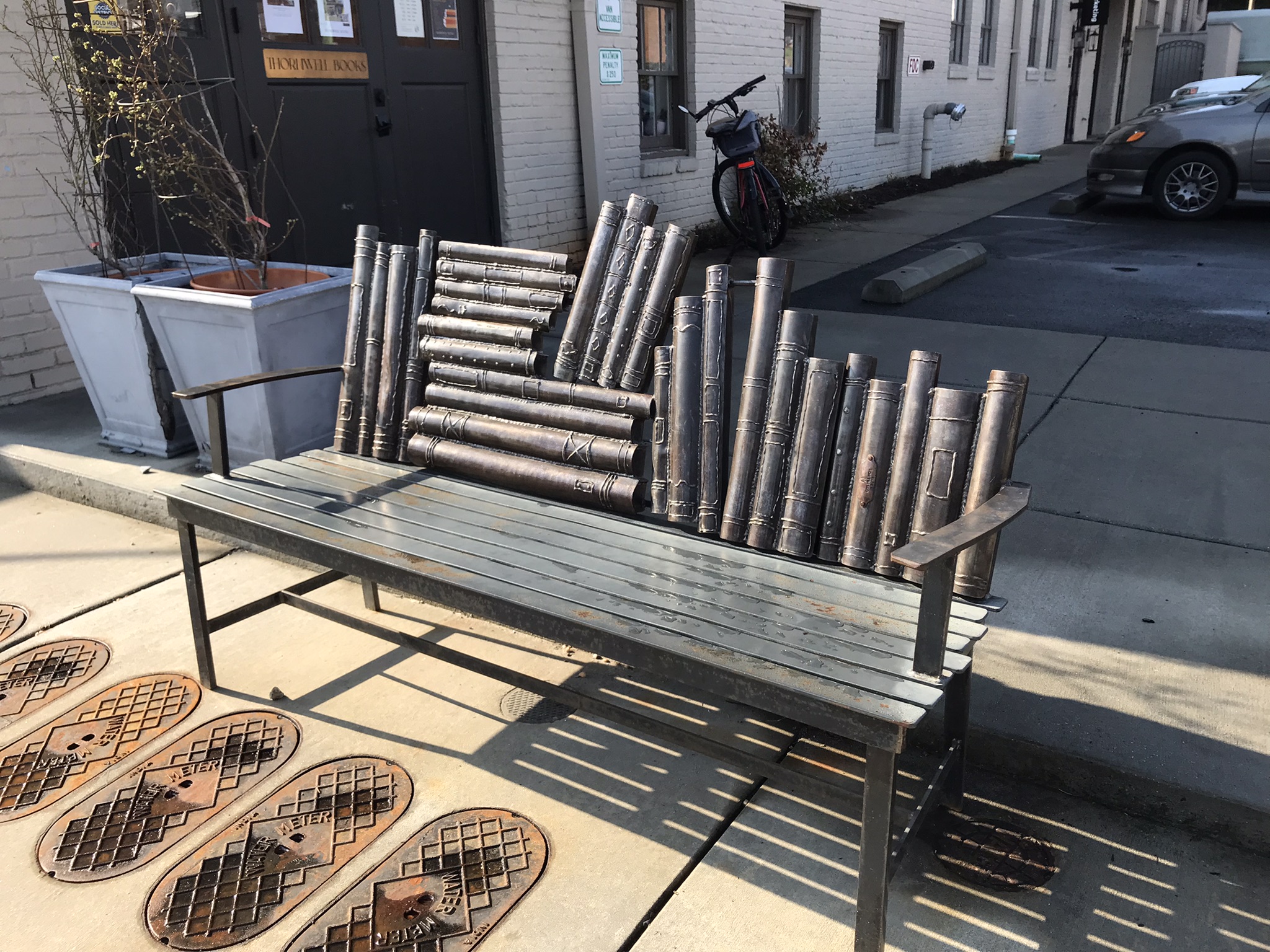
Interesting bench outside Thornwell Books

Meanwhile…

The war in the Middle East rages on as attacks spread throughout the region. A committee in Iran selected a new Ayatollah this weekend – the 56-year-old son of the one killed in the war the previous weekend. The bodies of the first six U.S. military personnel killed in the war were returned to Dover Air Force Base in Delaware on Saturday. A seventh U.S. military service person died this weekend from injuries sustained on Iran’s attack on Saudi Arabia on March 1. Russia is reportedly giving intelligence information about the U.S. military to Iran. Ukraine is going to help the United States with drone expertise.

Our European allies continue to watch and wait without making any commitments, except for Germany and Italy. And who can blame them? This is Trump and Netanyahu’s war of choice.

As more countries get dragged into the war to various degrees, it remains a dangerous situation without a clear path to an end.

Janet

The government should be afraid of its citizens, not the other way around.

“Ghost of the Battle of Guilford Courthouse” – historical ghost story

The twelfth story in my book, Traveling Through History: A Collection of Historical Short Stories, is a story about a ghost from the American Revolutionary War.

Traveling Through History: A Collection of Historical Short Stories, by Janet Morrison

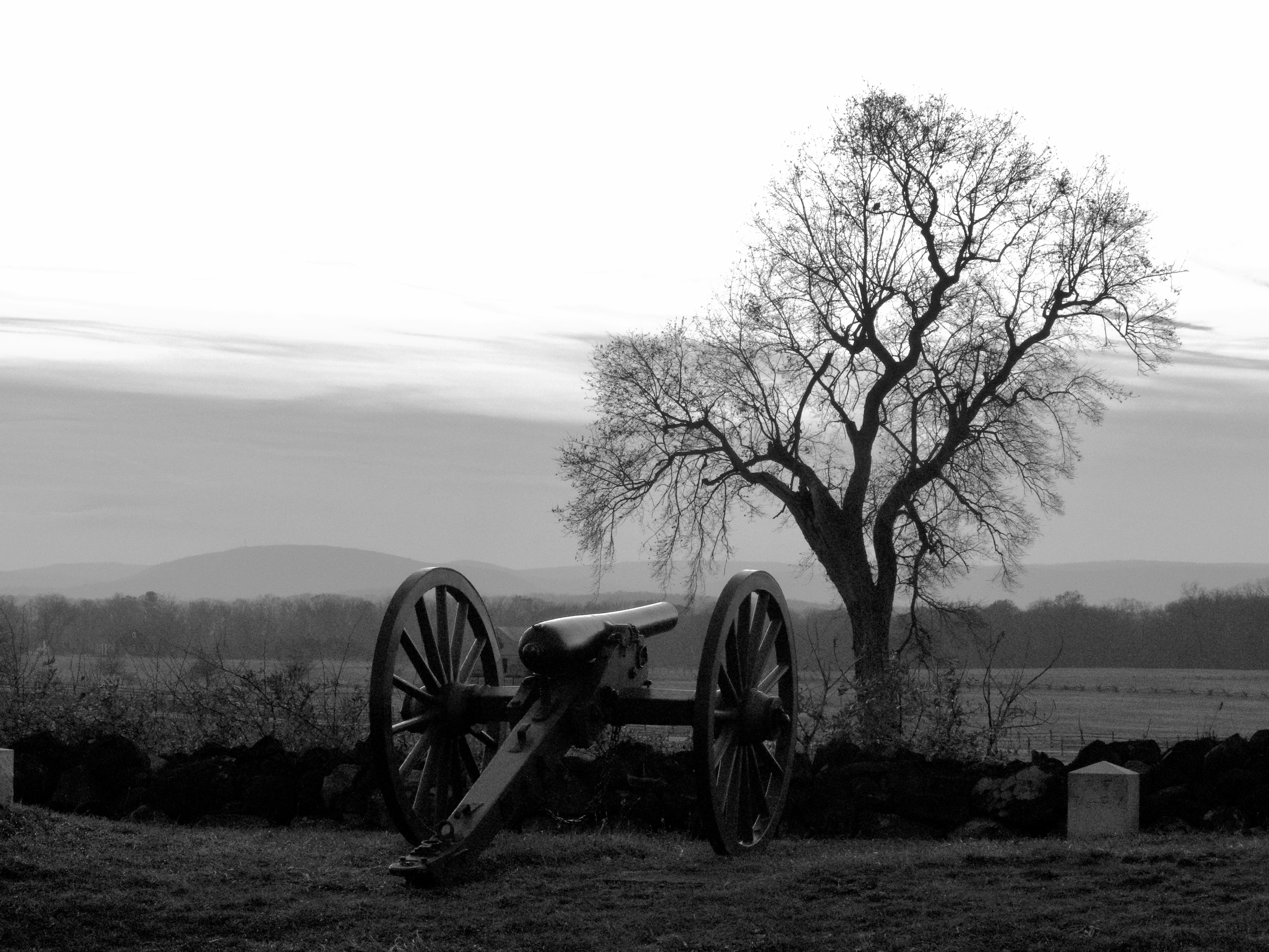
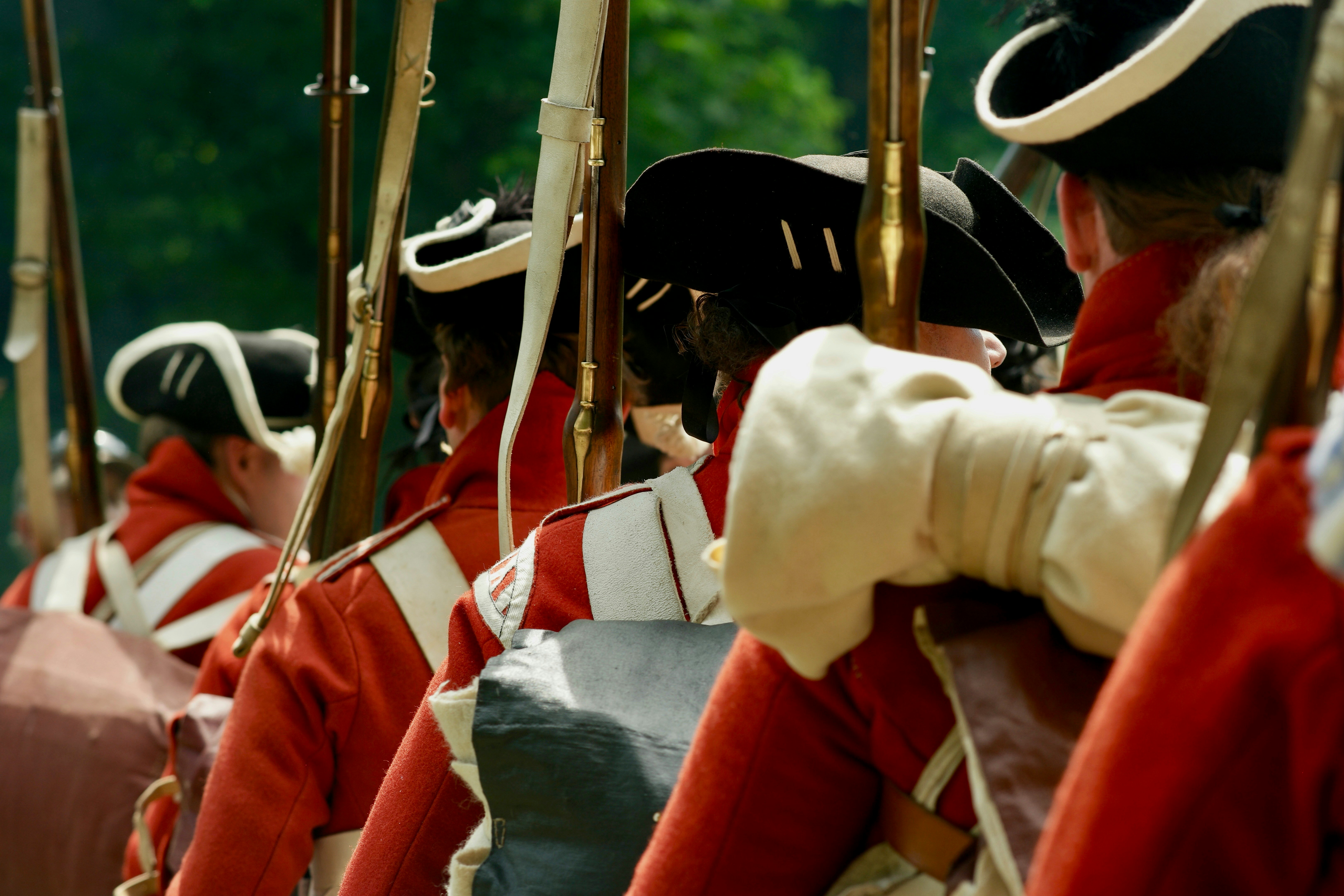
The story takes place in Greensboro, North Carolina in 1965, but it is about the ghost of a British soldier from the Battle of Guilford Courthouse which took place during the American Revolutionary War on March 15, 1781. It is my first (and possibly, last) ghost story.

Photo by Matt Briney on Unsplash

This story was inspired by some unexplained happenings at the condominium my sister and another teacher shared near the Guilford Courthouse Battleground in the 1980s.

None of us had any particular interest in ghosts until the commode upstairs would flush when no one was up there and even guests on occasion had the feeling that someone had entered their bedroom when there was no one to be seen. A can randomly falling off a pantry shelf was also unsettling.

I hope my ghost story will make you a little more knowledgeable about the Battle of Guilford Courthouse which was one of the last battles before Lord Cornwallis surrendered at Yorktown, Virginia.

There is a dog in the story for all you dog lovers.

Note: I made an error in the story. I originally had it set in the 1970s. At the last minute, I changed it to 1965. One of my 1970s characters called 9-1-1, and I forgot to change that when I shifted the story to 1965. It has been brought to my attention by an astute read and fellow writer that 9-1-1 emergency telephone service did not begin in the United States until 1968. My apologies. I try to have all details in my historical fiction writing to be accurate, but this one got past me.

If you missed any of my previous blog posts about the stories in Traveling Through History: A Collection of Historical Short Stories, here are the links: “The Tailor’s Shears” – Historical Short Story, “You Couldn’t Help But Like Bob” — historical short story, “To Run or Not to Run” – historical short story, “Making the Best of a Tragedy” – historical short story, “From Scotland to America” – historical short story, “Whom Can We Trust?” – historical short story, “Go fight, Johnny!” – historical short story, “A Letter from Sharpsburg” – historical fiction, “Slip Sliding Away” – historical short story, “Plott Hound Called Buddy” – historical short story, and “Secrets of a Foster Child” – historical short story.

Traveling Through History: A Collection of Historical Short Stories is available on Amazon, Barnes & Noble.com, or ask for it at your favorite independent bookstore. Stores that I know try to keep it in stock are Second Look Books in Harrisburg, NC; Highland Books in Brevard, NC; and Blue Ridge Books in Waynesville, NC.

I thank those stores and I thank you for supporting my writing!

Janet

The government should be afraid of its citizens, not the other way around.

“Secrets of a Foster Child” – historical short story

The eleventh story in my new book, Traveling Through History: A Collection of Historical Short Stories, is about a fourteen-year-old foster child who is a veteran at changing homes and foster families.

Some foster children only have a trash bad to put their belongings in.
Photo by Sven Brandsma on Unsplash

In “Secrets of a Foster Child,” Lorraine finally found a family she felt a part of in 1948, just three years after World War II ended.

Things did not go as hoped, but she just might find dignity in a simple suitcase.

The dignity of a simple suitcase.
Photo by Shamblen Studios on Unsplash

In 2001, the congregation of the church I am a member of contacted the county’s Department of Social Services in search of a hands-on project. When we were told that many foster children have nothing but a garbage bag to carry their belongings in to a foster home, we knew we had found a project we could get excited about.

We collected enough new and like-new suitcases to make sure every foster child in the county had a suitcase. We hoped that would help them no longer think of themselves as “throwaway children.”

As you can see, if you have been reading my book or reading this series of blog posts about the stories in my book, I get my inspiration from many sources.

In case you have missed any of the previous blog posts about the stories in the book, here are the links:

Thank you for reading my blog and supporting my writing. Look for Traveling Through History: A Collection of Historical Short Stories on Amazon or at your favorite independent bookstore.

Where to find my book of historical short stories

If you cannot find it locally, you can visit my website, https://www.janetmorrisonbooks.com, click on the book, then click on the Bookshop.org button. Through Bookshop.org you can order books from any independent bookstore in the United States. As an affiliate, I will make a commission from the sale of any book purchased through my website. Thank you!

Janet

The government should be afraid of its citizens, not the other way around.
“Plott Hound Called Buddy” – historical short story

The tenth story in my new book, Traveling Through History: A Collection of Historical Short Stories, is about a dog and the woman who befriends him.

I have loved dogs all my life, so I wanted to include a dog in at least one of the stories in my book. I thought about the noble Plott Hound – the State Dog of North Carolina.

Henry Plott, the son of immigrant from Germany, Johannes Plott, bred this particular hound dog to hunt black bears in the mountains in western North Carolina. Mr. Plott immigrated to North Carolina in 1750. The hound he developed is descended from the “Hanover hound” of Germany.

Mr. Plott was so successful that the Plott Hound was registered with the United Kennel Club in 1946, was recognized by the American Kennel Club in 2006, and was exhibited for the first time at the Westminster Show in 2008. It was named the official State Dog of North Carolina in 1989.

I know two of the descendants of Johannes Plott, so I have a special interest in this. Writing this story gave me an excuse to learn a little more about the Plott Hound. I hope you dog lovers will enjoy the story I wrote about “Buddy” and Lois, the retired teacher who took him in.

I wanted to include a picture of the Plott Hound, but I did not find a photograph that was in the public domain. There are several videos about the Plott Hound on YouTube. Here’s the link to one of them: https://www.bing.com/videos/riverview/relatedvideo?q=Plott+Hound&&mid=4493E23AF27D9EC24ACA4493E23AF27D9EC24ACA&FORM=VAMGZC or you can find other resources about the Plott Hound through a search engine.

Thank you for supporting my writing. Traveling Through History: A Collection of Historical Short Stories, is available from Amazon or ask for it at your favorite independent bookstore. It is available to libraries and bookstores through IngramSpark.

It can be ordered through my website, https://www.janetmorrisonbooks.com, by clicking on the Bookshop.org button. If you order the book via my website, as a Bookshop.org affiliate, I will get a small commission.

If you live in the Harrisburg area, ask for it at Second Look Books.

If you missed any of the previous nine blog posts about the stories in my book, here are the links: “The Tailor’s Shears” – Historical Short Story; “You Couldn’t Help But Like Bob” — historical short story; “To Run or Not to Run” – historical short story; “Making the Best of a Tragedy” – historical short story; “From Scotland to America” – historical short story; “Whom Can We Trust?” – historical short story; “Go fight, Johnny!” – historical short story; “A Letter from Sharpsburg” – historical fiction; and “Slip Sliding Away” – historical short story.

Tell your friends how they can find a copy of the book. If you and they enjoy it, a rating on Amazon or Goodreads will be greatly appreciated!

Janet

The government should be afraid of its citizens, not the other way around.

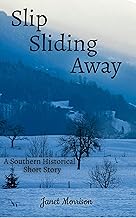
“Slip Sliding Away” – historical short story

With a possible major ice storm predicted here on January 24 and 25, and the accompanying possibility of power outages stretching into the week of January 26, I am scheduling this blog post on Thursday, January 22, to be published on January 27. Our power lines are not underground here, so ice storms wreak havoc with our electricity.

This post is about the ninth story in my historical fiction book, Traveling Through History: A Collection of Historical Short Stories. “Slip Sliding Away: A Southern Appalachian Short Story,” transports the reader to 1875 and an isolated cove in the southern Appalachian Mountains.

I originally wrote this story in the early 2000s. In fact, it was my first historical short story. It has gone through many revisions (and, hopefully, improvements!) since then. It is the story I offer as a free e-download on my website (https://www.janetmorrisonbooks.com) for subscribers to my e-newsletter. If you wish, you may do that to get a free for my fiction writing style.

In “Slip Sliding Away,” Hannah Johnson’s husband, Daniel, has seriously injured himself. A late spring blizzard sets in. Hannah retrieves an envelope of powder from her box of private treasures in the corner cupboard. She adds small amounts of the powder to her suffering husband’s tea as the night passes and she has no way to call for help.

Is she using the precious powder to ease his pain?

And what part does Daniel’s brother, James, play in this story? In fact, all of Daniel’s brothers play a part in this story as it progresses. Therein lies some humor in this otherwise serious subject matter.

You will have to read the story to find out about the powder and Daniel’s ragtag brothers.

How to get a copy of “Slip Sliding Away”

“Slip Sliding Away” is available as a standalone short story on Amazon. It is available in paperback and e-book on Amazon.

“Slip Sliding Away,” by Janet Morrison

Of course, I would be thrilled for you to purchase my book, Traveling Through History: A Collection of Historical Short Stories. “Slip Sliding Away: A Southern Appalachian Short Story” is one of more than a dozen stories in the book.

Traveling Through History is available in paperback from Amazon at (https://www.amazon.com/Traveling-Through-History-Collection-Historical/dp/B0FZSR6FPX/) and e-book at (https://www.amazon.com/Traveling-Through-History-Collection-Historical/dp/B0FZSR6FPX/.) 

Traveling Through History: A Collection of Historical Short Stories, by Janet Morrison

It is available in Harrisburg, North Carolina at Second Look Books, or you can order it from any independent bookstore in the U.S. by visiting my website (https://janetmorrisonbooks.com) and clicking on the Bookshop.org button. (Full disclosure, as an affiliate of Bookshop.org, I will receive a commission from any books you order through Bookshop.org by going through my website.)    

If you enjoy my books, please leave a brief review on such online sites as Amazon and Goodreads.

Janet

The government should be afraid of its citizens, not the other way around.

“A Letter from Sharpsburg” – historical fiction

As I write this on the night of January 20, 2026, Trump is on his way to the World Economic Forum in Davos, Switzerland. (In fact, news came in as I wrote this that Air Force One had been turned around due to an electrical problem. Trump will be moved to a back-up plane.)

This gathering includes many NATO countries – the very NATO countries he threatened with tariffs this week. He will, no doubt, attempt to dazzle them with his perception of the current economy of the United States. Those of us who live here, know better. The picture he painted today in his news conference was far-removed from reality. He will embarrass us in Davos. He would embarrass himself, but that is not possible.

The next couple of days will not go well. Trump never comes across as Presidential here at home or on the world stage. Will he further insult our allies at this forum? Probably. That’s all he knows to do. At the very least, he will probably make fun of French President Emmanuel Macron’s eye condition. Trump has a record of belittling people with medical problems.

In today’s news conference, he finally feigned regret that an ICE agent shot and killed Renee Nicole Good in Minneapolis. Did you hear why he pretended regret today? Because someone told him that Ms. Good’s father was a Trump supporter.

I cannot remain silent as I see my government attack the least of these among us. As a Christian, it is my responsibility to speak up for the people who have no voice or whose voices are being ignored. As the President claims ICE agents are only going after “the worst of the worst,” my eyes and ears know better.

American citizens are being accosted and detained. One has already been killed on a street in Minneapolis. My government has not come after me yet, but if I wait until it does, there will be no one left to speak up for me.

Without further adieu, here is my planned blog post for today

Today’s post is about the eighth story in my short story book. “A Letter from Sharpsburg,” is a fictitious letter from an imaginary Confederate soldier who had fought in the Battle of Sharpsburg in Maryland during the American Civil War.

Photo by John Kostyk on Unsplash

As I explain in the book, it was general practice for the Union to name battles in the Civil War for a nearby physical feature, such as a creek. It was the practice of the Confederacy to name battles for the nearest town. This has led to confusion for more than 160 years.

This battle took place along Antietam Creek, near the town of Sharpsburg. Therefore, the Union called it the Battle of Antietam and the South called it the Battle of Sharpsburg.

Another example is the First and Second Battles of Bull Run (Union name) being called the First and Second Battles of Manasses in the South. It seems to me that we studied the Civil War almost every year in elementary school, but I don’t recall ever being told how or why the North and the South had different names for the same battles. Knowing the reason behind this practice would have been helpful.

I patterned this fictitious letter after letters one of my great-grandfathers wrote to his parents and sister during the Civil War. It was common in that day for a soldier to begin a letter with the words, “I seat myself and take pen in hand to write you a few lines.”

I chose this battle because more Americans were killed on the battlefield that day than on any other day in American military history. It is said that 2,100 Union soldiers and 1,550 Confederate soldiers lost their lives on September 17, 1862 near Sharpsburg, Maryland. Nearly 10,000 Union soldiers were wounded and more than 7,700 Confederate soldiers were wounded there that day.

In my book, I included author’s notes, questions for consideration, and a bibliography of the sources I used in writing “A Letter from Sharpsburg.”

In case you missed them here are the links to my blog posts about the first five stories in my book: “The Tailor’s Shears” – Historical Short Story; “You Couldn’t Help But Like Bob” — historical short story; “To Run or Not to Run” – historical short story“Making the Best of a Tragedy” – historical short story; “From Scotland to America” – historical short story; “Whom Can We Trust?” – historical short story; and “Go fight, Johnny!” – historical short story.

Where to purchase Traveling Through History: A Collection of Historical Short Stories

You can find my new short story collection on Amazon in e-book (https://www.amazon.com/Traveling-Through-History-Collection-Historical-ebook/dp/B0FZQBMC2Q/)  and paperback (https://www.amazon.com/Traveling-Through-History-Collection-Historical/dp/B0FZSR6FPX/.)

You can find the paperback at Second Look Books in Harrisburg, NC, or ask for it at your local independent bookstore. Bookstores can order it from IngramSpark. It is supposed to be available at Barnes & Noble, but I’ve been told it is not necessarily in stock in the brick-and-mortar stores.

If you purchase my book and enjoy it, please give it a rating on Amazon and write a brief review of it for that site or Goodreads.com. Also, recommend it to your friends!

Word of mouth publicity is the best! Thank you!

Keeping me honest

My readers continue to try to keep me honest, which is my goal as a writer of historical fiction. Facts matter to me. Facts form the basis for my writing.

I mentioned in an earlier blog post that it had been brought to my attention that I have the wrong date in my book for the Battle of Kings Mountain. Yesterday, a friend clued me in that in “Ghost of the Battle of Guilford Courthouse: An American Revolutionary War Ghost Story,” I have someone calling 911 to report an incident to the police in 1963.

Unfortunately, 911 emergency service did not come into being until 1968. In my flimsy defense, I will point out that I originally had the story set in 1973. When I changed it to 1963, I failed to catch my 911 error.

I appreciate my historical errors being brought to my attention. This will help keep me on my toes as I write my novel. If you find another historical error in my book, please let me know.

Janet

The government should be afraid of its citizens, not the other way around.

“Go fight, Johnny!” – historical short story

Once-a-week since November 25, 2025, I have blogged about a different story in my new book, Traveling Through History: A Collection of Historical Short Stories. Today’s post is about the seventh story in the book in which my great-great-great-great-grandfather, John Calvin McElwee, tells his granddaughter (my great-great-grandmother) about his experience the day that the Revolutionary War came to his family’s doorstep.

The Battle of Kings Mountain took place near the border of North and South Carolina on October 7, 1780. Hearing the first shots of the battle fired, John, his father, and one of his brothers ran from their house to join the battle. John was just 15 years old.

John, his brother, and their father are not listed in all accounts of the Battle of Kings Mountain, since they were not members of an organized military company that took part in the battle; however, they are mentioned in various publications.

It was fun to imagine my great-great-grandmother as a little girl sitting on her grandfather’s lap as he told her about his work as a weaver and what happened the day of the battle.

The McElwee’s house was on land that became part of Kings Mountain National Military Park and, therefore, the U.S. Department of the Interior had a draftsman measure and draw the house in detail. Having that information made the house come alive for me and made it easy for me to visualize how the family lived. Unfortunately, the house was demolished around 1934 when the land was acquired by the U.S. Government for the park.

How fortunate I am to have access to drawings and floor plans for my McElwee ancestors’ house from the mid-1700s!

This story is more creative nonfiction than short story. I could have created conflict within the family to make it more of a historical short story, but I chose not to embellish the facts of the family in that way. I hope you will enjoy it anyway.

In case you missed them here are the links to my blog posts about the first five stories in my book: “The Tailor’s Shears” – Historical Short Story; “You Couldn’t Help But Like Bob” — historical short story; “To Run or Not to Run” – historical short story; “Making the Best of a Tragedy” – historical short story; “From Scotland to America” – historical short story; and “Whom Can We Trust?” – historical short story.

Where to purchase Traveling Through History: A Collection of Historical Short Stories

Traveling Through History: A Collection of Historical Short Stories, by Janet Morrison

You can find my new short story collection on Amazon in paperback (https://www.amazon.com/Traveling-Through-History-Collection-Historical/dp/B0FZSR6FPX/)  and e-book (https://www.amazon.com/Traveling-Through-History-Collection-Historical-ebook/dp/B0FZQBMC2Q/.)

You can find the paperback at Second Look Books in Harrisburg, NC, or ask for it at your local independent bookstore. Bookstores can order it from IngramSpark.

If you purchase my book and enjoy it, please give it a rating on Amazon and write a brief review of it for that site or Goodreads.com. Also, recommend it to your friends!

Word of mouth publicity is the best! Thank you!

Hurricane Helene Recovery Update

As of January 2, 2026, the North Carolina Department of Transportation has reopened 90% of the roads damaged by Hurricane Helene in September 2024. Some 270 bridges and 870 culverts have been repairs or replaced. Twenty-four roads in the state remain closed due to the hurricane and, of course, I-40 in the Pigeon River Gorge near the Tennessee line is still just one lane in each direction and a 35 mile-per-hour speed limit for months, if not years, to come.

The total monetary cost of damages is estimated by the NC Department of Transportation to be $4.9 billion. The State of North Carolina has spent $2.7 billion so far and has been reimbursed $411.46 million by the federal government.

Other states, take note.

Janet

Oh, Donald, what have you done?

Last week I wrote a blog post for today. As a result of what Trump did on Saturday, though, it no longer seemed appropriate to use it. I’ll save it for another day, because it is about one of the stories in my new book, Traveling Through History: A Collection of Historical Short Stories.

I have mentioned or alluded to Venezuelan dictator Nicolas Maduro before.

Flag of Venezuela
Photo by aboodi vesakaran on Unsplash

On August 28, 2025 in my blog, Meanwhile, in Washington, DC, I wrote that Trump was quietly stationing U.S. Navy Aegis guided-missile destroyers and other military ships and planes off the coast of Venezuela. I wrote, “The official White House explanation is that it is an anti-illegal drug operation, but it is no secret that Trump wants to overthrow the Maduro regime.”

On December 10, 2025, in my blog, Trump’s National Security Strategy – The Western Hemisphere, I gave some details of Trump’s November 2025 National Security Strategy (NSS) and the “Trump Corollary” to the Monroe Doctrine. Among other things, it talked about our use of lethal force and how American businesses would benefit. The NSS went so far as to state that any U.S. Government employee who interacts with countries in the Western Hemisphere must understand that it is “part of their job to help American companies compete and succeed.”

Now that Trump claims the U.S. will “run Venezuela” and we will “take back our oil,” I guess Trump and U.S. oil companies will be the beneficiaries of Saturday’s military action.

On December 31, 2025 in my A look back at 2025 blog post, I listed a few of  the things Trump did last year. One of my paragraphs read as follows: “He thinks he has the right to oust the dictator in a South American nation because that country sits on a lot of oil. He claims Venezuelans are bringing massive amounts of illegal drugs to the U.S. in those tiny boats. In his mind, though, it is easier to claim they’re transporting drugs and obliterate all the evidence along with the people in the boats.”

What Trump did in the wee hours on Saturday morning gives Putin the greenlight to take Ukraine and other European countries. It gives Xi the greenlight to take Taiwan.

Trump has left the United States without a moral leg to stand on when any other dictator in the world decides to go off half-cocked and overthrow a government or a leader they don’t like.

Trump says Maduro is a “bad person.” Just because a country has a “bad person” in charge does not give the United States or any other country the right to overthrow that person and their regime. After all, most of us think Donald Trump is a “bad person.”

The United States has overthrown foreign leaders before. It has never gone well. It goes against the Constitution of the United States of America. It overrides the authority of the U.S. Congress when a U.S. President launches a military attack on another country.

This is not rocket science; it’s just political science. It is the very foundation of our nation. It is not difficult to understand for those of us who have lived here for seven decades. We learned the tenets of American democracy from birth in our homes and at school in our formative years. We have continued to learn it throughout our lives just by having the privilege of being American citizens.

It is beyond unfortunate that we now have a U.S. President who was either never taught those things or has chosen to ignore them. He thumbs his nose at the law and those of us who love America. He believes he is above the law, and those of us who obey the law are “losers.”

And that, my friends, is how we arrived at Saturday morning, January 3, 2026.

Maduro and his wife are now being held in a prison in New York City. It is said that they will be charged with running illegal drugs to the United States.

This is all smoke and mirrors by the U.S. President, for just a few weeks ago he pardoned the former leader of Honduras for his running of drugs to the United States. So why spend an estimated $1 billion in U.S. taxpayer money to overthrow Maduro? And he is just getting started. The hard work comes after the overthrow, especially when you have no plan and the American people are not behind you.

In Trump World, it all depends on who you are and what Trump can get out of you.

The American people don’t want to run Venezuela. We don’t want to make Canada our 51st state. We don’t want to steal Greenland from Denmark. We don’t want a $400 million ballroom at the White House. We don’t want Trump’s name on the Kennedy Center for the Performing Arts. We don’t want a massive arch in Washington, DC. We don’t want masked federal officers snatching people off the streets. We don’t want Trump’s face on our money or our national park passes. We don’t want Trump’s name on anything.

Americans want affordable healthcare and a Centers for Disease Control and Prevention (CDC) we can trust. We want our food inspected by a reliable U.S. Department of Agriculture. We want people to make a fair wage that will enable them to reach the American Dream of home ownership. We want religion left out of our public schools. We want university professors free to teach without government interference. We want our national parks preserved and not destroyed for the sake of gas and oil exploration. We want endangered species protected from extinction. We want a country where citizens are encouraged to vote without intimidation. We want a country where we are all just Americans and minorities are not labeled “other.”

We want a U.S. Congress with the guts to stop Trump’s power grab and overreach.

We want a U.S. Supreme Court that admits the error of their ways when they ruled that a sitting U.S. President cannot be held guilty of breaking a law.

We want a President who speaks and acts from a place of intelligence and empathy – not a gutter-mouth bully. Is it too much to ask that we have a President who speaks in complete sentences? Is it too much to ask for a President who honors the U.S. Constitution? Is it too much to ask for a President who does not call our citizens vicious names?

Janet

P.S. Don’t forget the brave people of Ukraine.

“Whom Can We Trust?” – historical short story

Once-a-week, since November 25, I have blogged about a different story from my new book, Traveling Through History: A Collection of Historical Short Stories.

The sixth story in the book is “Whom Can We Trust? A Mecklenburg Declaration of Independence Short Story.”

Tradition tells us that Archibald and Maggie Sellers McCurdy built their log cabin in what is now Cabarrus County, North Carolina, in 1773. At that time, Cabarrus had not yet been formed out of the eastern part of old Mecklenburg County. Their house was on the National Register of Historic Places until vandals burned it down a few years ago. Sadly, I never did see the house, but I have seen photographs of it and detailed floor plans and exterior drawings have been preserved.

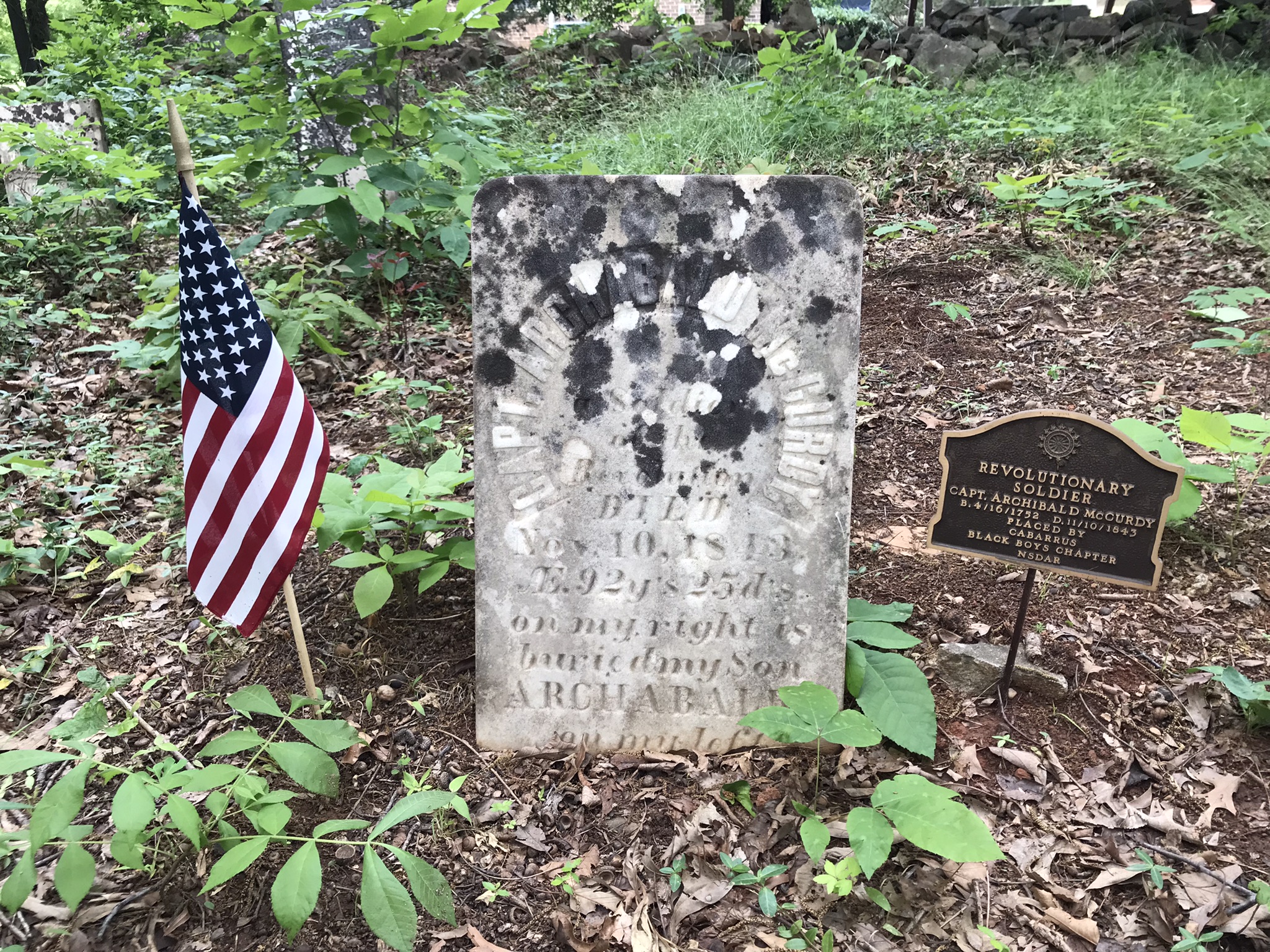
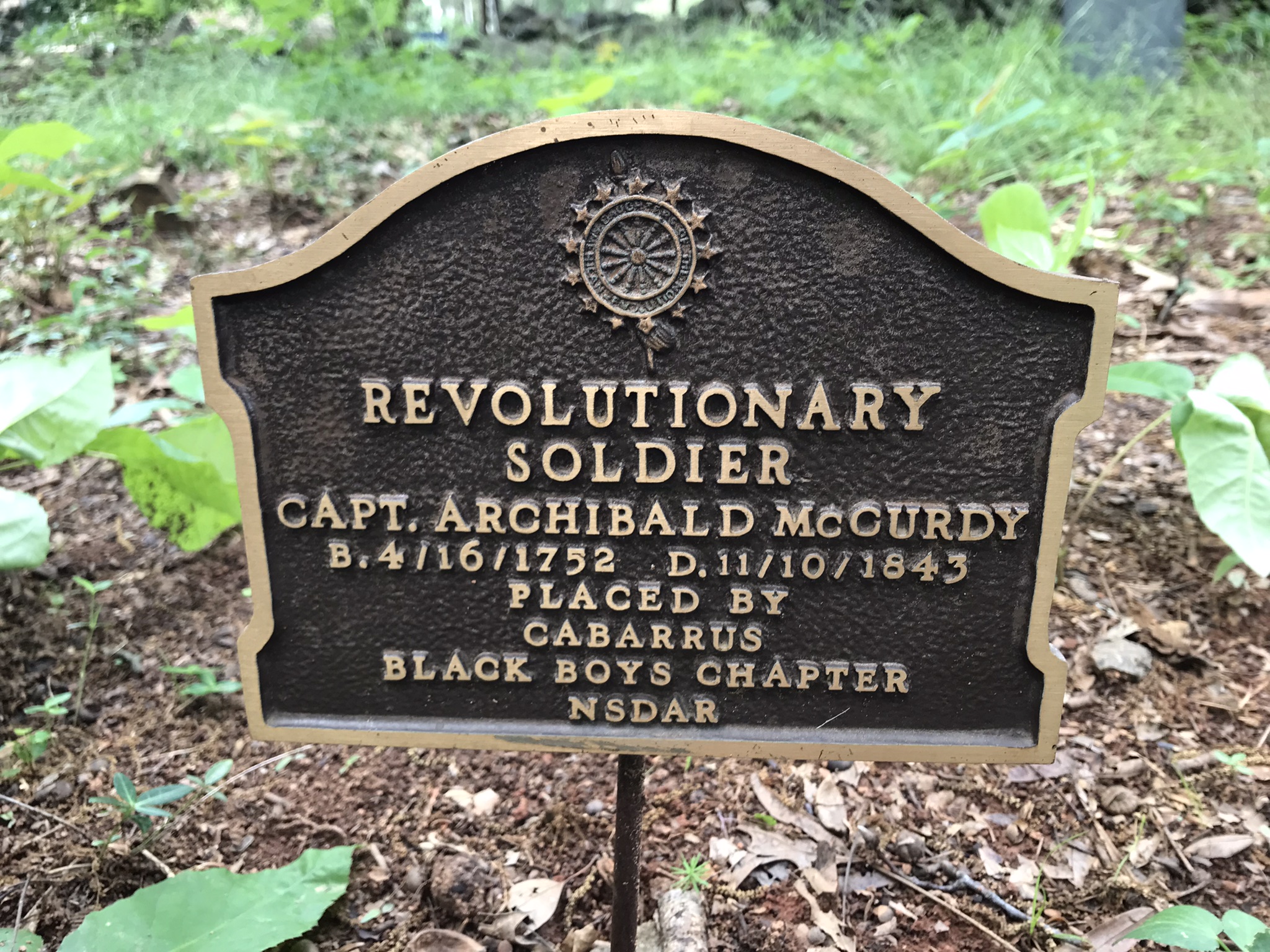
Archibald McCurdy’s gravestone at Spears Graveyard of Rocky Ri er Presbyterian Church, Cabarrus County, North Carolina

Those drawings and photographs made it easy for me to imagine the McCurdys’ lives. Theirs are names I’ve heard all my life. Archibald was a foot solider in the militia during the Revolutionary War. Maggie was a patriot in her own right, as she earned the name “She-Devil” by the British and Tories. I explain a couple of her feats in the Author’s Note at the end of “Whom Can We Trust?”

Marker placed at Archibald McCurdy’s grave by the Daughters of the American Revolution

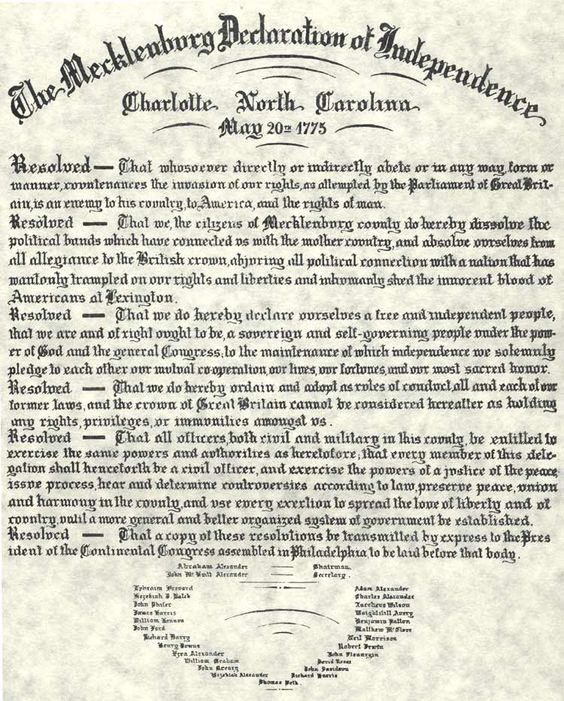
The story is set in May 1775 at the time of the signing of the Mecklenburg Declaration of Independence. I was inspired by a story I’ve heard all my life about what Archibald McCurdy did on the day that document was signed.

In case you missed them here are the links to my blog posts about the first five stories in my book: “The Tailor’s Shears” – Historical Short Story, “You Couldn’t Help But Like Bob” — historical short story, “To Run or Not to Run” – historical short story, “Making the Best of a Tragedy” – historical short story, and “From Scotland to America” – historical short story.

Where to purchase Traveling Through History: A Collection of Historical Short Stories

You can find my new short story collection on Amazon in e-book (https://www.amazon.com/Traveling-Through-History-Collection-Historical-ebook/dp/B0FZQBMC2Q/)  and paperback (https://www.amazon.com/Traveling-Through-History-Collection-Historical/dp/B0FZSR6FPX/.)

You can find the paperback at Second Look Books in Harrisburg, NC, or ask for it at your local independent bookstore. Bookstores can order it from IngramSpark.

Janet

“To Run or Not to Run” – historical short story

The fictional character I’m introducing to you today is George. He is a slave in South Carolina in the mid-1700s in the third story in Traveling Through History: A Collection of Historical Short Stories, “To Run of Not to Run.”

When you meet George, he is a young boy. He and his father, who was born in Senegal, have just been sold and are being taken from Camden to the Waxhaws.

Photo by Asso Myron on Unsplash

Here’s an excerpt from when George and his father are in the back of a wagon being taken to their new living situation in the Waxhaws:

“George sensed his father was tiring of his questions, so he shut his eyes tight and tried to turn off his mind. But the harder he tried not to think, the more questions flooded his head. The ones that kept crowding out all the others were ones he knew not to ask because he was afraid his papa did not know the answers. When will we see Mama again? When are we going to be free?

You will follow George as he has a lot to learn and grows up fast. His new master’s son is about his age. Therein forms a dynamic that will ultimately be further developed in the historical novels I am planning and writing.

Remember George. He is a character who grew out of my imagination and has never let me go. I don’t think he will let you forget him either.

Getting into the skin, brain, and soul of a young boy with black skin who is living as a slave in America in the mid-1700s allowed me to stretch my imagination in ways that my other fictional characters did not.

In case you missed my November 24 and December 1 blog posts about the first two stories in Traveling Through History: A Collection of Historical Short Stories, here are the links: “The Tailor’s Shears” – Historical Short Story and “You Couldn’t Help But Like Bob” — historical short story.

Where to purchase Traveling Through History: A Collection of Historical Short Stories

You can find my new short story collection on Amazon in e-book and paperback. You can find the paperback at Second Look Books in Harrisburg, NC, or ask for it at your local independent bookstore.

Hurricane Helene Recovery Update

I haven’t offered a Hurricane Helene recovery update since my November 3 blog post.

As of Friday, December 5, 25 roads in North Carolina were still closed due to Hurricane Helene’s wind, flooding, and landslides on September 26, 2024. That is a decrease of six roads since a month ago. There are three U.S. highways, two State highways, and 20 state roads closed more than 14 months after the hurricane.

In Tennessee… as of Tuesday, December 2, U.S. 321in Elk Mills, in the Watauga Lake area, is officially reopened since being heavily damaged by the hurricane.

Sections of the Blue Ridge Parkway in North Carolina will remain closed until at least next fall, and I-40 at the Tennessee line will continue to be just two lanes at 35 miles-per-hour for a couple more years while five miles of the highway are being rebuilt in the Pigeon River Gorge.

The following success story was cut and pasted from a U.S. Forest Service – National Forests in North Carolina Facebook post on December 3, 2025:  “Two decades ago, after Hurricane Frances and Ivan, our ecosystems team saw how erosion could unravel an entire ecosystem. Brady Dodd, hydrologist for the National Forests in North Carolina, developed and executed a plan to reshape eroded riverbanks, plant riparian flood resistant species and add erosion prevention structures. After Helene arrived, the banks held, and the water ran clear due to the work that had been done years prior. This story serves as a model to our forests as we continue to build resilience into each of our Helene recovery projects.”

We’ve gone from fall leaf season to snow ski season in western North Carolina since my last update. Be aware that you might run into a detour, and you can’t drive the full length of the Blue Ridge Parkway.

If you visit, please drop by Blue Ridge Books in Waynesville and Highland Books in Brevard. Tell them I sent you. They sell my books!

Janet