14 highlights of how things are going in America

This is a long blog post. Don’t blame me, blame Trump. If not for him, I would still be blogging just one day a week or occasionally skipping a week.

  • I am horrified that yesterday the President of the United States of America and the President of El Salvador sat in the Oval Office of the White House and agreed that Kilmar Abrego Garcia CANNOT be returned to the United States even though he was sent to an El Salvador prison by mistake without due process. The Sixth Amendment to the US Constitution guarantees everyone in the US to due process. That’s not just citizens. That’s anyone. President Nayib Bukele of El Salvador said returning Mr. Garcia to the US would be the same as smuggling a terrorist into another country. As Bukele voiced this ridiculous excuse, Trump smiled and nodded his head in agreement. (Have you noticed that Trump only smiles when showing delight in someone else’s misery?) The White House (i.e., Secretary of State Marco Rubio and White House Advisor Stephen Miller) chimed in saying no court in the US has the authority to conduct foreign policy, that only the President has that power. Last week, the US Supreme Court ordered Mr. Garcia’s return to the US because he was sent to a prison in El Salvador due to a clerical error, so this whole display of an egregious abuse of Presidential power was directly aimed at the US Supreme Court. What we have here is a Constitutional Crisis.

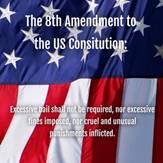
  • Furthermore, on a hot mic at that same news conference, Trump said to the El Salvador President/Dictator, “The homegrowns are next. You gotta build about five more places.” They were both enjoying the moment and laughing. “Home-grown” means US-born. And the US Vice President, the US Secretary of State, and the US Attorney General were complicit in their silence. No US President has ever voiced a desire to send American citizens to prisons in another country. The way Trump throws around threats that many individuals and groups should be “locked up,” we are left to understand that he now plans or at the least contemplates sending anyone he considers to be a criminal to a prison in another country. Make no mistake: Trump’s words were aimed at any American citizen who dares to disagree with him or criticize him. Don’t take Trump at his word, look into his intent. Don’t make excuses for him. Don’t kid yourself. We no longer have a normal Executive Branch in the US Government. Trump’s words yesterday were in direct conflict with the “cruel and unusual punishments inflicted” phrase in the Eighth Amendment to the US Constitution and were chilling on multiple levels.
  • Do you know why Trump has found a new ally and friend in President Nayib Bukele? Bukele “is the iron-fisted president of El Salvador (2019– ), who has unabashedly styled himself as the “world’s coolest dictator” and the country’s “philosopher king.” (https://www.britannica.com/biography/Nayib-Bukele)
  • On Sunday night, Trump jumped on social media and pretty much ordered the Federal Communications Commission to go after CBS because he did not like the news segments on “60 Minutes” that night about Ukraine and Greenland. Quoting from Trump’s post, “Hopefully, the Federal Communications Commission (FCC), as headed by its Highly Respected Chairman, Brendan Carr, will impose the maximum fines and punishment, which is substantial, for their unlawful and illegal behavior.” He said CBS should lose its license. I watched the segment about Ukraine. Scott Pelley, interviewed President Zelensky of Ukraine. As an American citizen, it looked like an excellent and honest interview in which Zelensky invited Trump to visit Ukraine and go wherever he wanted to in the country and see for himself the condition in which the country is. Zelensky said that Russia invaded Ukraine – which the whole world knows is true – but apparently, Trump can’t tolerate anyone saying anything negative about his buddy in Moscow. (And, no, Mr. Trump… Russia’s bombing of Sumy, Ukraine on Palm Sunday morning was not an accident.) Threats to revoke FCC broadcast licenses is Step One, my friends, of Donald Trump shutting down the free press in the United States of America. He ended his Sunday night social media rant with the words, “Make America Great Again!” in all caps. In yesterday’s press conference, Trump lashed out at CNN’s Kaitlin Collins as follows: “You said if the Supreme Court said someone needed to be returned, you’d abide by that,” Collins reminded him. Trump cut her off and it looked like he wasn’t going to address her question, but then he said, “Why don’t you just say, ‘Isn’t it wonderful that we’re keeping criminals out of our county? That’s why nobody watches you anymore.” You have no credibility.” The truth of the matter is that Kaitlin Collins is not afraid of Donald Trump. He is afraid of her because someone deep down he knows she does her research, she knows the US Constitution, and she will fight for freedom of the press with her last breath. His total disdain for the First Amendment to the US Constitution could not be more obvious. His total disdain for the First Amendment to the US Constitution could not be more obvious.
  • The Wall Street Journal reported on April 11, 2025, that the Trump Administration spent $154 billion more since the inauguration on January 20 than the Biden Administration spent in the same period last year.
  • Colonel Susannah Meyers, commander of the US Pituffik Space Base in Greenland was fired after not sharing Vice President J.D. Vance’s enthusiasm for the United States taking control of Greenland. She made the mistake of telling Vance that a US takeover did not reflect the community.
  • In my blog on Saturday, I wrote about my concerns about the Trump Administration declaring 6,100 living immigrants in the Social Security database as being dead. Another new bit of news about the Social Security Administration (SSA) is the announcement on Thursday that it will be making all announcements in the future on X instead of via press releases or announcements on its website. This, coupled with the recent announcement that many local SSA offices are closing and business cannot be conducted via phone means X is just one more roadblock for people needing SSA services. I’m going out on a limb, but I think most people on Social Security are not on X. Those of us who used to be on Twitter cancelled our accounts when Elon Musk bought Twitter and changed the name to X – and we aren’t going back!
  • The new image of Trump was hung in a prominent place in the White House – a place traditionally reserved for portraits of the immediate past President. President Obama’s portrait was taken down and hung elsewhere, but instead of a portrait of President Biden being hung in its place, a rendition of a campaign image of Trump was put up. It’s a defiant, angry image of Trump with his fist in the air. Can anyone say, “Petty?” Can anyone say, “Tacky” in the truest Southern US sense of the word?
  • Stocks and Bonds out-of-whack. Stocks were up a little on Friday, April 11, but US Treasury Bonds were down. With the stock market losing in general and causing investors to wonder what the future holds, one would think they would be turning to the more stable bond market. But that’s not what was happening on Friday. When investors and other countries are hesitant to purchase US Treasury Bonds, that sent up a red flag that economic instability might be worse than we thought, if that’s possible. However, on Friday afternoon as Trump flew to Florida for yet another golf weekend, the 27-year-old blond ever-cheerful and perky cross-necklace-wearing White House Pres Secretary Karoline Leavitt enthusiastically encouraged reporters in the White House Press Room to, “Trust President Trump. He knows what he’s doing.” You can’t make this stuff up.
  • US Secretary of State Marco Rubio sent a memo to every US Embassy in the world instructing State Department employees to report their colleagues for any instances of “anti-Christian bias.” It is reported that accusations of such bias can be made anonymously, but they should be as detailed as possible. Trump created a task force by Executive Order in February to not only hunt down anti-religious bias in his Administration but also in the Biden Administration, so why did the Rubio memo specify “anti-Christian bias?” Call me a left-wing lunatic, but I think this smacks of fascism. Rubio is the son of immigrants from Cuba, and this is the way he thanks America?
  • The Associated Press reports that, “Some journalists are reporting that Trump Administration officials are refusing to engage with reporters who list their pronouns in their signature.” The New York Times reports that one reporter’s email received the following response from White House Press Secretary Karoline Leavitt: “As a matter of policy, we do not respond to reporters with pronouns in their bios.”
  • On Thursday, April 10, 2025, the US House of Representatives passed the SAVE Act. That Act, if also passed by the Senate, will require proof of citizenship for voter registration. Republicans (and, apparently, four rogue Democrats in the US House) just cannot get it through their heads or hearts that millions of noncitizens are voting, so they had to come up with a hardnosed solution to a problem that does not exist. On the face of it, it does not sound that oppressive. One way to prove citizenship is to produce your birth certificate; however, that birth certificate must be in your current legal name. If you are a woman who took your husband’s surname when you got married, your birth certificate is no longer proof of your citizenship. Your only saving grace is your passport. You can’t afford $130 for a passport? Too bad! The Republicans want to take us back to “the good old days” prior to 1920 when women could not vote in the United States. One might not be able to prove that the SAVE Act is unconstitutional because it does not include words like “sex,” “women,” or “female,” but it is definitely in opposition to the spirit of the 19th Amendment. How can it be interpreted otherwise when it is women who traditionally take their husband’s surname in the US? Voter suppression, plain and simple, under the guise of preventing non-citizens from voting.
  • While we are on the topic of voting… President Trump’s Director of National Intelligence, Tulsi Gabbard, voted in Hawaii last November even though she had sworn last June that her legal state of residence was Texas so she and her husband could take advantage of a homestead tax exemption in Texas. The excuse her office gave: she was trying to shield her address from public view for security reasons. Even if that is true, it did not make it legal for her to cast her vote in Hawaii. Can anyone say, “Voter Fraud?”
  • In my April 11, 2025, blog post, I expressed concern over the fact that 17 of the 300 student visas revoked by Secretary of State Marco Rubio were from four universities in North Carolina. It came to light on CNN on Saturday that the actual number is 525, but that number doesn’t make me feel any better. If the 525 figure is to be believed, that means three percent of them are from just four universities in North Carolina. Can that be possible? And if that is correct, why are North Carolina universities being targeted? Secretary Rubio sat in the Cabinet meeting on Friday and said they were only giving the boot to international students who came to America to “vandalize libraries,” but that couldn’t be further from the truth. First of all, the Trump Administration has already shown its disdain for libraries in his Executive Order a couple of weeks ago ordering the Institute of Museum and Library Services to be “eliminated to the maximum extent consistent with applicable law.” Second of all, it looks like any international student is at risk of being sent back home, which short-term and long-term will be a brain-drain and tragedy for the United States and for those individual students. But then on Sunday I learned that a student at Appalachian State University has been added to the list of international students in North Carolina whose visas have been revoked. Counting the Duke University alumnus and an alumnus on Optional Practical Training that’s 18 students at five universities in NC alone. In a TV interview on Sunday, Congressman Robert Garcia of California, who serves on the Homeland Security Committee, said the total number now is more than 800. The Trump Administration needs to come clean about the numbers and the fact that most of these students are being kicked out of the United States for only one reason:  they are from another country. That is horrible, anti-education, and anti-American. It is also a hallmark of a Fascist regime. But any government that can declare living immigrants to be dead can kick foreign students out of the country for no reason – many of them just a couple of weeks before the end of a semester and graduation for some of them. That’s cruel, plain and simple. All under the guise of stamping out anti-semitism. Nothing could be further from the truth and anyone with common sense knows it. Thank you, Harvard University, for not caving in to the façade.

I will blog about more such happenings in America tomorrow.
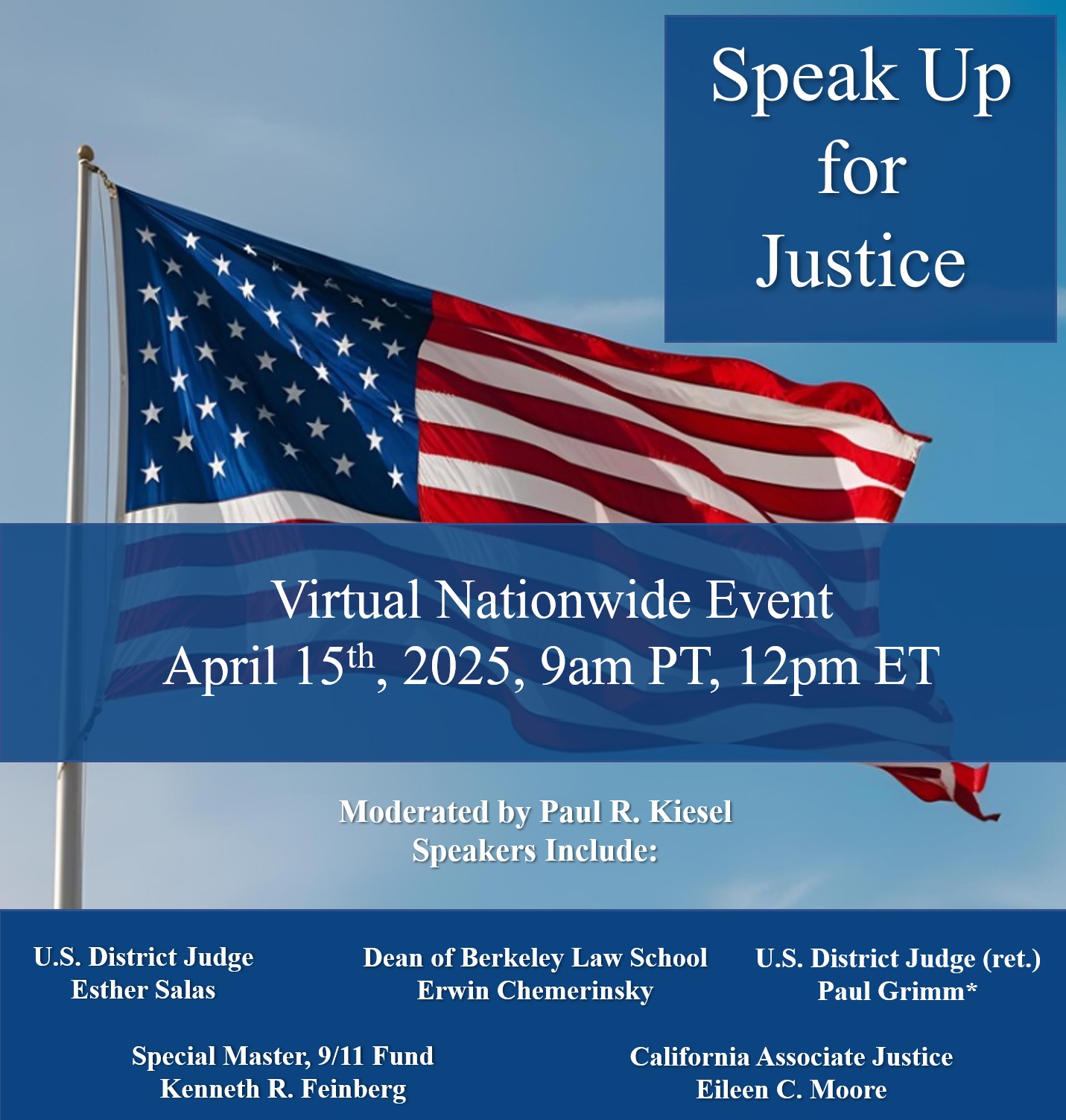
Reminder: Go to https://speakupforjustice.law for more information and to register for the 12:00 Noon Eastern Time “Speak Up For Justice” event on Zoom. In part, the website states, “The Speak Up For Justice event seeks to bring the country together to voice support for the judiciary at a time when it is under unprecedented attack.”

Janet

Two US Supreme Court Rulings in 1898 and 2025

There is so much we can learn from history! Today’s headlines often mirror events that happened years ago.

You get a bonus blog post from me this week. As I explained yesterday, what I wanted to say this week amounted to more than anyone wants to read in one sitting.

Today’s post is about a couple of US Supreme Court rulings. Tomorrow’s post is about Hurricane Helene recovery in western North Carolina six months after the storm

United States v. Wong Kim Ark, 1898

My sister made me aware of the United States v. Wong Kim Ark US Supreme Court case. This ruling about American birthright came down in 1898.

The 14th Amendment was ratified on July 9, 1868 – 30 years before the Wong Kim Ark case. The wording of the 14th Amendment seems straightforward, but our current US President wants to do away with it.

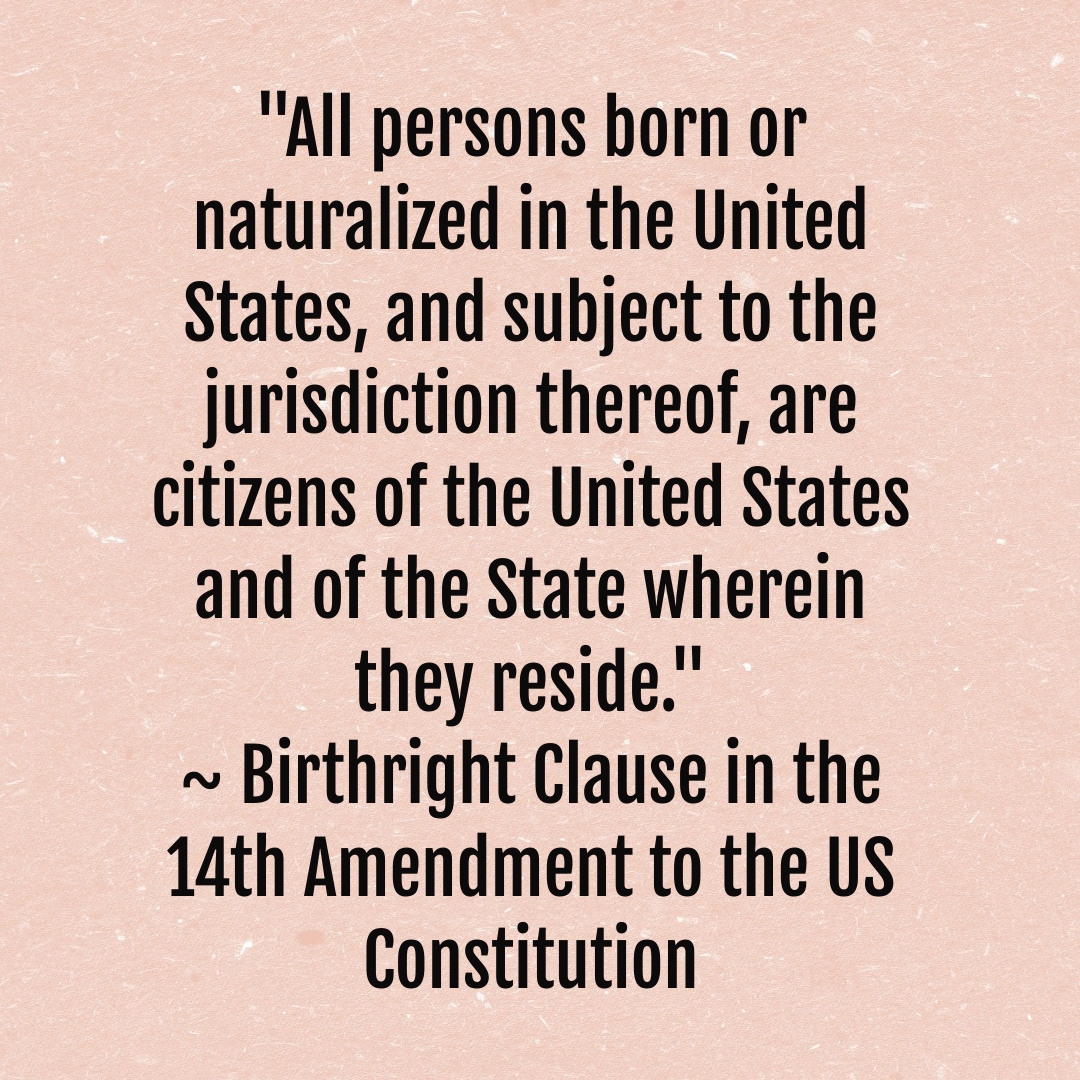
The first clause of the 14th Amendment to the US Constitution reads as follows: “All persons born or naturalized in the United States, and subject to the jurisdiction thereof, are citizens of the United States and of the State wherein they reside.”

Let’s take a step back and see what prompted Mr. Wong Kim Ark to take his complaint all the way to the US Supreme Court.

Who was Wong Kim Ark and what was this Court Case about?

Wong Kim Ark was born in San Francisco, California in 1873. His parents were subjects of the Emperor of China but were permanently residing in the United States. The family still lived in San Francisco in 1890 when Wong Kim Ark took a trip to China.

He returned to his home in San Francisco on July 26, 1890. He lived there and worked as a laborer as a US citizen. In 1894 he took another trip to China but, when he returned to the US in August 1895, he was denied entry on the grounds that he was not a US citizen.

A lower court ordered him to be released because he was a US citizen. The United States appealed the lower court’s decision, and the case went to the US Supreme Court.

Justice Horace Gray delivered for the majority in the 6-2 ruling by the US Supreme Court. In his statement he indicated that the Chinese Exclusion Act of 1882 had no relevance in this case.

The Chinese Exclusion Act was the first law of any significance that limited immigration into the United States. The Act was the result of violent acts committed against Chinese workers. It prohibited Chinese laborers from entering the US for ten years. Exceptions included merchants, teachers, students, travelers, and diplomats.

Justice Gray wrote, “It is conceded that, if he is a citizen of the United States, the acts of Congress, known as the Chinese Exclusion Acts, prohibiting persons of the Chinese race, and especially Chinese laborers, from coming into the United States, do not and cannot apply to him.”

As in most cases that reach the level of the US Supreme Court, there is more here than meets the eye. Having taken one Constitutional Law course in college does not qualify me as a Constitutional scholar, so I’ll just leave it at that.

If you wish to delve more deeply into the United States v. Wong Kim Ark decision, you may do so. I just found it serendipitous that the anniversary of this case fell during a time when the 14th Amendment to the US Constitution is under fire.

Why is the 14th Amendment under attack by Trump?

It is obvious that the president does not want children of undocumented Hispanic immigrants who are born in the US to automatically have US citizenship as guaranteed by the 14th Amendment.

The White House appears to be arguing its case on https://www.whitehouse.gov/presidential-actions/2025/01/protecting-the-meaning-and-value-of-american-citizenship/. It seems short-sighted to me for Trump to “show his hand” on this matter since it is destined to go before the US Supreme Court if he insists on pursuing his contempt for the 14th Amendment.

We have not heard the last of this.

A March 5, 2025 US Supreme Court ruling to consider

On March 5, 2025, we saw only five of the nine US Supreme Court Justices vote that the United States should be required to honor its promises of $2 billion in foreign aid through the now-possibly-defunct United States Agency for International Development (USAID). The slim majority decision gave me a sigh of relief but immediately angered me because the vote should have been 9-0.

Photo by Isak Engström on Unsplash

What is it in the life experiences of Associate Justices Alito, Kavanaugh, Thomas, and Gorsuch that influenced them to vote in the negative? What made those four men believe that funds authorized by the US Congress and promised to other countries and organizations should not be honored? Should not be paid?

What makes those four men think the United States should not be a country of its word? I really want to know.

Justice Alito argued in an eight-page dissent that resembled a pro-MAGA social media post that a US District Court Judge could not compel the US Government to spend money authorized by Congress. He essentially went after Judge Amir Ali, the lower court judge who had ruled in the case.

From what I have read, I think his anger is misplaced. It is the US Constitution that gives Congress the authority to allocate money. If Mr. Alito has a problem with that, perhaps he should have stated his disfavor with the Constitution instead of against Judge Amir Ali.

I certainly hope Justice Alito was not lashing out at Judge Ali because Judge Ali was born in Canada. I hope he wasn’t lashing out at Judge Ali because he was appointed by President Joe Biden. And I certainly hope he wasn’t lashing out at Judge Ali because he is a Muslim.

Perhaps I’m looking for a “there” when there’s no “there” there, but the current US Supreme Court in general seems to be in Trump’s pocket. This is the same group of Justices that ruled in 2024 that nothing a US President does is illegal.

I pray we haven’t heard the last of this!


Arlington National Cemetery

With so much going on, and a couple of long blog posts in March, I waited until today to mention how the US Department of Defense is erasing history specifically on the Arlington National Cemetery website. US history seems to be in Trump’s cross-hairs.

Under the heading, “Arlington National Cemetery removed links to webpages about Black, Hispanic and female veterans,” Snopes.com (published March 14, 2025; updated March 15, 2025) verified that the following links have been removed from the Arlington National Cemetery website:

          African American History, removed from the Notable Graves subsection;

          Hispanic American History, removed from the Notable Graves subsection;

          Women’s History, removed from the Notable Graves subsection;

          African American History, removed from the Themes drop-down menu of the Education section; and

          Civil War, removed from the Themes drop-down menu of the Education section.

This should be no surprise, since Trump has called veterans suckers and losers.


The latest US Department of Defense blunder

It seems to me that our Department of Defense (DoD) needs to spend less time erasing history and more time holding top secret war plans in a secure location (which until the Trump Administration was the policy) and much less time holding top secret war plan meetings via text messages.

Thank you, Jeffrey Goldberg, editor-in-chief of The Atlantic magazine, for being a true patriot and not leaking the plans for the United States bombing the Houthis in Yemen last week. Leaking the plans that you were texted would have put US military personnel is grave danger. Were you included on the text list by mistake, or is there someone in the DoD who wanted this information leaked to a journalist?

I wonder who DoD Secretary Hegseth will text top secret information to next.


Until my next blog post

I hope you have a good book to read.

Hold your family close.

Remember the people of Ukraine and western North Carolina.

Janet

The Importance of Marbury v. Madison Today

This is a timely anniversary date that landed in my lap!

The US Supreme Court heard the arguments for the Marbury v. Madison case on February 11, 1803, and handed down its decision 222 years ago today on February 24, 1803. That’s a quick turn around compared to today’s Supreme Court!

A photo of the US Supreme Court building.
The US Supreme Court Building.
(Photo by Tim Mossholder on Unsplash.)

It isn’t often that one hears a reference made to this US Supreme Court case, but a news commentator on TV mentioned it just 11 days ago and another one mentioned it four or five days ago. I chose Marbury v. Madison for today’s blog post when I created my 2025 editorial calendar last year. Talk about serendipity! Little did I know last fall what a place we would be politically today.

In a nutshell, Marbury v. Madison established the right of the courts to determine constitutionality of the actions of the Executive and Legislative branches of government in the United States.

The three branches of the federal government are equal; however, the Judicial branch has the authority to rein in the other two branches when they take actions deemed to be in conflict with the United States Constitution.

Photo of a top spinning in perfect balance.
And image of what balance looks like. (Photo by Christophe Hautier
on Unsplash.)

Until January 20, 2025, I took Marbury v. Madison for granted. I will never take it for granted again.

When I started writing today’s post a week ago, I copied what the National Archives website said about Marbury v. Madison and saved it as a Word document in case the National Archives website disappeared. (The USAID website disappeared for a while before being moved to the US State Department website. Incidentally, as I wrote this paragraph on Friday afternoon, a judge ruled that the Trump Administration can proceed to dismantle USAID.) Trump fired the National Archivist about 10 days ago. We historians fear that he or Elon will torch the National Archives. That’s one way to erase history, but I digress. (It is a real fear, though.)

Back to Marbury v. Madison

Quoting the National Archives website (https://www.archives.gov/milestone-documents/marbury-v-madison) because I cannot state the case’s background any better: “In 1801, outgoing President John Adams had issued William Marbury a commission as justice of the peace — but the new Secretary of State, James Madison, refused to deliver it. Marbury then sued to obtain it. With his decision in Marbury v. Madison, Chief Justice John Marshall established the principle of judicial review, an important addition to the system of “checks and balances” created to prevent any one branch of the Federal Government from becoming too powerful.”

Photo of the National Archives building in Washington, DC
US National Archives, Washington, DC. (Photo by Juliana Uribbe on Unsplash.)

Also, quoting from the National Archives website: “‘A Law repugnant to the Constitution is void.’ With these words written by Chief Justice Marshall, the Supreme Court for the first time declared unconstitutional a law passed by Congress and signed by the President.”

I think some folks living and working on Pennsylvania Avenue in Washington, D.C. need to read up on this. We now have a US President who wrote on social media nine days ago, “He who saves his Country does not violate any Law.” It’s up for debate whether he is doing anything to save our country, but the frightening thing is that he has put in writing that he is above the law.

He also said that when it comes to agencies of the Executive Branch only he and the US Attorney General can interpret laws. That might be in conflict with the principle established by Marbury v. Madison.

It is the US Supreme Court that will ultimately decide if the US President does anything that is unconstitutional.

The US Constitution gave the President the power to veto an act of Congress and appoint federal judges with the advice and consent of the US Senate, and it gave Congress the power to impeach the President or a judge. The powers of the Supreme Court were not spelled out in such detail. When Marbury v. Madison came along in 1803, Chief Justice Marshall – who strongly believed that the Supreme Court was equal in power to the Executive and Legislative branches – led the court in seizing the opportunity to establish the principle of Judicial Review.

The US Supreme Court’s authority to declare federal or state laws unconstitutional has never been seriously challenged. I hope that will still be true in 2029.

In case you’re wondering what happened to William Marbury…

With the decision made in the Marbury v. Madison case, the Secretary of State was directed to deliver to William Marbury his commission as a justice of the peace for the county of Washington, in the District of Columbia.

In the big scheme of things, I wonder if the parties involved in this case had any idea going into it that it was destined to be a landmark decision.

In conclusion

I still have freedom of speech and I will continue to use my blog as a platform to share my opinions and my research into the US. Constitution. Those of you who have been reading my blog for more than 10 years know that is nothing new. I just feel more compelled now to blog about the US Constitution.

The words of the preamble to the US Constitution with a slightly blurred image of the American flag in the background.
Preamble to the Constitution of the United States of America

My college major was political science, and I regret that I only took one Constitutional Law course. In fact, I was so intimidated by the subject that I procrastinated taking the required course until my final quarter. (The university was on the quarter system then instead of the semester system.)

As it turned out, the course was fascinating and I wished I’d taken it earlier so I would have had time to take more constitutional law courses. I readily admit that one constitutional law course does not a constitutional law expert make, but I’m trying to shine a light on the document.


Hurricane Helene Update

As of Friday, 155 roads in North Carolina are still closed due to Hurricane Helene, including Interstate 40 near the Tennessee line. That is a decrease of 14 in the last week, inspite of snow and some sub-zero wind chills. This week’s count consists of 1 interstate highway (I-40), 11 US highways, 17 state highways, and 126 state roads. (To give some perspective, it has now been five months since the hurricane.)

I failed to report in last Monday’s blog post that Eric Church’s foundation, Chief
Cares, has purchased land in Avery County, NC and hopes to place 40 modular homes to house families that lost their homes due to Hurricane Helene. A road must be built and water and sewer lines installed. Church and his foundation hope to secure land in adjoining counties so they can provide more housing for hurricane victims. Church and fellow-country music singer Luke Combs organized and spearheaded a concert at Bank of America Stadium in Charlotte last October to raise money for hurricane relief.

The work of Brother Wolf Animal Rescue and The 21st Century Packhorse Librarian continue and will appreciate your support for the foreseeable future.

Jake Jarvis of Precision Grading in Saluda continues to work in the area every day free-of-charge with his heavy earth-moving equipment. He has built bridges, reconstructed driveways and private roads, and excavated places for homes to be rebuilt. The last couple of weeks have been challenging due to ice, snow, and high winds.


Until my next blog post

I hope you have a good book to read. Next Monday I plan to blog about the books I’ve read in February.

Value your freedoms, family, and friends.

Remember the people of Ukraine and western North Carolina.

Janet

#OnThisDay: Gideon v. Wainwright

I should have kept my notes from studying the Gideon v. Wainwright US Supreme Court case when I took Constitutional Law as a senior political science major in college. Fifty years later, I remembered the Gideon case as the one that gave individuals charged with a crime in the United States the right to legal counsel, but I was more than a little fuzzy on the details. Hence, today’s post necessitated my doing some research.

Who was Wainwright?

Louie L. Wainwright was the Secretary of Florida Department of Corrections from 1962 to 1967.

Who was Gideon?

Clarence Earl Gideon had an eighth-grade education. He reportedly ran away from home while a middle school student. He was no stranger to the law throughout his life as he was jailed or in prison more than once for committing nonviolent crimes.

So how in the world did his name get attached to a landmark US Supreme Court case in 1963?

Photo by Jon Tyson on Unsplash

Earlier charges against Gideon bear no bearing on the Gideon v. Wainwright case. The pertinent background facts in the determination of this case are as follows:

Gideon was charged with breaking and entering with intent to commit a misdemeanor after allegedly breaking into a pool hall in Panama City, Florida in June 1961 with intent to commit a misdemeanor. At that time (I do not know the current Florida laws) that charge constituted a felony. Gideon asked the judge in that case to appoint legal counsel from him because he could not afford an attorney. Florida law only permitted for free legal counsel in capital offense cases at that time.

After the judge was forced under state law to deny Gideon’s request, Gideon represented himself in the trial. Despite doing a commendable job considering his education and background, he was found guilty and sentenced to five years in prison.

On the grounds of his constitutional rights having been violated, Gideon filed a petition with the Florida Supreme Court. The state court denied the petition.

Against all odds, Gideon then filed a handwritten petition with the United States Supreme Court and the justices agreed to hear the case. What Gideon was calling into question was the interpretation of the last clause in the Sixth Amendment to the US Constitution.

The Sixth Amendment was ratified with the following wording in 1791 and has never been amended:

“In all criminal prosecutions, the accused shall enjoy the right to a speedy and public trial, by an impartial jury of the State and district wherein the crime shall have been committed, which district shall have been previously ascertained by law, and to be informed of the nature and cause of the accusation; to be confronted with the witnesses against him; to have compulsory process for obtaining witnesses in his favor, and to have the Assistance of Counsel for his defence.”

The US Supreme Court agreed to hear Gideon’s case in part to determine if the 1942 Betts v. Brady case should be reconsidered. In Betts v. Brady, the US Supreme Court had ruled that persons charged with a felony in a State Court was not guaranteed legal counsel under the Due Process Clause of the Fourteenth Amendment.

The Outcome of Gideon v. Wainwright

The US Supreme Court unanimously overturned the Betts v. Brady decision. The Court found the Court had ignored precedent set by Powell v. Alabama (1932) when it decided Betts v. Brady.

Justice Hugo Lafayette Black wrote the opinion for the Court. In part, he stated that “reason and reflection require us to recognize that in our adversary system of criminal justice, any person hauled into court, who is too poor to hire a lawyer, cannot be assured a fair trial unless counsel is provided for him.”

Justice Black went on to say that the ideal of a fair trial cannot be met if a poor defendant is not granted the right of legal counsel.

Therefore, today we have the perseverance of Clarence Earl Gideon and a decision by the US Supreme Court 61 years ago today on March 18, 1963 for the right individuals in the United States have to free legal counsel to defend them in-person in a trial whether it be in a state or federal district case, if they cannot afford to hire an attorney.

Being in the Bill of Rights, the right to a fair trial is fundamental in the United States. This is a right people in such countries as Russia, China, and North Korea cannot imagine.

Remember that when you vote in November.

Until my next blog post

I hope you have at least one good book to read this week.

Don’t forget to visit https://www.janetmorrisonbooks.com to subscribe to my e-newsletter and to read about the books and short stories I have written.

Remember the people of Ukraine, Gaza, and all the other places in the world where innocent people are suffering.

You and I do not have to agree on politics but, at least for now, I am free to state my opinions. I hope you are free to state yours.

Janet

#OnThisDay: Miranda v Arizona, 1966

It was just a month ago that I blogged about the 1954 US Supreme Court landmark decision, Brown v Board of Education of Topeka. I referred to the fact that our legal framework is under attack by the current sitting US Supreme Court. I fear the overturning of Roe v Wade will be just the tip of the iceberg. Time will tell.

Americans now know that we cannot take any of our freedoms for granted. The Trump-inspired insurrectionists’ attack on the US Capitol on June 6, 2021 surely taught most of us that, if nothing else.

“Miranda Rights”

One of the assurances we have in the United States stems from a landmark decision issued by the US Supreme Court on this date in 1966: Miranda v Arizona. I’m sure you’ve heard of “Miranda Rights” if you watch any police procedural television series set in the United States.  

Photo credit: Logan Weaver on unsplash.com

Since the Miranda v Arizona decision, “you have the right to remain silent…” when being arrested. I’ve never been arrested, and I hope I never will be. You never know, though, when something like that might happen. Many people are falsely accused and arrested due to that or by cases of mistaken identity or are falsely singled out due to the color of their skin or for having the same name as someone for whom there is an arrest warrant. That last one can happen to anyone.

If you’re ever arrested in the United States of America – rightly or wrongly – you’ll be glad that on June 13, 1966, the US Supreme Court proclaimed that you must be informed of your rights by the arresting police officer. You have the right to remain silent. If you relinquish that right, anything you say can be held against you in a court of law. You have a right to legal counsel – either a lawyer you hire or one appointed for you by the court if you cannot afford to hire one yourself.

Miranda v Arizona was decided by a 6 to 3 majority of the US Supreme Court. The majority ruled based on the 5th Amendment to the US Constitution. Dissenting justices argued that the law wasn’t necessary and that police officers inclined to conduct questionable interrogations would just ignore the decision.

I think most Americans know enough about the law now that they are aware that they “have the right to remain silent” and that they “have a right to legal counsel.” An informed citizenry will help keep police officers with questionable motives and tactics in check. Of course, there are always exceptions to the rule. My black friends can attest to that.

The original Miranda Case

In a nutshell, Ernesto Miranda was convicted after confessing under police interrogation that he was guilty of kidnapping, rape, and armed robbery. The conviction was overturned by the Miranda v Arizona US Supreme Court decision. Mr. Miranda was tried again, convicted, and sentenced to 20-30 years in prison.

Seeing Miranda v Arizona in action

I served on a jury in my county’s Superior Court in the 1970s. The case before us was a child neglect matter due to a mother keeping her children out of school based on a religious belief that the world was going to come to an end on a specific date in the near future.

The mother’s reasoning was that her children didn’t need an education, since the world was going to end in a few months. It appeared to be an open-and-shut case until the woman’s attorney informed the judge that his client hadn’t been read her Miranda Rights. The case was immediately dismissed.

Since my last blog post

I had the privilege of watching and listening to four free webinars offered by Chad R. Allen. He offered lots of useful information about book publishing and, specifically, how to write a successful book proposal.

I also watched and listened to a free webinar by Geoff Affleck about how to advertise on Amazon.

Until my next blog post

Keep reading! I hope you have a good book to read this week.

Make time to enjoy a hobby.

Remember the people of Ukraine and Uvalde, Texas.

Janet

#OnThisDay: Brown v Board of Education of Topeka, 1954

The recent “leak” that the United States Supreme Court is on track to abolish the 1973 landmark decision Roe v Wade should stand as a wake-up call to all Americans.

Even a 49-year-old Supreme Court decision that has stood the test of time and numerous challenges, can be undone by five Supreme Court Associate Justices who claimed under oath before Congress that they had no intention of voting to undo that 1973 Court decision.

This begs the question, “What comes next? What other US Supreme Court decisions will be wiped away by this Court which was “stacked” by our former president and the radical “right” in Congress?

If I just “stepped on your toes,” so be it.

Brown v Board of Education of Topeka, 1954

This brings me to the topic of today’s blog post, which I chose months ago because it is the anniversary of another landmark US Supreme Court decision, Brown v Board of Education of Topeka. It was 68 years ago today that the Court published its unanimous decision on that case, which made it illegal to have separate public school systems based on race.

Photo credit: CDC on unspash.com

Until Brown v Board of Education of Topeka, it was legal for states to have “separate but equal” school systems for the different races. Everyone knew there was nothing equal about them, but they were legal in the eyes of the law.

The Brown v Board of Education of Topeka decision overturned the 1896 US Supreme Court case, Plessy v Ferguson. Plessy v Ferguson is proof that the US Supreme Court can make terrible mistakes. That decision ruled that having “separate but equal” school systems for each racial group was all right, and now it was deemed legal under the U.S. Constitution.

I grew up in the racially-segregated South. Before you get too puffed up about being from one of the other sections of the United States, though, take a moment to consider your childhood. Segregation might not have been mandated where you lived, but were your community and schools racially-integrated prior to the 1960s?

In a recent conversation with a friend from the Midwest, I said that our public schools here in Cabarrus County, NC were integrated when I was in the seventh grade. That was 1965. The person I was talking to made an interesting remark: “I lived in a non-segregated state, but I didn’t go to school with black students until high school. I lived in a farming community and there just weren’t any black people.”

Since I also grew up in a farming community, I found it strange that there weren’t a mix of white people and black people where she grew up. It was interesting to hear her perspective on the issue.

To our more-enlightened 21st century minds, it seems ridiculous that prior to Brown v Board of Education of Topeka it was legal to have racially-segregated public school systems. Since I was born in 1953, 1954 doesn’t seem very long ago. (Please stop rolling your eyes. If you don’t already understand, you will someday.)

The dual school systems didn’t disappear overnight – not by long shot. They continued here in Cabarrus County until the beginning of the 1966-67 school year. The previous school year, students had the option of attending the school not designated for their race. Few students chose to do that. For instance, in the previously all-white school of 1,000 students that I attended, only three black students chose to enroll in 1965. Looking back on it, I can’t imagine the courage it took for them to do so.

The following school year, the previously all-black schools in the county were closed. The buildings weren’t even used! I believe that’s proof in and of itself that the school board members knew that previously all-black schools weren’t on par with the previously all-white schools. Or, perhaps they knew that most white parents wouldn’t want their children assigned to those previously all-black schools. They carried a stigma which was based on racial bias and a deep-seated prejudice.

What a luxury the school board had then to let school buildings sit empty. It was just a couple of years before the county’s population started growing so fast that the school board was never again able to build schools fast enough to keep up.

The mid-1960s were volatile years as school desegregation took place. Southern states were held up by the national media as a backward place where white people resented black people and wanted their schools kept separate. That’s what we were told and we didn’t know any better until race riots broke out in Boston in September 1974 when the public schools there were ordered to desegregate.

In conclusion

In light of this history and what I read last week in Viola Davis’ memoir, Finding Me, I’m left to conclude that people everywhere are prejudiced against people who don’t look like they do.

We see racial profiling and discrimination all over the United States. Housing redlining takes place every day as mortgage lenders find ways to disguise such practices which limits where people of color can purchase homes. Every time I think this no longer takes place, investigative reporters uncover proof that I’m wrong.

I’ve come to realize that the desegregation of public schools didn’t always translate into equal opportunity. Students of all races and economic backgrounds experience different levels of support and nurture at home. Those of us who grew up in happy homes were blissfully unaware that some of our fellow students were subjected to abuse and neglect in their homes. Teachers — knowingly or unknowingly — bring their own prejudices into the classroom. So do students. It’s human nature, and it’s something we all need to be aware of as we interact with one another in our daily lives. You don’t know what the other person might be going through in his or her personal life.

Until my next blog post

I hope you have one or more good books to read this week.

Take time for a hobby, family, and friends.

Remember the people of Ukraine.

Janet

#OnThisDay: Plessy v Ferguson, 1896

I had originally considered writing about the 40th anniversary of the eruption of Mount Saint Helens today, but then I was reminded that it was on this day in 1896 that the United States Supreme Court handed down a decision that changed the course of American history. The case was Plessy v. Ferguson.

Plessy v. Ferguson was one of the cases we studied in the constitutional law class I took in college. The decision in this landmark case sanctioned segregation in the United States.

What happened after the American Civil War?

The Thirteenth, Fourteenth, and Fifteenth Amendments to the United State Constitution were intended to guarantee the civil rights of African Americans in the years after the Civil War and forevermore. Some states found ways around the intent of those amendments by instituting such things as a poll tax that many former slaves could not afford to pay and literacy tests that former slaves who had been denied an opportunity to learn to read or write couldn’t possibly pass.

The result of the poll taxes and literacy tests was the disenfranchisement of black men. (This just applied to men because women didn’t gain the right to vote until 1920.)

Racially-segregated public schools were the legal norm in some states in the post-Civil War years and into the 1960s. Narrow interpretation of the U.S. Constitution made these state laws possible.

The Louisiana Separate Car Act

The Separate Car Act took effect in Louisiana in 1890. It dictated that railway companies had to provide separate cars for blacks and whites and made it against the law for anyone of either race to enter a car designated for the other race.

Photo by Gemma Evans on Unsplash

Creole professionals in New Orleans organized the Citizens’ Committee to test the constitutionality of the Separate Car Act. They hired Albion Tourgée as legal counsel. Mr. Tourgée had a record as a reformer. They wanted to find a person of mixed race to serve as plaintiff in a test case. They maintained that the act could not be applied on a consistent basis because it did not define the “white” and “colored” races.

Who was Plessy in Plessy v Ferguson?

Homer Adolph Plessy was seven-eighths white and one-eighth African American. He bought a ticket to take the East Louisiana Railroad from New Orleans to Covington, Louisiana. He boarded a passenger car for whites. When he refused to move to a car for African Americans, he was arrested.

Mr. Plessy was found guilty and appealed the decision.

Who was Ferguson in Plessy v Ferguson?

John H. Ferguson was the judge when Mr. Plessy was tried in U.S. District Court.

Counsel for Mr. Plessy argued that the Louisiana Separate Car Act violated the Thirteenth Amendment to the U.S. Constitution – the amendment that prohibited slavery.

The Fourteenth Amendment of the U.S. Constitution states the following in section 1: “All persons born or naturalized in the United States… are citizens of the United States and of the State wherein they reside. No State shall make or enforce any law which shall abridge the privileges or immunities of citizens of the United States; nor shall any State deprive any person of life, liberty, or property, without due process of laws; nor deny to any person within its jurisdiction the equal protection of the laws.”

Counsel for Mr. Plessy argued that the Act violated this amendment because it did not provide African Americans “equal protection of the laws.” Judge Ferguson dismissed that claim, too.

The case was appealed to the Louisiana State Supreme Court where Judge Ferguson’s ruling was upheld.

Plessy v Ferguson

The U.S. Supreme Court agreed to consider the case, which was titled Plessy v Ferguson and oral arguments were heard April 13, 1896. The court’s 7 to 1 decision with one associate justice not voting, was rendered 124 years ago today on May 18, 1896.

U.S. Supreme Court Building
Photo by Bill Mason on Unsplash

The majority opinion in the case

Associate Justice Henry Billings Brown wrote for the majority. He wrote that the Louisiana Separate Car Act didn’t violate the Thirteenth Amendment because it did not reestablish slavery or servitude. He wrote that the act wasn’t in violation of the Fourteenth Amendment because the amendment only addressed the legal equality of whites and blacks and did not address social equality. Justice Brown maintained that the law in question in Louisiana provided equal cars for the two races. He backed up his statement for the court’s majority by citing various states’ courts that allowed for racially-segregated public schools. He wrote: “If one race be inferior to the other socially, the Constitution of the United States cannot put them upon the same plane.” Furthermore, he wrote that the intention of the Louisiana law in question was to preserve “public peace and good order” and was “reasonable.”

The minority opinion in the case

Associate Justice John Marshall Harlan of Kentucky, as the only dissenter, wrote in the minority statement that the majority of the Supreme Court had ignored the purpose of the Separate Car Act. To Justice Harlan, it was obvious that the purpose of the act was “under the guise of giving equal accommodation for whites and blacks, to compel the latter to keep to themselves while traveling in railroad passenger coaches.” He argued that “Our Constitution is color-blind” and does not see or tolerate citizens being divided by class. He said the act affected the free movement of both races and, therefore, violated the equal protection clause of the Fourteenth Amendment.

Stating his dissent to the decision in the strongest possible terms, Justice Harlan wrote, “in my opinion, the judgment this day rendered will, in time, prove to be quite as pernicious as the decision made by this tribunal in the Dred Scott Case.” (In the Dred Scott case in 1857, Chief Justice Roger B. Taney wrote that African Americans were not entitled to the rights guaranteed by U.S. citizenship.)

By the way, Associate Justice John Marshall Harlan came to be called “The Great Dissenter” because in the 34 years he sat on the U.S. Supreme Court (1877 until his death in 1911) he was often the dissenting voice, particularly in cases involving civil rights.

The separate but equal doctrine

Although the words, “separate but equal” do not appear in the majority or minority opinions in Plessy v Ferguson, that doctrine was a result of the case. The “separate but equal” doctrine made possible the continuation of racially-segregated public schools for decades.

The Brown v Board of Education of Topeka landmark U.S. Supreme Court case in 1954 ruled that separate but equal public schools were unconstitutional; however, in the county in which I lived in North Carolina, voluntary school integration was not instituted until 1965, and integration wasn’t mandatory until the following school year. Brown v. Board of Education of Topeka essentially overturned Plessy v Ferguson.


Since my last blog post

I’ve continued to work on a short story around the May 20, 1775 Mecklenburg Declaration of Independence.

Until my next blog post

Be safe. Be well. Be positive. Be creative and productive.

I hope you have a good book to read. I’m listening to Commonwealth, by Ann Patchett.

Let’s continue the conversation

I attended an all-white school until the seventh grade. That year, integration was optional. Only three black students attended the school of first through eighth grades. The year I was in the eighth grade, the public schools in our county were fully-integrated. Looking back on it now, I don’t know what all the fuss was about.

How about you? Did you attend a racially-segregated school? Please feel free to share your experience in the comments below and on my Facebook pages where I post my blog.

Thanks for dropping by!

Janet

Thoughts on the US Constitution

As a political science major in college, I was required to take at least one Constitutional Law course. Intimidated by the prospect of taking a law class, I put off taking Constitutional Law until my last quarter before graduation. Much to my surprise, I thoroughly enjoyed the class (except for the copious amount of reading it required) and 41 years later I still remember some of the Supreme Court cases we studied. That class, more than any other, opened my eyes to the nuances of how the US Constitution governs everything from voting rights to the classification of tomatoes as a fruit or as a vegetable in light of the Tariff Act of 1883.The current US election season and, more specifically, the present civil unrest here in Charlotte have brought the Constitution and certain our constitutional rights to mind.

constitution_pg1of4_ac
First page of the US Constitution

2016 US Presidential Election

The US Presidential campaigns this year have made me uneasy about the interpretation of the US Constitution. One political party has taken fear mongering to a new level. We in “battleground states” are bombarded by endless TV ads telling us if the other major party’s candidate is elected, she will abolish the Second Amendment. In a nutshell, that amendment assures our right to “keep and bear arms.”

US Constitution,  First Amendment

The same political party dealing in the fear mongering over the Second Amendment holds the First Amendment in contempt. The First Amendment is near and dear to my heart. It guarantees freedom of religion, freedom of speech, freedom to peaceably assemble, and freedom to  redress of grievances. The 19th Amendment, which gave women the right to vote in 1919, runs a very close second!)

US Constitution, Second Amendment

The Second Amendment gives the US Government the right to establish a military and confirms the right of a citizen to “bear arms.” I understand and appreciate the thinking behind the Second Amendment, but I believe one side of the 2016 Presidential campaign has championed it to the exclusion of the other amendments. The baseless fear mongering that, if elected, the other major party’s candidate will “take away all your guns” has reached a fever pitch. Personally, I’m more concerned that the candidate championing the Second Amendment does not see the value of the First Amendment. I believe it is the First Amendment that makes America, America. It is our rights guaranteed by the First Amendment for which citizens of many other countries envy Americans.

Protests this week in Charlotte

The riots that took place in Charlotte on Tuesday and Wednesday nights and the peaceful protests last night prompt me to reflect on the First Amendment. Rioting and destruction of property cannot be tolerated, but the right of citizens to peacefully assemble and protest must be protected. Peaceful protests can shine a spotlight on an issue and bring it to the forefront of public discussion. The prime example that comes to mind is the Civil Rights Movement of the 1960s led by the late Rev. Dr. Martin Luther King.

The protests this week in Charlotte were the result of the death of a man at the hands of the police. The protests in Charlotte have resulted in a national discussion of race relations, the inordinate number of African-American men who have been shot by police in our country, and the distrust of police held by people of color. If any good can come out of what has transpired in Charlotte this week, perhaps it will be a more open and honest conversation in America about the racial prejudices and biases most people in our country hold to varying degrees. It is through frank public discourse that we will better understand and respect one another. I pray that something good will come out of this violent, angry, and sad week. In the meantime, I anxiously await what the darkness of tonight will bring to the streets of Charlotte.

In conclusion

The US Constitution is a living, breathing document. It has been amended 27 times as our society continually reinvents itself. It is the bedrock of our government and is constantly up for debate by citizens and, ultimately, by the US Supreme Court.

The primary purpose of my blog is to shed light on my life as a writer, and I have avoided political content until today. Inasmuch as the 2016 federal and state elections just might be the most important elections of my life, I felt compelled today to post my thoughts about certain aspects of the US Constitution.

Until my next blog post in a few days, I hope you have a good book to read and productive writing time.

Janet