As we near the end of another week of governmental and stock market chaos, today I’m writing about various things happening in the United States. As I finished drafting this blog post at 7:45 last night, I hoped we would have an uneventful news evening so I wouldn’t have to edit it.
We didn’t. I could have added to it, but I chose not to. It will be published at 5:00 a.m. on April 10 without any more additions or edits. I’m sorry it is 2,400 words long. Keeping up with what the Trump Administration is doing is now a full-time job and it is exhausting.
President Trump wants $92 million four-mile long military parade from the Pentagon to the White House on his 79th birthday on June 14. It just happens to also be the 250th anniversary of the US Army and Flag Day, but we all know the real reason for the parade. He begged for one during his first term until people who had some sense told him the city streets of Washington, DC would buckle under the weight of missile launchers and such. He really, really wanted a military parade like they have in Beijing. I don’t know what will happen when he finds out his birthday falls on a Saturday this year. He’s usually in Florida playing golf every Saturday.
How many little blunders will the Executive Branch make before they get their act together? On April 3, Ukrainians who have sought legal safety here during the war in their homeland were told by the US Department of Homeland Security that they had seven days to get out of the United States. The next day they received emails telling them to disregard the earlier notice. Can you imagine the anguish they experienced overnight thinking they had to return to a war zone this week?
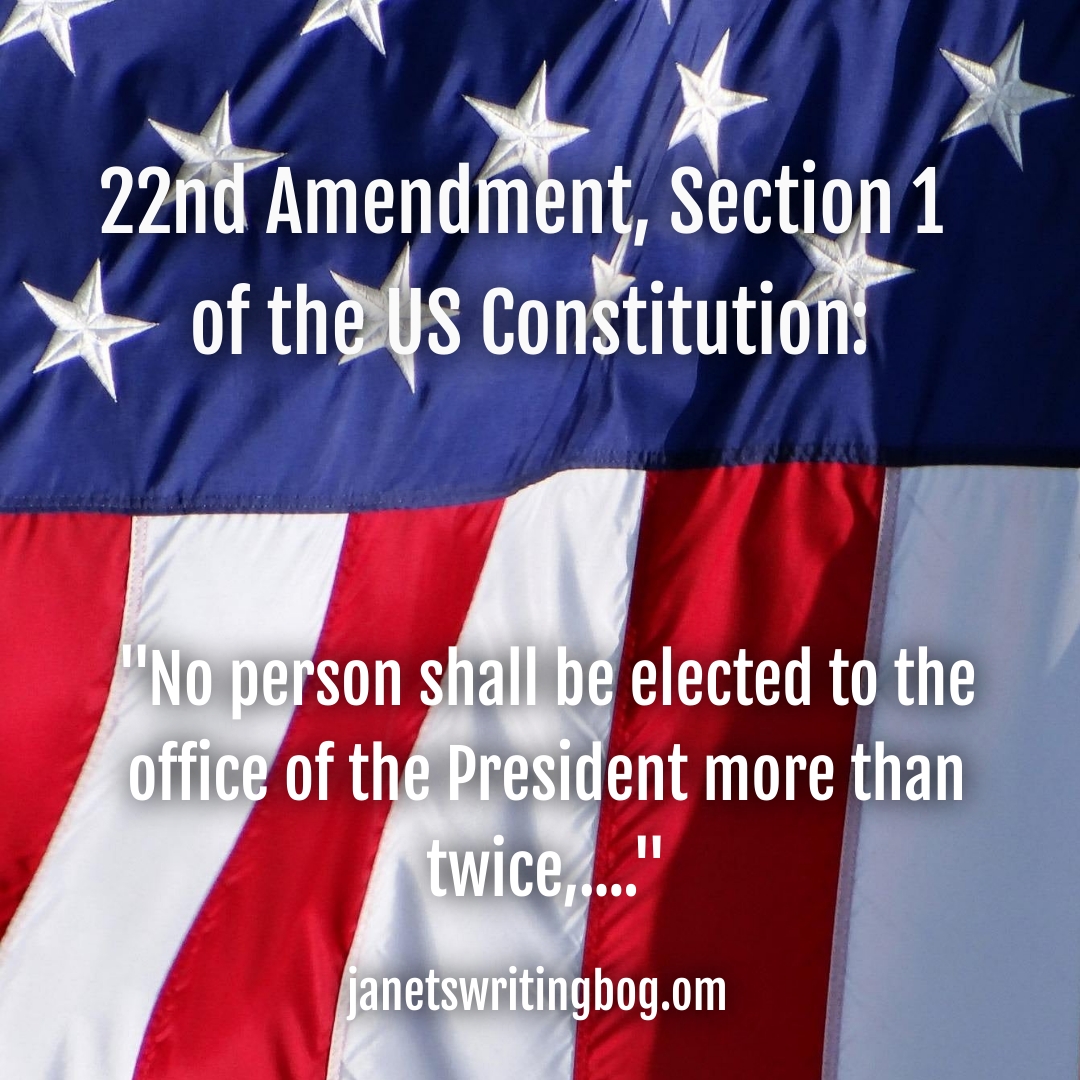
In US Senate hearings for her nomination to be US Attorney General, Pam Bondi firmly answered, “No, Senator, not unless they change the Constitution” when asked if President Trump could run for a third term; however, Forbes quoted her as saying in a Fox News interview on April 5, 2025, “We’d have to look at the Constitution” and “it would be a “heavy lift.” I’m not a Constitutional scholar and I know it is possible to repeal an Amendment (i.e. 18th Amendment about prohibition), but it seems clear to me…
Vice Adm. Shoshana Chatfield, the U.S. military representative to the NATO Military Committee in Brussels, was fired last weekend. She is at least the ninth senior US military officer to be fired by the Trump Administration, four of them being women.
After slashing National Park Service personnel numbers, Secretary of the US Interior Department Doug Burgum has ordered all national parks to remain open regardless of severe staffing shortages this summer. That’s good news for those of us hoping to visit a national park this summer and support small businesses outside the park that have had a horrible time getting back on their feet since Hurricane Helene, but not such good news for the remaining park rangers and support personnel.
With promises of selling off the timber in our national parks, I don’t know what will be left of any of them if Trump clear cuts them. Maybe he won’t, but there is no one stepping up so far to stop him. Would someone please tell him that the lumber from the northern forests in Canada is stronger wood and less likely to warp than our pine trees? That’s why we buy lumber for construction from Canada. It takes the fir trees in Canada longer to grow than in most of the US. The slower a tree grows, the stronger the wood.
And would someone please tell him how many decades it takes to grow a pine tree or a hardwood tree? He probably doesn’t know, but the worst part is that he doesn’t care. He only sees dollars signs when he sees a tree. I feel sorry for people who have no sense of a forest’s true worth. It’s not measured in dollars.
Elon Musk’s company, SpaceX, was awarded a $5.92 billion contract by the Pentagon to conduct Space Force rocket launches. No conflict of interest there!
Yesterday afternoon, US Trade Representative Jamieson Greer learned about the 90-day pause in all tariffs except those against China while he was appearing before a Congressional committee. In other words, while he was on Capitol Hill to explain his president’s tariff policies, he learned about Trump’s about-face at the same time the rest of us did.
Anyone who agreed to work for Trump should have known from history, though, exactly what level of chaos they were signing up for. All they needed to do was see how he went through top officials during his first term. To work for Trump is to have your desk anchored to a revolving door.
The National Weather Service (NWS) will no longer provide any weather alerts in any language other than English although nearly 68 million people living in the US speak a language other than English in their homes. Of course, with so many firings in the NWS, extreme weather alerts will probably soon be a thing of the past. Who needs tornado warnings anyway?
The president now takes his human resources advice from Linda Loomer, a conspiracy theorist who says the attack on the US on September 11, 2001, was “an inside job.” After a meeting with Loomer, Trump fired two top national security advisors because they weren’t loyal enough to him. He said she didn’t tell him who to fire – she just told him who to hire.
US Department of Defense Secretary Pete Hegseth said he might cut US military personnel by 90,000 because we’re turning our attention to Asia and away from Europe and we’ll rely more on technology than people in uniform.
Trump talked again about Gaza on Monday, calling it “real estate,” and casually saying “we’re” going to “own it” and the Palestinians will just be moved into other countries… other countries that are going to welcome them. Does that sound like a good plan to anybody? Just shove the people around like you’re playing chess but, if you were playing chess, you would give more thought to your moves. In Trump’s eyes, these aren’t human beings. Plain and simple.
What kind of person refers to part of another State (in this case, part of the State of Palestine) as “real estate” as if it is a parcel of land that’s for sale on the open market? Only a person who is up to no good and only looking out for himself.
In the midst of the stock market jumping all over the place and retirees seeing the value of their 401K accounts being jerked around yesterday, it was reassuring that President Trump was signing an Executive Order that removed limitation on water pressure from shower heads and household appliances. We each have priorities.
Trump saw on Monday how the stock market reacted from a rumor that he was going to lift tariffs. The market shot up for a few minutes until the Trump Administration denied that tariffs were going to be paused. On Tuesday he said a tariff pause was not being considered. Wednesday morning, he got on social media and told people to buy stock, but not just any stock. He ended his advice with “DJT.” He never does that. Those are his initials, but “DJT” is also the ticker symbol or stock symbol for his Trump Media & Technology Group Corporation. That stock opened at $15.52 per share Wednesday morning. A few hours later Trump suddenly paused all the tariffs except the 125% tariff on goods from China. DJT closed at $20.27.
On Tuesday, Trump said, “We’re making a fortune with tariffs. $2 billion a day, do you believe it? I was told $2 billion a day.” Who told him that? Probably one of his “yes men.”
As this week progressed, Trump has played with tariffs like a yo-yo. No one knows from one hour to the next where any of the tariffs stand. It’s just a game for him to play and he delights in the power he has. Americans and everyone around the world are left not being able to trust the President of the United States. There is no credibility. There is nothing to trust. There is nothing to rely on.
Irreparable damage has been done to America’s standing in the world.
As I write this at 3:15 (ET) on Wednesday afternoon, April 9, Trump is taking questions from reporters on live TV. His responses to questions go seamlessly from tariffs to gangs cutting off the fingers of people who call the police to Liberation Day to the various geniuses who work in his Administration to Joe Biden’s incompetence to other countries sending us their prisoners to the “good old days” when Trump was young and already thinking about tariffs to the need for flexibility to walls to NASCAR and Indy race “champions” to China ripping us off to people “getting yippy”….
We’re left to wonder if the people “getting yippy” are the same people he called “panicans” earlier in the week. My dictionary is inadequate.
Trump’s press conferences and speeches are “word salads” (Trump calls it “weaving”) of endless incomplete sentences and nonsensical trains of thought in which no rail car is connected to another rail car and there is no locomotive leading the way. No one knows where the train is going or why it left the station.
Update on Abrego Garcia
On April 4, a district court judge gave the Trump Administration until 11:59 p.m., Monday, April 7 to return Abrego Garcia to the US after he was mistakenly shipped off to a prison in El Salvador. Trump was so concerned about this “administrative error” that he had to fly to Florida and play golf to deal with his stress. (Forgive my sarcasm.)
The White House line maintains that Mr. Garcia is now in the custody of El Salvador and the US must honor that diplomatic principle. That seems like a lame excuse to me while at the same time Trump is literally threatening to take Greenland away from Denmark by force if he has to. Where is the diplomacy?
On April 5, the immigration lawyer fighting for Mr. Garcia was fired by Attorney General Pam Bondi because he wasn’t toeing the Trump line. In other words, he argued that there was a court order allowing Mr. Garcia to stay in the United States and he should not have been deported to a prison in El Salvador.
Later Monday afternoon, April 7, the US Supreme Court “paused” the Monday night deadline so they could take more time to consider the case.
As far as I have been able to find, that’s where Mr. Garcia’s case sits. Why does everything have to get so complicated? He was sent to El Salvador in error, and he should be returned to his wife and son in Maryland.
Trump’s Treatment of Universities & Student Visas
Add Brown, Cornell, and Northwestern to the list of universities being threatened with loss of funds if they don’t cease the Diversity, Equity, and Inclusion policies.
US Secretary of State Marco Rubio bragged that he had revoked the student visa for 300 international students in the United States. He said they were “lunatics” and that they had come to our country under false pretenses. He said they planned to do us harm. We were led to believe it was because 300 specific international students had either broken US law or posed a threat to US security
Now, we’re learning that student visas are being revoked to punish the governments of their home countries. How sad is that? How cruel to the students! For the most part, these young people have excelled in their studies and wanted the opportunity to pursue university degrees from some of the most respected institutions of higher learning in the world.
I’m beginning to wonder about the numbers. At least six visas have been revoked from students at the University of North Carolina at Charlotte, at least two from North Carolina State University at Raleigh, at least six from the University of North Carolina at Chapel Hill, and two Duke University graduate student and an alumnus on Optional Practical Training.
That’s 17 revoked student visas at just four universities in North Carolina. Why would six percent of the 300 revoked student visas target four campuses in North Carolina? Or is the total more than 300?
Weaponization of the US Justice Department
Late yesterday afternoon, Trump ordered the US Justice Department to investigate Chris Krebs and Miles Taylor. Investigate them for what? For using words? For having the audacity of thinking they had freedom to criticize the US President under the First Amendment to the US Constitution?
Chris Krebs was the director of the Cybersecurity and Infrastructure Security Agency during the first Trump Administration. Trump is accusing Krebs of being part of an effort to steal the 2020 election for Joe Biden just because Krebs repeatedly said he could find no evidence of election fraud.
Miles Taylor was chief-of-staff at the US Department of Homeland Security when he wrote an op-ed for the New York Times about the resistance he was witnessing within Trump’s first term as President. Taylor wrote that op-ed anonymously but later revealed in 2020 that he had written it. He had resigned from the Trump Administration the year before. He has written two books and has a podcast, “The Whistleblowers.” Trump is accusing Taylor of treason.
What will US Attorney General Pam Bondi do with this order? In her hearings before Congress, she said in no uncertain terms that she would not weaponize the Justice Department against Trump’s political enemies.
Two months in, what will Pam Bondi do? Will she stick by her words or will she make a farce out of her earlier words? Will she cave in to Trump’s rein of tyranny? What will the US Congress do?
What we have here is a Constitutional Crisis. It’s time for members of the US Congress and the American people to stop looking the other way. Stop thinking or saying anything about this is normal.
Who is Trump’s next target?
Until my next blog post
I apologize if I didn’t catch all my typos.
My planned blog post for tomorrow is an open letter to Trump supporters, but you’re welcome to read it, too.
I hope you have a good book to read.
Keep paying attention.
Remember the people of Kentucky, Myanmar, Ukraine, and western North Carolina.
Janet
































 Janet's Writing Blog
