I write southern historical fiction, local history, and I've written a devotional book. The two novels I'm writing are set in Virginia and the Carolinas in the 1760s. My weekly blog started out to follow my journey as a writer and a reader, but in 2025 it has been greatly expanded to include current events and politics in the United States as I see our democracy under attack from within. The political science major in me cannot sit idly by and remain silent.
Until this year, I could not imagine a world in which a hurricane could sneak up on a country. I have been blessed to grow up in a country where meteorologists tracked weather systems and, with growing precision every year, could forecast where such a storm would make landfall and how wide an area would likely experience hurricane-force or tropical storm-force wind.
With a few exceptions, with the support of the National Weather Bureau, meteorologists have been able to predict within a margin of error how much rain and the wind velocity localities can expect from a hurricane.
The Trump Administration sees no benefit in science, and that includes the work of the National Weather Bureau. If the National Weather Bureau is dismantled, we will not be much better off than the people of Galveston, Texas were in 1900.
Note: Not the hurricane that hit Galveston in 1900, of course. Photo by NASA on Unsplash
Galveston, Texas, in 1900
Galveston, Texas was a thriving city of 37,700 people in 1900. It claimed to be the “third richest city in the United States in proportion to population.” The seaport was booming. Sixty percent of the cotton grown in Texas was being exported through the port at Galveston.
Victorian mansions and public buildings were being built with elaborate architecture. The banking industry was booming. Grand social events filled the calendars of the elite citizens. All the modern conveniences of the time could be enjoyed in Galveston.
Things couldn’t have been going better!
In fact, things were going so well that residents became complacent, ignoring the fact that their city was on an island in the Gulf of Mexico and it’s highest point was just nine feet above sea level.
September 8, 1900
Although the U.S. Weather Bureau issued a hurricane warning on September 4, most Galveston residents ignored it.
Accustomed to weathering tropical storms, the residents paid little attention to the downpours of rain on the morning of September 8, 1900, even as Isaac Cline, the chief meteorologist at the Galveston Weather Bureau went door-to-door to warn people of the imminent danger. By afternoon, though, the tide was rising at an alarming rate and the wind had picked up.
By mid-afternoon, much of the city was flooded, but the worst was yet to come. It is now estimated that sustained winds reached at least 145 miles per hour that evening and there was a fifteen-foot storm surge.
When the next morning came, the sea was calm but 3,600 houses and businesses were gone. Entire blocks closest to the beach had been wiped away, and more than 6,000 people had died.
With all transportation and communication with the mainland destroyed, Galveston was cut off from the outside world for days as the survivors faced the grim task of disposing of bodies.
After burials at sea turned out to be unsatisfactory, funeral pyres were put up along the beach and bodies were burned for weeks after the storm.
After the Galveston hurricane
A seventeen-foot seawall was constructed in Galveston, which saved the city during future hurricane.
On a wider scope, the hurricane drew focus on the need for improved weather forecasting and warning systems. Weather stations were established through the Caribbean, and ships started tracking storms.
Late-20th-century and early 21st-century technological advances have made hurricane tracking and route predictions more precise, yet Mother Nature is a force stronger than any system of predictions. Even with all the various computer models that predict the path a hurricane will take, they are so large and so powerful that there is still uncertainty.
No one predicted the speed with which Hurricane Hugo would plow across South Carolina and the southern piedmont of North Carolina 200 miles inland in 1989. And no one predicted the extent of flooding and damage Hurricane Helene would do more than 500 miles inland in September 2024.
Even with the best technology, we are still vulnerable to hurricanes, but the warning system we have had in place in the 21st century is light years ahead of the warnings that were possible in 1900.
One hundred and twenty-five years later, the September 8, 1900, hurricane that hit Galveston still holds the record as the worst natural disaster to ever hit the United States, in terms of lives lost.
In 2025, we must fight for the National Weather Bureau to remain intact so no city is walloped with little warning like Galveston was in 1900.
Speaking of hurricanes…
Hurricane Helene Update
As of Friday, 37 roads in North Carolina were still closed due to Hurricane Helene, which hit the mountains in the western part of the state on September 26, 2024. That count includes five US highways, two state highways, and 30 state roads.
I had never heard of the “Bonus Army” or this incident until I stumbled across it while looking for blog topics I could write about on or near — their anniversary dates. This one belonged on yesterday’s blog but got crowded out by the 157th anniversary of the ratification of the 14th Amendment to the U.S. Constitution.
Since the “Bonus Army” needed its own day on my blog, that’s today’s topic.
Why the name “Bonus Army”
As the federal government is prone to do, it came up with a plan to reward individuals who served in the military during World War I but there was a catch. They couldn’t receive their “bonus” payment until 1945 – nearly 30 years after their combat service.
Established by Congress in 1924, the so-called “Tombstone Bonus” would be paid to World War I veterans in 1945 to thank them for their service.
It brings to mind the case of soldiers who were in the American Revolution in the 1770s but were not eligible for a pension until 1832 when most of them were dead.
There seems to be a pattern here.
But then came The Great Depression
The stock market crashed in 1929, and by 1932 things were not getting any better.
Desperate for financial relief, 400 World War I veterans gathered in Portland, Oregon. Led by veteran Walter M. Waters, on May 17, 1932, they left Portland on a donated train and traveled to Iowa, from where they had to walk and hitchhike the remaining 900 miles to Washington, D.C. to make politicians acknowledge their dire straits.
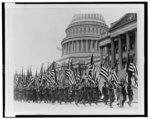
“Bonus Army” participants demonstrating in front of an empty U.S. Capitol in summer of 1932. (Photo from Library of Congress; taken by Underwood & Underwood)
Other veterans learned of the movement and headed to Washington, D.C. By June 1, 1932, there were 1,500 veterans in the nation’s capital to plead with Congress and President Herbert Hoover to find a way to give them their bonus checks early.
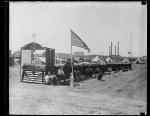
The veterans camped out in various locations across Washington, D.C. The Anacostia Flats site was the largest of their shanty towns at 30 acres. It gained the name “Camp Bartlett” because it was John H. Bartlett, the former Assistant Postmaster General and former Governor of New Hampshire who owned the land and let the veterans camp there.
Anacostia Flats encampment in Washington, D.C. in 1932. (Photo from Library of Congress, from the Harris & Ewing Collection)
On June 1, D.C. Police Superintendent Brigadier General Pelham D. Glassford asked Congress for $75,000 to feed the veterans, but the request was denied.
In mid-June, the U.S. House of Representatives approved the immediate payment of the bonus, but the U.S. Senate rejected it. President Hoover had said he would veto the bill if it passed in both chambers.
Photo taken in 1932 at one of the Bonus Army encampments in Washington, DC. (Photo from Library of Congress; taken by Harris & Ewing, photographer)
Veterans kept coming to Washington to plead their case. By the end of July, 1932, it was estimated that up to 20,000 of them had arrived.
It did not end well
In an action that rattles one’s nerves even to read about it 93 years later, on July 28, 1932, President Hoover ordered the U.S. Army and local police to remove all the protesting veterans from Washington.
General Douglas MacArthur led the mission. George S. Patton, whose name we all know from World War II, also participated. In an ironic turn of events, one of the veterans expelled from the nation’s capital by Patton was Joe Angelo, the soldier who saved Patton’s life in World War I.
Some 3,500 U.S. Army infantry and cavalry troops were called up to rid the city of the marchers. Of that number, 800 were actively used in the mission while the other 2,700 were held in reserve.
Violence ensued as the marchers resisted, but they were no match for the fire power of the U.S. Army. Five tanks manned by soldiers with machine guns, troops using tear gas and bayonets, and troops with torches setting fire to the encampments was more than the unarmed veterans could overcome.
Some of them thought they would be safe at Camp Bartlett, since it was on private land and the order to evacuate had only mentioned federal lands. They soon learned that Camp Bartlett was to be cleared also.
General MacArthur threatened to have a civilian bystander arrested for shouting, “The American flag means nothing to me after this!” at the troops.
One of the marchers, William Hashka of Chicago, was shot and killed near the U.S. Capitol.
Excuses and reactions
In a statement that sounds all too familiar to us in 2025, President Hoover claimed that many of the marchers were not veterans. He said they were Communists and criminals.
Falling in line with Hoover, MacArthur said only ten percent of the marchers were veterans.
Vice President Charles Curtis was heckled about the incident while making a speech in Las Vegas on July 29. He responded with, “You cowards, I’m not afraid of any of you.”
Police Superintendent Glassford said on July 29 that the use of federal troops had caused the trouble and that it could have been handled peacefully.
Does any of this sound familiar to you in 2025?
Some newspapers across the nation endorsed Hoover’s actions, while others called it “sheer stupidity.”
In 1936, the World War I veterans received their bonus, but it took Congress overriding President Franklin D. Roosevelt’s veto to accomplish it.
During World War II, in 1944, Congress passed the G.I. Bill to assist veterans.
Until my next blog post
I hope you have a good book to read.
Don’t forget the people of Ukraine and western North Carolina – or the starving children in Gaza.
Today is the anniversary date for two events that warrant our attention. The 14th Amendment to the U.S. Constitution was ratified on July 28, 1868 – 157 years ago today.
And on July 28, 1932, U.S. President Herbert Hoover ordered the U.S. Army to remove the protesting World War I veterans from Washington, D.C.
To give each of those events their due attention, I will blog about the 14th Amendment today, and I will blog about the “Bonus Army” tomorrow.
The 14th Amendment
The Preamble to the U.S. Constitution
Until the recent past, we never heard much about the 14th Amendment to the U.S. Constitution, and many of us would have been hard pressed to have told you what it was about without looking it up.
Now it is front and center and will be a major issue before the U.S. Supreme Court when they reconvene this fall.
The 14th Amendment is known as “The Birthright Amendment.” It came about immediately after the Civil War to extend citizenship to formerly enslaved individuals; however, the words “formerly enslaved,” “slave,” “slavery,” “Africa,” “African” or any other such qualifiers do not appear in the document.
The Trump Administration wants to abolish the 14th Amendment. Trump claims that it only applies to the people who were slaves prior to the Civil War. If successful in proving that before the U.S. Supreme Court, it will mean that the children of undocumented immigrants will no longer be awarded U.S. citizenship.
That is a major political and legal issue, so it will be incumbent upon the U.S. Supreme Court Justices to weigh all aspects of the matter carefully. Regardless of the Court’s ruling, a lot of people are going to be angry.
People who do not want citizenship to be automatically granted to a baby born on U.S. soil argue that other countries have no such law.
It’s not just Section 1 of the 14th Amendment that makes Trump uneasy. I imagine Section 3 makes him and some politicians nervous in light of the January 6, 2021, attempted coup.
The text of the 14th Amendment
AMENDMENT XIV
Section 1. All persons born or naturalized in the United States, and subject to the jurisdiction thereof, are citizens of the United States and of the State wherein they reside. No State shall make or enforce any law which shall abridge the privileges or immunities of citizens of the United States; nor shall any State deprive any person of life, liberty, or property, without due process of law; nor deny to any person within its jurisdiction the equal protection of the laws.
Section 2. Representatives shall be apportioned among the several States according to their respective numbers, counting the whole number of persons in each State, excluding Indians not taxed. But when the right to vote at any election for the choice of electors for President and Vice-President of the United States, Representatives in Congress, the Executive and Judicial officers of a State, or the members of the Legislature thereof, is denied to any of the male inhabitants of such State, being twenty-one years of age, and citizens of the United States, or in any way abridged, except for participation in rebellion, or other crime, the basis of representation therein shall be reduced in the proportion which the number of such male citizens shall bear to the whole number of male citizens twenty-one years of age in such State.
Section 3. No person shall be a Senator or Representative in Congress, or elector of President and Vice-President, or hold any office, civil or military, under the United States, or under any State, who, having previously taken an oath, as a member of Congress, or as an officer of the United States, or as a member of any State legislature, or as an executive or judicial officer of any State, to support the Constitution of the United States, shall have engaged in insurrection or rebellion against the same, or given aid or comfort to the enemies thereof. But Congress may by a vote of two-thirds of each House, remove such disability.
Section 4. The validity of the public debt of the United States, authorized by law, including debts incurred for payment of pensions and bounties for services in suppressing insurrection or rebellion, shall not be questioned. But neither the United States nor any State shall assume or pay any debt or obligation incurred in aid of insurrection or rebellion against the United States, or any claim for the loss or emancipation of any slave; but all such debts, obligations and claims shall be held illegal and void.
Section 5. The Congress shall have power to enforce, by appropriate legislation, the provisions of this article.
Hurricane Helene Update
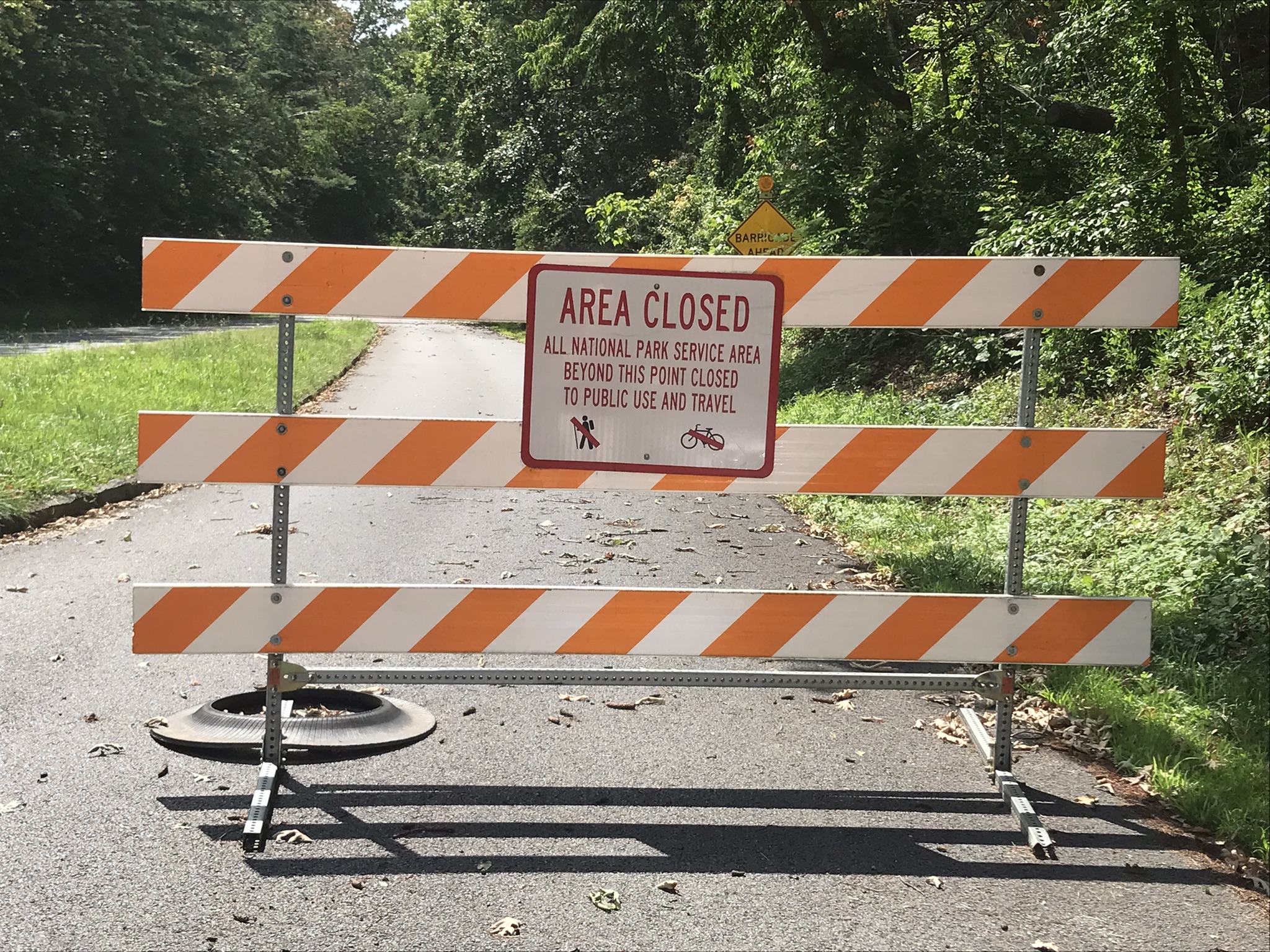
Barricade on Blue Ridge Parkway beside entrance to Folk Art Center at Asheville, June 10, 2025
12 more miles of the Blue Ridge Parkway in North Carolina have reopened from Milepost 305.2 near Beacon Heights and U.S. 221 to Milepost 317.5 at U.S. 221 near the Linville Falls community!
The Linville Falls spur road, campground, picnic area, and visitor center remain closed, due to hurricane damage.
There were at least 57 landslides across almost 200 miles of the Blue Ridge Parkway in North Carolina. Recovery has been broken down into three phases. The 12-mile opening last week is one of 12 projects included in Phase 1. When that phase is completed this fall, some 48 miles of the Parkway will have been restored.
Phase 2 includes the repair of 21 landslides in eight areas which are mostly located between Milepost 318.2 and Milepost 323.4, south of Linville Falls. It is hoped that Phase 2 will be completed by the fall of 2026.
Phase 3 is in the planning stage. During that phase, repairs will be made to 23 sites between Milepost 336.7 and 351.9, which lies between Little Switzerland and Mount Mitchell. There is no published timeline for the work to begin or be completed in Phase 3.
I have driven the entire 252 miles of the Blue Ridge Parkway in North Carolina many times and its 207 miles in Virginia at least once, but I doubt I will live to see it fully rebuilt.
As of Friday, of the 1,457 roads that were closed in western North Carolina last September due to Hurricane Helene, all but 34 are now completely open, which is the same as the prior week’s report. The NC DOT reports 42 roads have partial access.
I-40 at the Tennessee line is still lust opened with a total of two lanes and a 35-m.p.h. speed limit. A report I heard on TV last week said it will take years to fully reconstruct the interstate highway.
Until my next blog post
Keep reading everything you want to read – and some things you don’t want to read but need to read.
Remember the people of Ukraine and western North Carolina and the children in Gaza who are starving to death through no fault of their own.
In yesterday’s blog post, A 4th of July like no other, I lamented the fact that I do not feel celebratory on this United States Independence Day.
Here are my thoughts on this 4th of July – the 249th birthday of America.
Photo by Kristina V on Unsplash
Never take your freedom to read whatever you want to read for granted. People have died to protect that freedom, and there are people and organizations that think they have the right to take that freedom away from you.
Never take your freedom to practice the religion of your choice – or to practice no religion at all – for granted. People have died to protect that freedom, but there are some people who think they can force their warped brand of Christianity on all our citizens.
Never take your freedom of assembly for granted. People have died to protect that freedom, but there are people who want to limit our access to gathering if our ideas don’t align with theirs.
Never take your freedom to complain, grumble, criticize, question, and protest against your elected officials for granted. People have died while protesting and people have died to protect that freedom. If we lose that freedom, we have lost our democracy.
Never take your freedom to vote for granted. People have died to protect that freedom, but there are loud voices in our country today who want to put many hoops for us to jump through in order to vote. They want to make it such a cumbersome process that we will miss a step or just give up. They try to convince us that voter fraud is rampant, but investigations have proven it rarely happens.
Never take the freedom of the press for granted. People have died to protect that freedom. The freedom of the press is under attack by the President Donald J. Trump, by his press secretary Karoline Leavitt, and by Secretary of Defense Pete Hegseth. But they are wrong. The press is not “the enemy of the people!” It is incumbent upon each and every one of us to defend and protect the press. If we lose that precious freedom in the United States, we will most assuredly lose all our other freedoms.
Remember the people of Ukraine and western North Carolina.
Keeping silent is being complicit
Resist!
Rise up!
Speak up!
Speak out!
Get into good trouble!
That’s how Independence Day 2025 needs to be celebrated… while we still can.
Tomorrow marks the 249th birthday of the United States of America. It was on July 4, 1776 that our national Declaration of Independence was signed in Philadelphia.
Photo by Kyle Mills on Unsplash
This has been a tough year so far. In the months leading up to July 4, I wasn’t sure how festive this year’s celebration would or could be. Many of us are embarrassed by the actions and words of the current US President, the US Congress, and the US Supreme Court.
Many of us are worried about the future of our country and its standing in the world. Many of us are worried about our financial security as individuals. Many of us are grieving for the rights and benefits we and the poorest of the poor in the world have lost at the hands of the Turmp Administration. People are starving and dying unnecessary of preventable diseases because the aid that the United States had funded and promised has been halted in the name of efficiency, waste, fraud, and diversity.
What should I blog about just hours before Independence Day?
A week or so ago, I decided to mark this Independence Day by posting “A Light and Lively Look at Independence Day in America.” I had the whole post written, illustrated, and scheduled for 5 a.m., July 4, 2025.
I included links to comedian Nate Bargatze’s skits on the iconic TV show, “Saturday Night Live” or “SNL.” Both skits featured Bargatze as General George Washington and four regular SNL cast members (Bowen Yang, Mikey Day, Kenan Thompson, and James Austin Johnson) as American soldiers under his command in 1776 and 1777.
Bargatze’s trademark deadpan delivery made the skits hilarious. I thought sharing links to video recordings of the skits would be a good way to remind Americans that we need to laugh at ourselves. We shouldn’t take ourselves too seriously.
But as the days went by this week, I had a nagging feeling that I could not in good conscience go forward with that post tomorrow. It didn’t feel right. We have nothing to laugh about on this Independence Day.
Our country is in a precarious place. Our democracy and everything we thought we knew about our country are crumbling in front of our eyes.
This is my 73rd Independence Day. Until this year, it has always been a happy day – a day to be proud of my country, a day to pick wild blackberries, a night to hold a sparkler with close adult supervision when I was a young child, a day to go to a parade, a day to eat hotdogs and hamburgers, a day to watch a fireworks display, a day to sing patriotic songs, a day to wave the flag, a day to celebrate our freedoms.
Not this year. Now, none of that feels right. Oh, we still have some freedoms, but the current U.S. President and his minions have them in a vice grip. They are tightening the screws more each day. Those freedoms are being crushed and trampled on.
The last straw for me was seeing “Alligator Alcatraz” on TV and hearing some Republicans in high places of power making jokes about it. They’re making jokes about how the alligators and pythons will keep the detainees in line.
They joke about how the human beings detained there — and yes, although they are here illegally, they are human beings – will have to learn to run in a zigzag fashion while being chased by alligators. They joke about how security will be a small expense because the alligators and pythons work for free. They are human beings with names and families and very few of them are criminals. Coming into the United States without the proper paperwork is not a felony. It is a misdemeanor.
Even with all that “free” security provided by wildlife, we are told that “Alligator Alcatraz” will cost the American taxpayers $450 million-a-year. Florida will pay that upfront and then be reimbursed by FEMA. Personally, I don’t think that was why the Federal Emergency Management Administration was intended for. Even so, the cost in money is beside the point.
This “Alligator Alcatraz” detention center looks like a concentration camp. The human beings will be kept in cages – just like the first Trump Administration kept detainees in the first time. The wire cages are inside tents, and the Trump Administration claims these tents can survive a category 2 hurricane. We might find out over the next five months if that claim is valid.
While in Florida to visit “Alligator Alcatraz” in the Everglades, Trump was asked by a reporter how long individuals would be held there. He gave a long and typically incoherent response that did not address the question at all. He talked about how he lives in Florida and will spend “a lot of time here…” and how he has redecorated the Oval Office. It was a bizarre response to a simple question, but in its bizarre-ness it was one of his typical nonsensical “weaves”
Where are the people who called President Joe Biden incompetent? Where are they now that we have a U.S. President who is incapable of forming a complete sentence or staying on topic?
But that is not my main point.
My thoughts today and each day this week as I anticipated the 4th of July are… disbelief and horror. I am horrified that the United States of America is constructing a concentration camp – just as it did during World War II. Then the camps were built to restrict the movement of people of Japanese descent. In 2025, they are for anyone with brown skin or a Spanish accent.
The photographs of the masked ICE agents are horrifying. They look exactly like the masked Boko Haram self-proclaimed jihadist militant group in Nigeria, except those thugs were black and most of the ICE agents are white. What they have in common in addition to their face coverings is a penchant for terrorizing people, including little children. What they appear to have in common is hate and a personal delight in inflicting pain and terror.
Police officers in the United States don’t wear face masks. People who are ashamed of what they are doing wear face masks. People who don’t want to be caught or recognized wear face masks. Have the dark face coverings of ICE agents in 2025 replaced the white hoods of the Ku Klux Klan? The sight of the masked ICE agents triggers that comparison in my mind, and the first word that comes to mind is “cowardice.”
What kind of person – mostly men – takes a job as an ICE agent? Who takes a job in which they have to trade their souls for a mask and a pair of handcuffs or wad of zip ties? Are they so filled with hate and racism that they enjoy terrorizing families and children?
And those ICE agents? They will, no doubt, say they were just following orders. If that lame excuse rings a bell, it is because that’s what Hitler’s henchmen cried at the Nuremberg Trials in 1945 and 1946.
I don’t recognize this America. I don’t understand this America. I cannot celebrate this America.
As I indicated in my blog post yesterday, #OnThisDay: 26th Amendment Ratified, 1971 – Part One, when I started researching the history of the 1971 ratification of the 26th Amendment, which lowered the voting age in federal elections in the US from 21 to 18 years of age, I got in over my head quickly and the blog post grew like topsy.
Therefore, I split the post into two posts. My post yesterday gives important background information which helps to put today’s post in perspective.
Starting with the beginning of America’s involvement in World War II, here is how the 26th Amendment finally came about. As I said in yesterday’s blog post, the military draft and the setting of the voting age in the United States became intertwined decades ago.
World War II
Japan attacked Pearl Harbor in Hawaii on December 7, 1941. Congress gave President Franklin D. Roosevelt the authority to send US military personnel anywhere in the world. The distinctions between draftees, regular army, National Guardsmen, and Reservists were removed for the war. They were all part of the army.
Eleven months after the attack on Pearl Harbor, Congress lowered the draft age to 18 and raised the upper limit to the age of 37.
Also in 1942, West Virginia Congressman Jennings Randolph introduced a bill in the House of Representatives to lower the voting age from 21 to 18. That was the first of 11 times that Randolph would introduce such legislation in his political career which eventually found him in the US Senate.
It seems that Randolph had a particular faith in the youth of America. He is quoted as saying that American young people, “possess a great social conscience, are perplexed by the injustices in the world and are anxious to rectify those ills.”
What seems idiotic to us in 2025 is the fact that black men were not considered for the draft until 1943. The so-called reasoning for that was the assumption that white men and black men could not work together in a military setting and white racists believed that black men were not capable of serving in the military!
As a result, in 1943 a racial quota system was put in place under which black men were drafted in numbers to coincide with their percentage of the general population. At that time, just over ten percent of the US population was black.
But even with this new quota, black soldiers were restricted to serving in “labor units.” That changed, though, as World War II progressed and they were needed in combat positions.
President Franklin D. Roosevelt lowered the minimum age for the age to the age of 18 during World War II, but the minimum voting age held at the age of 21. At that time voting age was set by each state.
The slogan, “Old enough to fight, old enough to vote” gained momentum in 1943, and George became the first state to lower voting age for state and local elections from 21 to 18.
By the end of World War II, of the 34 million men registered for the draft, 10 million had been inducted into the military.
Post-World War II until the Korean War
In 1947, President Harry S. Truman asked Congress to let the 1940 Selective Training and Service Act expire and recommended that the US military could rely on voluntary enlistments.
However, in 1948, the minimum number of military personnel was not reached, so Truman asks for the draft to be reinstated. The new act called for the drafting of men between 19 and 26 years old for twelve months of active service.
Korean War (June 25, 1950-July 27, 1953)
Mean between 18½ and 35 were drafted for an average of two years. Men who had served in World War II were not required to sign up for the Korean War draft; however, I know a fighter pilot who served in World War II who was called back into active service during the Korean War. (By the way, he is 100 years old now.)
The Universal Military Training and Service Act passed in 1951. It required men from 18 to 26 years old to register. The next year, Congress enacted the Reserve Forces Act. It required every draftee and every enlisted man to an eight-year military service obligation. That obligation meant that after their term of active duty, they were assigned to standby reserve and knew they could be called back into active duty upon a declaration of war or a national emergency.
Post-Korean War until Vietnam War
In his 1954 State of the Union address, President Dwight D. Eisenhower said, “For years our citizens between the ages of 18 and 21 have, in time of peril, been summoned to fight for America. They should participate in the political process that produces this fateful summons.”
Jennings Randolph (mentioned above in the US Congress in the 1940s) was a Democrat. As a US Army General, Dwight Eisenhower had led US forces in the European Theatre in World War II and was a Republican. So why did it take until 1971 for the 26th Amendment to the US Constitution to come about?
Vietnam War, Civil Rights, and Voting Rights
The US provided military advisors in South Vietnam beginning in the early 1950. The war in North and South Vietnam, Cambodia, and Laos continued.
President Lyndon B. Johnson started pressuring Congress to let him send active-duty troops to Vietnam after a military incident in the Gulf of Tonkin on August 2, 1964. The US was carrying out a covert amphibious operation near North Vietnamese territorial waters. North Vietnam responded, and then based on skewed intelligence the US falsely claimed that another incident occurred on August 4, 1964.
There was very little support in the US for America to send troops to fight in that war, but what a tangled web we weave once we set out to deceive!
The first US Marines landed in DaNang, South Vietnam on March 8, 1965. The first anti-war demonstrations took place in the US since the end of the Civil War. Ironically, that was the same day that the US Supreme Court handed down its decision in US v. Seeger, which broadened the definition of conscientious objection but it was still based on religious beliefs.
Although President Johnson appointed a study commission to come up with changes to the Selective Service system, the war raged on and thousands of young men left the US to avoid the draft.
Photo by Ryan Stone on Unsplash
The Civil Rights Act of 1964 make discriminatory practices based on race illegal; however, some states continued to enforce poll taxes and literacy tests. That necessitated the adoption of the 24th Amendment to the US Constitution in 1964 which outlawed poll taxes.
Some states still had literacy tests that had to be passed before a person could register to vote. It was seen as a way to prevent black people from voting. Therefore, the Voting Rights Act of 1965 was necessary. It prohibits any racial discrimination in voting in the United States.
Photo by Unseen Histories on Unsplash
And yet, if you were under 21 years old, you could be drafted and sent to fight in Vietnam but you still could not vote.
In 1969, President Richard M. Nixon ordered a “random selection” lottery system for the draft in place of drafting men at the age of 19. In 1970, Nixon wanted Congress to end student deferments.
On June 15, 1970, in US v. Welsh, the US Supreme Court ruled that men holding ethical and moral beliefs against the war could be exempt as conscientious objectors.
The US Supreme Court handed down its decision in Oregon v. Mitchell (a case brought by Oregon, Arizona, Texas, and Idaho) on December 21, 1970. In a 5 to 4 decision, the Court ruled that the federal government can set voting age in federal elections but not on the state and local level. It also made it illegal for states to require passage of a literacy test in order for an individual to register to vote. Oregon v. Mitchell
There was no end in sight for the US sending troops, which included female nurses, to Vietnam, but they could not vote until they reached the age of 21. Sadly, many of the soldiers in all the wars up to and including most of the war in Vietnam never got the chance to vote because they died before the 26th Amendment was ratified.
Photo by Ryan Stone on Unsplash
Ratification of the 26th Amendment
Under increasing pressure to lower the federal voting age to 18, on March 10, 1971, the US Senate unanimously voted in favor of the proposed 26th Amendment. Thirteen days later, the US House of Representatives voted overwhelmingly in favor of it. It went to the states for ratification, and in a record-setting two months, the required three-fourths of the state legislatures ratified the amendment. It went into effect on July 1, 1971, and President Nixon signed it into law on July 5, 1971.
Post-Vietnam War (for a military and draft perspective)
A cease-fire was reached between the US and North Vietnam on January 27, 1973, and US prisoners-of-war began to return home. The last US combat troops left South Vietnam on March 29, 1973.
The 1967 Selective Service Act, which had been extended by Congressional action, was allowed to expire in 1973. Therefore, the draft ended.
The United States operates with an all-volunteer armed forces now; however, all male citizens between 18 and 26 years of age are required to register for the draft and are liable for training and service until they reach the age of 35.
Until my next blog post
Keep reading that novel or nonfiction book that has you captivated. We all need an escape from daily worries and current events.
Never take your family or friends for granted.
Don’t forget the people of Ukraine and western North Carolina.
Mr. Ira Lee Taylor of Harrisburg, North Carolina, was an unassuming man. I grew up knowing him as my mailman and the father of a friend at school. It wasn’t until 2006, when I started writing a local history column for Harrisburg Horizons newspaper that I learned from another local World War II U.S. Army veteran that Mr. Taylor took part in the invasion of Normandy on D-Day.
That invasion took place 81 years ago today. Very few veterans are still here to tell their stories. Interviewing Mr. Taylor a number of times in the six years I wrote for the newspaper was one of the privileges of my life.
Instead of June 6, 1944, only being a date in a history book, it became a day of incredible heroism and sacrifice as I heard Mr. Taylor’s vivid memories of that day, the training in preparation for it, and the other battles he was in throughout the war in Europe.
Mr. Taylor served in the U.S. Army’s 4th Division. The entire 4th Division left New York City on four ships on January 19, 1944. About passing the Statue of Liberty, he said, “That was a beautiful thing. We said, ‘We don’t know whether we’ll ever see you again or not.’” Many of them never did.
More than one hundred other ships joined the 4th Division over the next three days. The Liberty Ships were carrying ammunition, food, and other supplies. He said the ships would scatter during the day, but at night they would close in almost touching each other. It took eleven days for them to cross the Atlantic and arrive in Liverpool, England.
They were transported by train from there to Devonshire, England, where they trained for the invasion of Normandy which was occupied and heavily fortified by the Germans.
He talked about how they meticulously prepared their trucks and other equipment so they would be sea worthy. They practiced loading everything up and going to the port of Plymouth. From there, they would sail down the English Channel to a place that was set up to look like “Utah Beach” in Normandy where they would train for the invasion.
Each time they set out, they didn’t know whether it was the real thing or another practice run. Of course, they did not know exactly what they were training for.
After months of planning and incredible secrecy, the invasion was scheduled for June 5, 1944. General Dwight D. Eisenhower knew he had a small window of opportunity before the moon would begin to wane.
No, June 5 is not a typo. That was set as the day for the invasion. The night before, Mr. Taylor said the troops were briefed. They were told, “The 4th Division will make the landing on D-Day. We’re sacrificing the 4th Division to make that landing. We anticipate eighty percent casualties. You’ll pass two islands in the Channel on the way – one’s Guernsey and the other one’s Jersey. You might hear some shooting and all, but don’t worry about it. That doesn’t concern you at all. Two other outfits are taking care of that.”
“The morning of June 5, the gate was locked with an MP guarding it. They wouldn’t let us out, and the boys started singing, ‘Don’t Fence Me In,’” Mr. Taylor said with a chuckle. But then the mood turned somber and they knew this was it.
Mr. Taylor’s outfit set out late on the evening of June 4. They got halfway across the English Channel and a huge storm came up. General Eisenhower was forced to call off the mission, but the invasion had to take place no later than June 6.
So Mr. Taylor’s outfit loaded up again on the night of June 5 before dark. He was on one of 499 ships that took part in the invasion.
Patton’s 3rd Division, the 90th Division, and the 4th Division were all lined up, but the 4th went out first because it was to hit the beach in the first wave.
If you’ve seen the movie, “Saving Private Ryan” or some war documentaries, you might have an inkling of an idea what the invasion was like, but I don’t think any of us can really grasp the horror of it. One thing a film doesn’t give you is the smell, but Mr. Taylor talked about the smell.
He talked about how special troops sneaked onto the Normandy coast before daybreak on June 6 and disarmed many of the mines on the beaches, right under the noses of the German soldiers. At the same time, glider troops were silently landing inland carrying tanks and infantrymen. The 82nd and 101st Airborne dropped ten miles inland, behind enemy lines.
Mr. Taylor talked about the four hundred light and heavy bombers that flew over them until six o’clock in the morning.
The 4th Division missed its target by about a mile, but started landing on Utah Beach at 6:30 a.m. on June 6, 1944.
Mr. Taylor talked about the mines and the iron crosses all over the beach as the Germans anticipated an invasion, the 50-caliber machine guns, the wounded soldiers being taken back to the Landing Ship, Tank (LST) he was on. It carried twenty tanks and 200 troops and doubled as a hospital.
Mr. Taylor was in many battles, including the Battle of the Bulge and the Battle of Huertgen Forest. He had majored in Forestry at North Carolina State University at Raleigh, so he had a particular appreciation for the Huertgen Forest of fir and pine trees, but it was there that the 4th Division lost half of its men and the forest was shattered in the fighting.
Mr. Ira Lee Taylor with his World War II medals, February 24, 2007.
Needless to say, Mr. Taylor felt fortunate to survive the war. He came home, married his sweetheart, and got a job at the post office. Somehow, he put the horrors he had witnessed behind him, but in his later years he wanted to share his story. And I’m a better person for having interviewed him.
If you are interested in reading all of Mr. Taylor’s stories, my five-part newspaper series can be found in Harrisburg, Did You Know? Cabarrus History, Book 1, which is available in paperback at Second Look Books in Harrisburg and in paperback and e-book from Amazon (https://www.amazon.com/Harrisburg-Did-You-Know-Cabarrus-ebook/dp/B0BNK84LK1/). That book contains the first 91 articles I wrote for the newspaper.
Until my next blog post
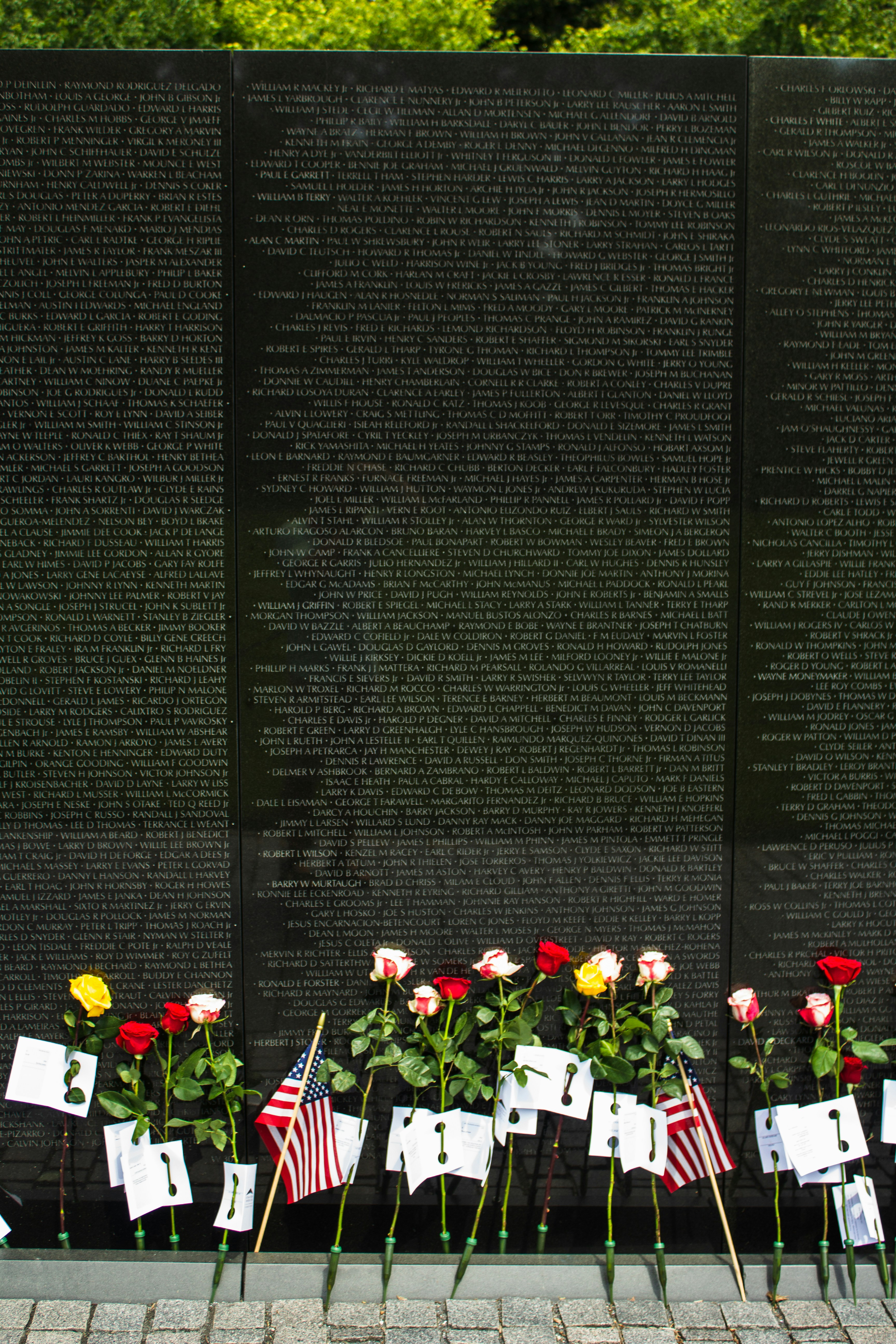
Take some time today to think about the men who took part in the D-Day invasion. We owe them a debt of gratitude that we can never repay.
This is the day every year on which Americans are called on the remember the men and women who have died in the military service to our country. It dates back to 1868. After the Civil War, the 30th day of May was set aside as “Decoration Day” on which the graves of those soldiers who had given their lives for their country were to be decorated with flowers.
For decades it was called Decoration Day. Unfortunately, since it was begun as a day to remember those who had been killed in the military service of the United States, some in The South selected a different day in May to honor those who had died fighting for the Confederate States in the Civil War.
I can remember older people even in the 1960s who still marked Confederate Memorial Day. I’m glad we have gotten beyond that, or at least I hope and think we have.
Even after World War I, the day was specifically to remember those who died in the Civil War. After World War II, though, it was decided that it should be a day to honor the sacrifice made by all who had died in the military service, no matter the war or circumstances of their death during service.
Congress passed the National Holiday Act of 1971 and it designated that Memorial Day will be observed on the last Monday in May.
In 1915, Moina Michael was inspired by the poem “In Flanders Field” to write the following: “We cherish too, the Poppy red That grows on fields where valor led. It seems to signal to the skies that blood of heroes never dies.”
Photo by Irina Iacob on Unsplash
She then had the idea that we should wear red poppies on Memorial Day to honor those who died in the service. She sold them on her own and gave the money she made to benefit veterans in need. The custom was admired by a Madam Guerin of France, and she initiated the practice there to raise money for the children orphaned and the women widowed by war. The practice spread across many countries.
In 1922, the Veterans of Foreign Wars (VFW) organization became the first organization to sell the poppies across the US. IN 1924, disabled veterans started making the artificial poppies for the VFW members and their auxiliary members to sell.
So, if you see them selling poppies outside a supermarket, a shopping mall, or elsewhere today, stop and buy a poppy and wear it today to remind yourself and those who see you what this holiday is all about.
Until my next blog post
I hope you have a good book to read.
Spend time with friends and family for you and they won’t be here forever.
Remember the people of Ukraine, western North Carolina, and the flooding victims in New South Wales, Australia, and in southern France. No part of the world is immune to war or extreme weather
Today is the 250th anniversary of the signing of the Mecklenburg Declaration of Independence in Mecklenburg County, North Carolina. It predated the national Declaration of Independence by more than a year.
A recreation of the Mecklenburg Declaration of Independence.
In case it sounds familiar, I have blogged about the Mecklenburg Declaration of Independence on or near May 20th several times in the more than ten years I’ve been blogging.
My immigrant ancestors were among the Scottish Presbyterian pioneers who settled old Mecklenburg County, North Carolina. Years of discontent in the American colonies were piled on top of the anti-British Crown feelings they brought with them across the Atlantic.
Weary of unfair taxes imposed by the Crown and the discrimination they were subjected to as Presbyterians slowly brought the settlers to the boiling point. An example of the persecution these Presbyterians felt were the Vestry and Marriage Acts of 1769. Those acts fined Presbyterian ministers who dared to conduct marriage ceremonies. Only Anglican marriages were recognized by the government.
On May 20, 1775, the citizens of Mecklenburg County, North Carolina declared themselves to be free and independent of the rule of Great Britain. It was a sober and sobering declaration not entered into lightly. Those American patriots meant business, and they knew the risks they were taking.
Archibald McCurdy, an elder in Rocky River Presbyterian Church, heard the document read from the steps of the log courthouse in Charlotte. When he got home, he and his wife, Maggie, listed everyone they knew of who could be trusted in the coming fight for American independence.
No original copies of the Mecklenburg Declaration of Independence survive today. The local copy was lost in a house fire at the home of one of the signers. The copy taken to the Continental Congress in Philadelphia by Captain James Jack on horseback was also lost. Later, signers of the document recreated it from memory.
Nevertheless, those of us who were raised on stories of the Mecklenburg Declaration of Independence and the brave souls who risked their lives to sign it know that the document was real. The blood of the American patriots still flows in our veins and their spirit of freedom still beats in our hearts.
Hurricane Helene Update
As of last Friday, 54 roads in North Carolina were still closed due to Hurricane Helene. That count included five US highways, four state highways, and 45 state roads. That’s a decrease of one state highway and one state road since the week before.
Until my next blog post
I hope you have a good book to read.
Remember the people of Ukraine and western North Carolina. Their situations are quite different, but the people in both places are stressed and weary.
My blog today is about my favorite local history story. It was 254 years ago last Friday – May 2, 1771, that a group of teenage boys and young men from Rocky River Presbyterian Church in present-day Cabarrus County, North Carolina, decided to blow up a shipment of King George III’s gunpowder.
The Regulator Movement in Rowan and Alamance counties to our north was reaching a boiling point in April 1771. Word reached the settlement of Scottish immigrants at Rocky River that a shipment of gunpowder was coming from Charleston, South Carolina to Charlotte and on to Salisbury, North Carolina. That gunpowder was destined to be used to put down the Regulators.
The Regulator Movement never took hold in present-day Cabarrus County (which was part of Mecklenburg County), but there was a strong and growing anti-Royal government sentiment here. Destruction of that gunpowder shipment would be detrimental to the government.
Nine teenage boys and young men from Rocky River decided to take matters into their own hands. They found out the munitions wagon train of three wagons would camp for the night of May 2 at the muster grounds near or along the Great Wagon Road in what is now Concord, North Carolina.
They blackened their faces to disguise themselves and sworn an oath on a Bible that they would never tell what they were about to do and would never reveal the names of the participants. They set out for the militia muster grounds some nine miles away and surprised the teamsters and guards. They had no desire to harm those men, so they led them and their animals to a safe distance away.
The gunpowder and blankets were gathered into a pile, and a train of gunpowder was laid. James White, Jr., fired his pistol into the trail of gunpowder. The resulting explosion was heard some nine miles away in the vicinity of Rocky River Presbyterian Church. Some people thought it was thunder, while others thought it was an earthquake.
Photo by Vernon Raineil Cenzon on Unsplash
The nine perpetrators made their way home, cleaned themselves up, and said nothing about their overnight adventure.
The Battle of Alamance took place on May 6, 1771, and the Regulator Movement was effectively put down by the royal government. Governor William Tryon proclaimed on May 17, 1771, that he would pardon the rebels if they would turn themselves in by May 21.
That deadline was extended until May 30. Some of the perpetrators headed for Hillsborough to turn themselves in, but they were warned along the way that it was a trick. Governor Tryon planned to have them hanged. Some returned to the cane brakes of Reedy Creek, not far from the church, while others fled to Virginia and Georgia.
In a trail which began on May 30, 1771, twelve Regulators were found guilty of high treason. Six were hanged.
Perhaps news of that trial reached Rocky River or maybe half-brothers James Ashmore and Joshua Hadley simply feared that one of the other gunpowder perpetrators would disclose their identities. For whatever reason, Ashmore and Hadley went independently to tell Colonel Moses Alexander what they knew. Imagine their surprise when they ran into each other on Colonel Alexander’s front porch!
James Ashmore pushed his way into the Colonel’s house and told him he was ready to talk. He was taken to Charlotte on June 22, 1771, where he gave a sworn deposition before Thomas Polk, a Mecklenburg County Justice of the Peace.
Ashmore revealed the names of the other eight young men who had conspired and carried out the attack. The search for the men began in earnest. Several of them narrowly escaped capture, and their stories and more details of the progression of the case through the colony’s royal government at included in my book, Harrisburg, Did You Know? Cabarrus History, Book 1, which is available from Amazon in e-book and paperback and at Second Look Books in Harrisburg, NC.
William Tryon became Governor of New York and Josiah Martin was appointed Governor of North Carolina. Twenty-nine “inhabitants of Rocky River & Coddle Creek Settlement” (including my great-great-great-great-grandfather) signed a petition asking Governor Martin to pardon the perpetrators, but the request was denied.
Photo by Kate Remmer on Unsplash
For nearly a year, the women of Rocky River Presbyterian Church provided food and clothing for the perpetrators who hid in the cane brakes along Reedy Creek. Rev. Hezekiah James Balch prayed openly for the young men’s safety from the church’s pulpit. Their identities remained a well-kept secret.
The young men were fugitives until independence was declared. After the Mecklenburg Declaration of Independence was issued on May 20, 1775, followed by the Mecklenburg Resolves eleven days later, all county citizens were considered to be in rebellion.
Back to the present
Yesterday was “May Meeting” at my home church, Rocky River Presbyterian in Cabarrus County, North Carolina. It wasn’t a “meeting.” It was more like an annual homecoming. It dates back to 1757. It is held on the first Sunday in May. The 11:00 a.m. worship service includes The Lord’s Supper/communion.
After the worship service, we all gather around a long wire “table” for Dinner in the Grove except on the occasional year now like yesterday when it rains or has poured rain all night and we have to eat inside the fellowship hall. Everyone brings their best and favorite homemade dishes and it is the biggest feast you can imagine.
Imaging May Meeting 1771
The more I study and contemplate the blowing up of the King’s munitions wagon train by members of Rocky River Presbyterian Church on May 2, 1771, the more I try to travel back in my mind’s eye to May Meeting 1771.
Everyone for miles around knew that the King’s gunpowder had been blown up on Thursday night. Everyone probably had a pretty good idea who among them had participated in the act of civil disobedience.
I imagine the hushed conversations under the large oak, scalybark hickory, red cedar, and poplar trees in the former church grove a couple of miles from our present sanctuary where the congregation met in a log church.
Local people were, no doubt, coming to grips with which side they were going to attach their allegiances in the inevitable coming war. Most, as it turned out, would choose to be patriots. After all, they had left Scotland and some had left Ireland in search of a better life, and they were pretty sure the King of England was not offering them a better life. He was placing more and more taxes and tariffs on them.
On Sunday, May 5, 1771, I imagine individual men carefully approached one or two men they knew they could trust and then they made quiet comments about the gunpowder explosion while they roughed the hair on the heads of their little boys who were too young to know the gravity of the situation.
I imagine many of the individual women did the same with their trusted friends while they small daughters clung to their long skirts.
And I’m sure the teenagers huddled in their usual groups and talked about what had happened on Thursday night. There was, no doubt, speculation about which of their friends had taken part in the attack.
I can imagine them quietly calling the roll, so to speak, and speculating about why Robert Davis was not at church that day. Or why were Ben Cochran and Bob Caruthers in serious conversation away from the crowd? Had they taken part? How much trouble were they really in? What was going to happen to the boys and young men who were guilty? How would they be punished?
Hurricane Helene Update
As of Friday, 56 roads in North Carolina were still closed due to Hurricane Helene. That count included four US highways, four state highways, and 48 state roads.
“’These grants will go a long way in helping western North Carolina’s beloved small business owners keep their doors open after Helene,’” said Governor Josh Stein. “’But the volume of unfunded applications makes it crystal clear – more help is desperately needed. I’m ready to work with the legislature to deliver support for small businesses that power our mountain economy.’”
After being closed for seven months, Morse Park at Lake Lure, NC partially reopened last weekend. The 720-acre lake itself remains drained as storm debris, silt and sediment are still being removed.
The village of Chimney Rock, NC was nearly wiped off the face of the earth by Hurricane Helene. It had been hoped that the town and Chimney Rock State Park would open by Memorial Day, but that’s not going to be possible. The security checkpoint will continue until further notice. You must have a pass to enter and travel through the village on the temporary road. NCDOT is working on a temporary bridge in the village to help restore access to the state park. The park has not announced a reopening date. The notice I read last Wednesday night from the Village indicated that construction of a new US-64/US-74A/NC-9 has begun.
Until my next blog post
Get a good book to read.
Don’t forget the good people of Ukraine, Myanmar, and western North Carolina.













 Janet's Writing Blog