Exploring Qualla Boundary

Several weeks ago, my sister and I spent several days in Cherokee, North Carolina. We have visited Cherokee many times, but I had never seen the “Unto These Hills” outdoor drama. Since the drama was rewritten a few years ago to give a truer presentation of the Cherokee Indian perspective on their history, I was eager to see it.

A leisurely drive on the Blue Ridge Parkway is always an activity we enjoy, so we got on the parkway on the southern edge of Asheville and took it to its end at Soco Gap. We went through 15 tunnels on that 80 or so southernmost miles of the Blue Ridge Parkway. Various wildflowers, including the Flame Azalea (or native/wild azalea) was at or just past its peak.

Flame Azalea along the Blue Ridge Parkway
National Park Service sign noting the highest elevation on the Blue Ridge Parkway Motor Road at 6,053 feet.

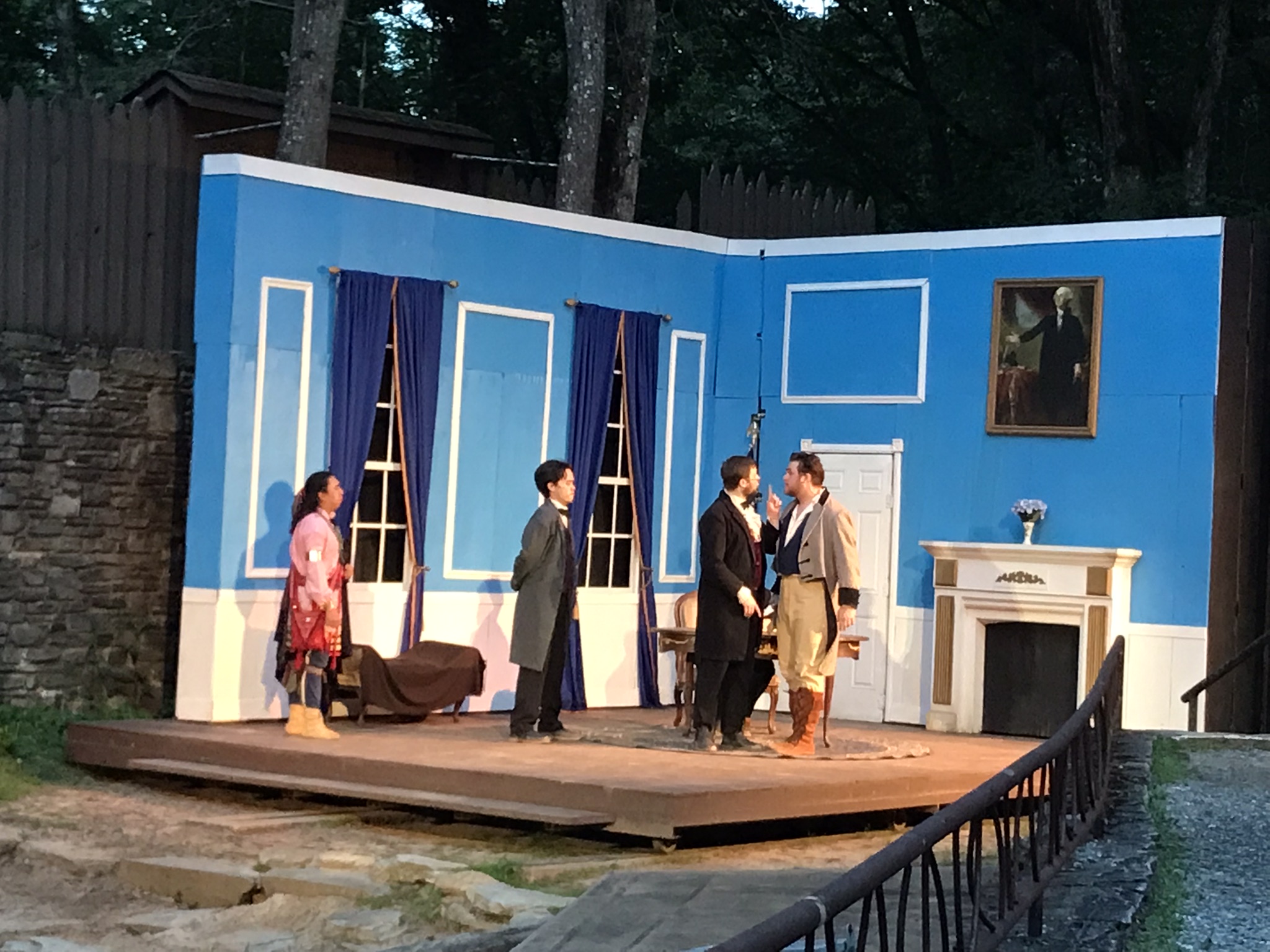
We had perfect weather all week, including the night we had tickets to see “Unto These Hills.” The acting was superb. It was amazing to see the history of the Cherokee people presented in two hours.

The play emphasized how the Cherokee and the European explorers, traders, and settlers had a congenial relationship in the beginning. It wasn’t until the Europeans started cheating the Cherokee and tricking them into poor decisions and hollow treaties that things deteriorated.

Another scene from “Unto These Hills”
A scene from a visit to the White House in the “Unto These Hills” outdoor drama

The last straw, of course, was when the United States forced the Cherokee to give up their beautiful and lush ancestral lands for what turned out to be a death march to the Indian Territory of present-day Oklahoma. They were promised a good life, but it was just another broken promise by the white man.

A scene from “Unto These Hills” outdoor drama in Cherokee, NC

The Cherokee people who refused to leave the Great Smoky Mountains hid in the hills. It is the descendants of those brave souls who now populate the Qualla Boundary and are officially known as the Eastern Band of the Cherokee Indians.

By visiting the Museum of the Cherokee Indian and the Oconaluftee Indian Village, you can learn a great deal about the Cherokee Indians’ rich history and traditions. For instance, they lived in houses, not teepees. They did not wear elaborate feather headdresses like the Plains Indians. Cherokee men back in the day were up to seven feet tall and the women averaged only a few inches shorter.

An example of a Cherokee house from an earlier century. (The cutaway is not a window; it is there to show the wall’s construction. Cherokee houses did not have windows because they were only used for sleeping. All their work was done outside.)
Weaving display at Oconaluftee Indian Village in Cherokee, NC
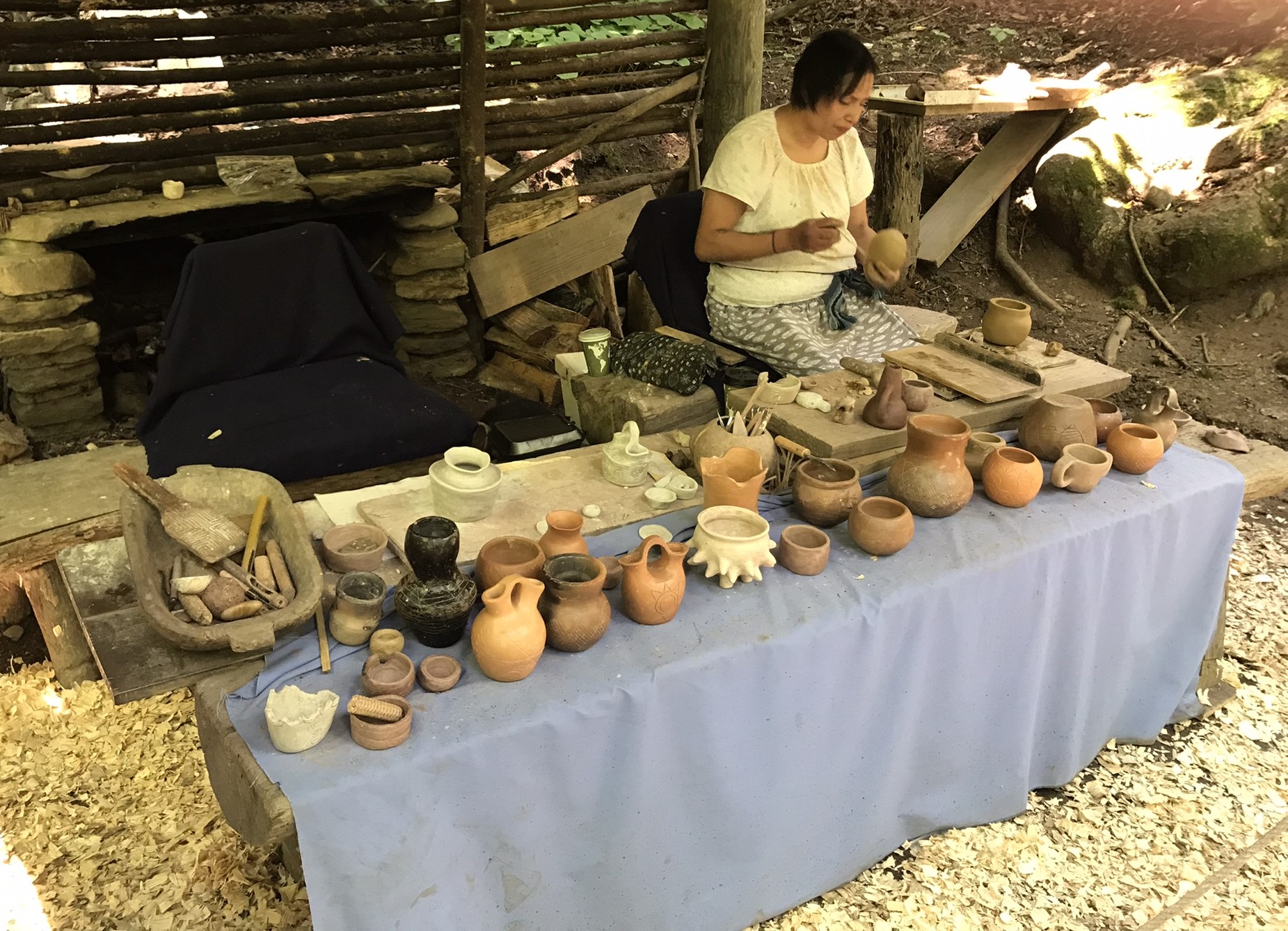
A pottery display and demonstration at Oconaluftee Indian Village in Cherokee, NC

Many Cherokee people continue to master the time-honored crafts of making clay pottery, intricate bead work, exquisite basketweaving, and wood carving. It takes weeks and sometimes months for the native plants and other natural resources for these items to be gathered and prepared, not to mention the intricate work to create the finished products. Those priceless items can be admired and purchased at the Qualla Arts and Crafts Mutual, Inc.

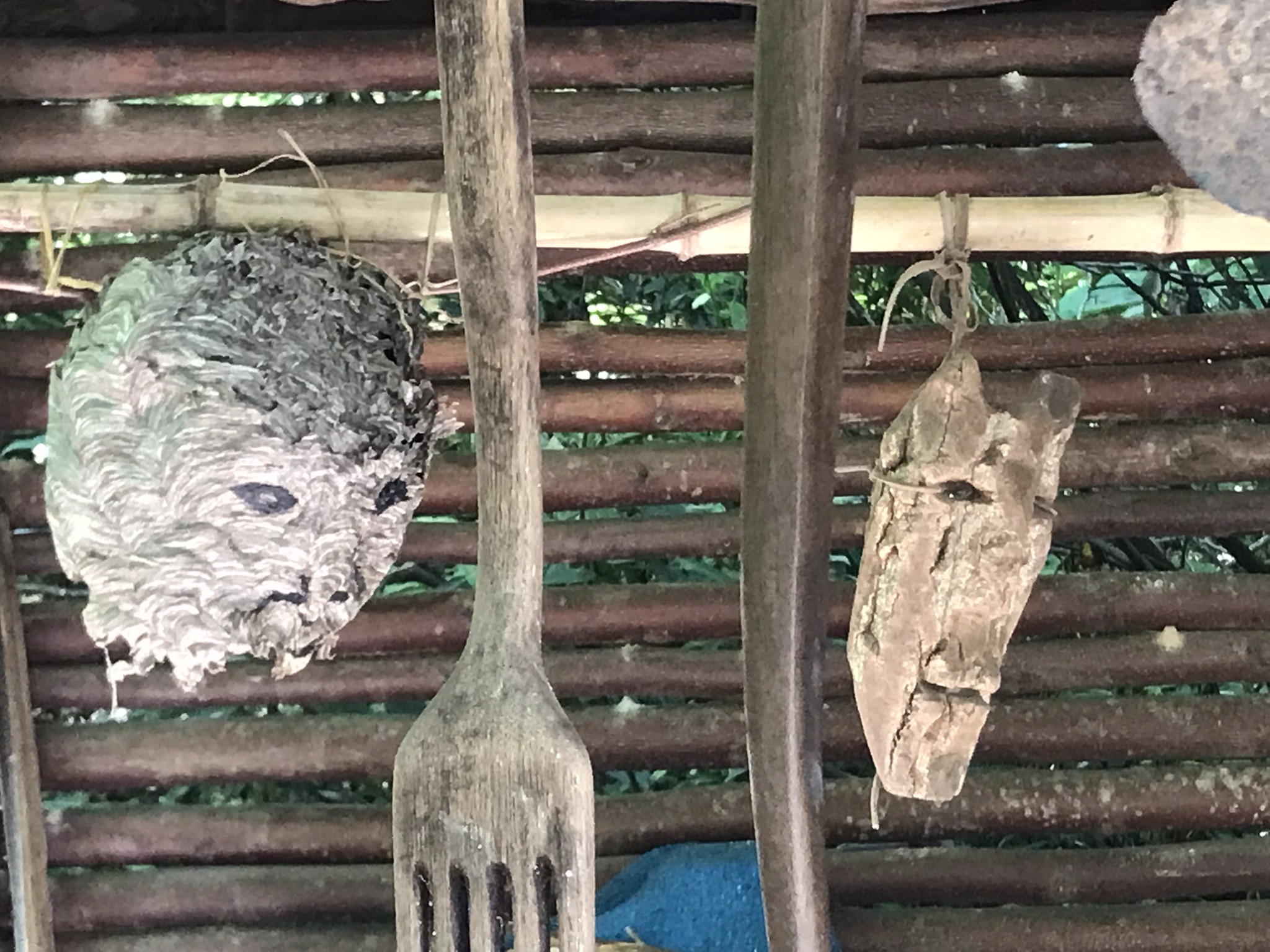
Cherokee ceremonial masks were made from various natural resources, including wood and even hornets’ nests (as seen on the left in the photo.)

Although some of the signage indicates otherwise, the Qualla Boundary is not a reservation. The Cherokee people own their land and the Qualla Boundary is held in trust for them by the United States Government.

The Cherokee not only had their own written language; they also had their own newspaper starting February 21, 1828. Although the United States Government tried to eradicate the Cherokee language and traditions, that policy failed. Today the Cherokee language is making a comeback. There is even a Cherokee immersion school in which only Cherokee is spoken.

On our recent visit, we used Cherokee as our base. One day we drove through the center of the Great Smoky Mountains National Park to and including Little River Road and Clingman’s Dome and back to Cherokee.

Another day we drove 10 miles to Bryson City, North Carolina and the Deep Creek entrance to the Great Smoky Mountains National Park. We hiked to three waterfalls we’d never seen before and enjoyed learning lots of facts about the park along the way to two of them with a park ranger.

When planning your trip, check online for the planned hikes and lectures offered by park rangers at the Oconaluftee Visitors Center near Cherokee, NC, the Sugarlands Visitors Center near Gatlinburg, Tennessee, Cades Cove near Townsend, Tennessee, and at the Deep Creek entrance to the park at Bryson City.

The Cherokee honor water and the residents and visitors alike are blessed to have the Oconaluftee River flowing right through the town of Cherokee. This shallow, wide, rocky river is the perfect place for tubing and splashing around in the water. I have memories of enjoying the river on my first trip to Cherokee when I was a young girl.

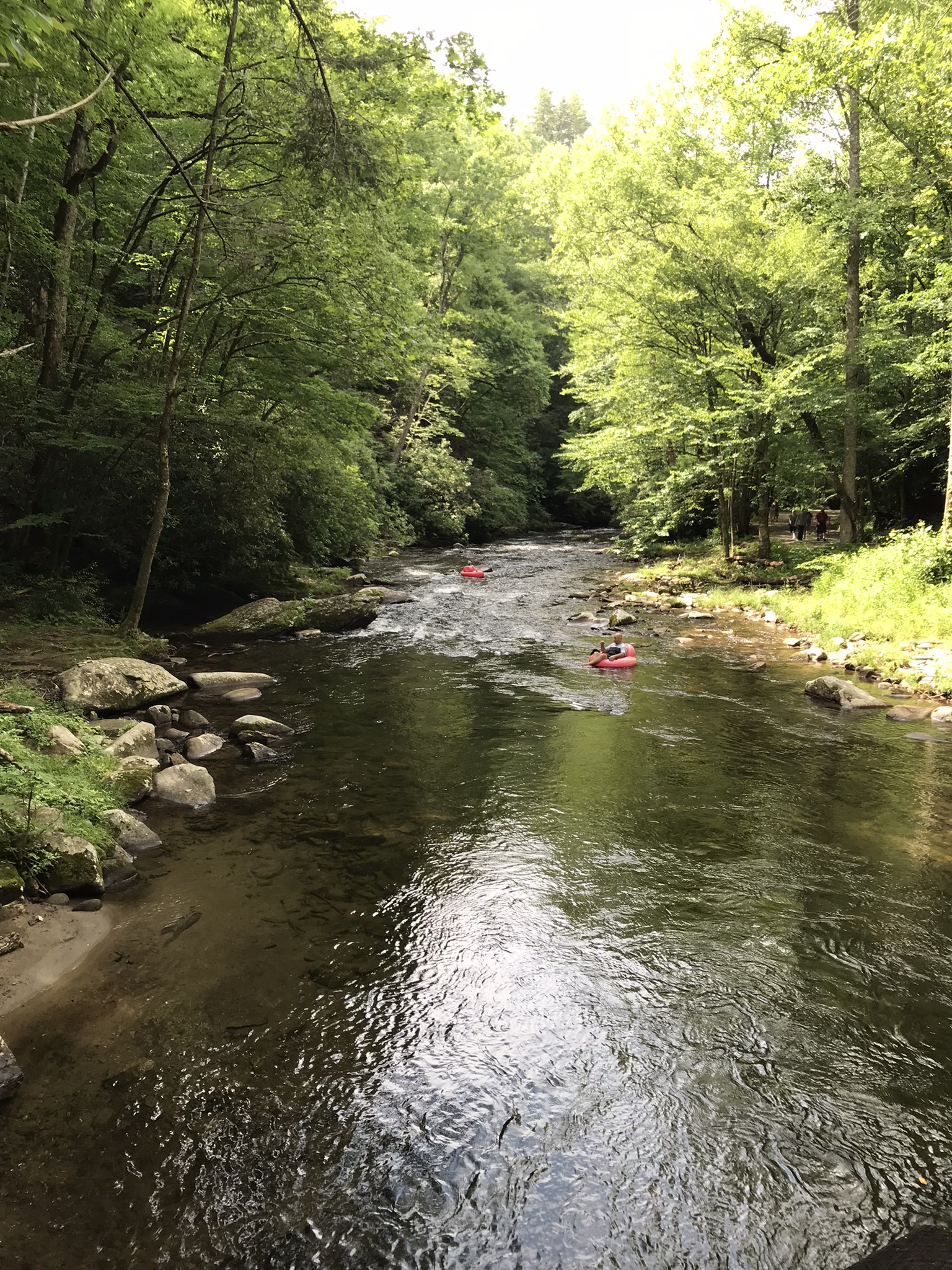
Deep Creek in the section of the national park is a popular creek for tubing. Many families were taking advantage of the creek for tubing on the very warm day we were there. If I were just younger and braver…. It looked like a lot of fun!

People tubing on Deep Creek near Bryson City, NC in Great Smoky Mountains National Park

All that hiking and tubing will make you hungry. My sister and I enjoyed the buffet at Granny’s Kitchen Restaurant on US-19 North going from Cherokee toward Maggie Valley. The wife in the couple who own and operate the restaurant is a Cherokee Indian. It is said if you want to find a good place to eat, look where the locals eat. This was certainly the case at Granny’s. (I am receiving no compensation for publicizing the restaurant. It is a good value and experience for the money. You will not leave hungry!)

People from all over the United States enjoy the Blue Ridge Parkway, the Qualla Boundary, and the Great Smoky Mountains National Park. We kept track of the different license plates we saw. When the trip was over, we had seen cars from 42 of the 50 states and several from Ontario, Canada.

Great Smoky Mountains National Park is the most-visited national park in the country. People are drawn to it by its beauty and biodiversity.

If you wish to learn more about Cherokee, the Great Smoky Mountains National Park, and the Blue Ridge Parkway, I recommend my vintage postcard book, The Blue Ridge Mountains of North Carolina. I packed as many facts and as much history into the book as Arcadia Publishing would allow. The book is available in paperback and e-Book from Amazon.


Since my last blog post

I continue to declutter by going through closets, old magazines, and boxes of memorabilia, photographs, newspaper clippings, and recipes. It is satisfying to look at what I’ve accomplished. My fiction writing has suffered for it, but this really needed to be done.


Until my next blog post

Keep reading and traveling every chance you get.

Visit your local public library, if you are fortunate enough to have one. If you haven’t visited it recently, you might be surprised to find some of the things it offers: Internet access, free access to software such as Ancestry.com, magazines you would like to read but cannot afford to subscribe to, music CDs, used books for sale, a magazine swap, ….

Remember the people of Ukraine.

Janet

#OnThisDay: Apollo-Soyuz Test Project, 1975

This was not planned, but when I started to write this blog post I realized the event whose anniversary we mark today happened 200 years and one week after the historic petition I blogged about last Monday. It’s nice when serendipity happens.

Whereas last Monday’s blog post was about a petition written in 1775 as the American colonies were on the verge of war with Great Britain, today we jump forward to mark an historic joint space exploration venture between the United States and the Soviet Union.

Both events now seem like ancient history in light of where space exploration has taken us today, so it is sobering for me to realize the event I write about today happened a couple of months after I graduated from college. It seems like just yesterday! The passage of time is beyond my understanding.


What was the Apollo-Soyuz Test Project?

The Apollo-Soyuz Test Project was the first multinational space exploration project.


Photo of the night sky filled with stars
Photo by Jack Cohen
on Unsplash

A little background

What made the Apollo-Soyuz Test Project particularly surprising and interesting was that the two participating countries – the United States and the Soviet Union – had been serious and unfriendly competitors in space travel since the late 1950s. The era was known as “the space race.” Each of the countries was determined to beat the other one in reaching every progression in space travel with the ultimate goal of putting a human being on the moon.

This is an over-simplification, but with the United States putting humans on the moon in 1969, the space race transitioned into a posture of sharing knowledge. It was an outgrowth of the “Détente” that started in 1969. Détente brought about more relaxed relations between the US and the Soviet Union.


Things get real in 1973

In the first half of 1973 the two countries announced the names of the astronauts and cosmonauts for the project as follows:

U.S. Commander Thomas P. Stafford

U.S. Command Module Pilot Vance D. Brand

U.S. Docking Module Pilot Donald K. “Deke” Slayton

US backup crew:  Alan L. Bean, Ronald E. Evans, and Jack R. Lousma

Soviet Commander Aleksei A. Leonov

Soviet Flight Engineer Valeri N. Kubasov

Soviet backups: Anatoli V. Filipchenko and Nikolai N. Rukavishnikov

The crews trained together for the first time at NASA’s Johnson Space Center in Houston, Texas in July 1973.

Some details of the project


Soyuz

Launch: July 15, 1975, at 8:20 a.m. EDT
Launch Site: Baikonur Cosmodrome, Kazakhstan
Flight Crew: Alexey A. Leonov, Valery N. Kubasov
Landing: July 21, 1975

Apollo

Launch: July 15, 1975, at 3:50 p.m. EDT
Launch Site: Launch Complex 39, Kennedy Space Center, Florida
Flight Crew: Thomas P. Stafford, Vance D. Brand, Donald K. Slayton
Landing: July 24, 1975

Mission

Docking Time: July 17, 1975, at 12:12 p.m. EDT
Undocking Time: July 19, 1975, at 11:26 a.m. EDT
Total Duration of Joint Activities: 19 hours, 55 minutes
Orbital Inclination: 51.8 degrees

(Source: The Apollo-Soyuz Mission – NASA)

Both spacecraft made orbital adjustments over the first two days to pave the way for the two vehicles to dock in space. People all over the world watched the docking at 12:12 p.m. Eastern Daylight Time, July 15, 1975. Hatches on both vehicles were opened at 3:17 p.m.

Celebratory handshakes and commemorative gifts were exchanged between the astronauts and cosmonauts. U.S. President Gerald Ford and Soviet Communist Party General Secretary Leonid Brezhnev called them to express their congratulations. The astronauts and cosmonauts shared a meal and the hatches were closed for the day.

The following day Brand joined Kubasov in the Soyuz and Leonov joined Stafford and Slayton in the Apollo spacecraft. TV interviews and tours were given, experiments were conducted, and lunch was eaten. Afterwards, Kubasov and Brand left the Soyuz and joined Slayton in the Apollo. Leonov and Stafford then spent time in the Soyuz.

By mid-afternoon the historic exchanges were completed, there was another round of handshakes and goodbyes were said.

At 8:02 a.m., July 19, 1975 the spacecraft were undocked.

Quoting from the NASA website: “As the Apollo capsule backed away, it blocked the sun from the Soyuz vehicle, creating the first human-made eclipse and enabling the cosmonauts to photograph the sun’s corona. The two spacecraft then docked once more, with final undocking at 11:26 a.m.


The end of the successful project

The Soviet cosmonauts continued to conduct life-science experiments for another day. The Soyuz 19 landed near its target on July 21, 1975. It was the first time a Soviet space mission launch and landing were televised.

The Apollo capsule remained in orbit with the astronauts carrying out space-science and Earth-observing experiments for five days after the undocking. It was the last planned ocean landing for U.S. human spaceflight. Splashdown occurred at 5:18 p.m., Eastern Daylight Time on July 24, 1975.


Until my next blog post

What happened on Saturday was an attack on democracy. Let’s hope this week is less eventful than the weekend.

I hope you have a good book to read.

Enjoy some time with your friends and family.

Don’t forget the people of Ukraine.

Janet

This Writer Needed a Change of Scenery — Part II

On the first Monday of each month I usually blog about some of the books I read the previous month. I will write about a couple of the books I read in May in my post on June 17.

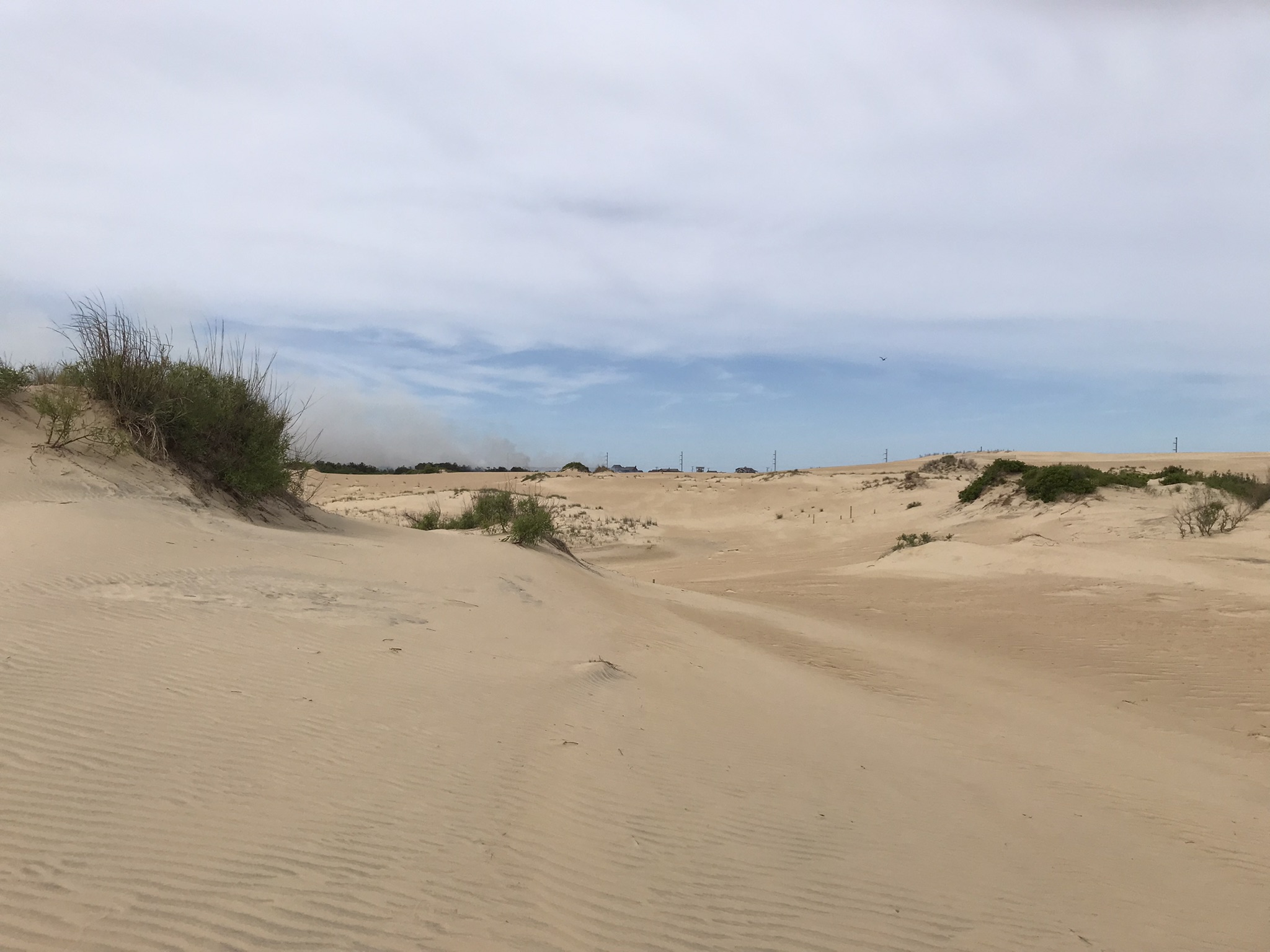
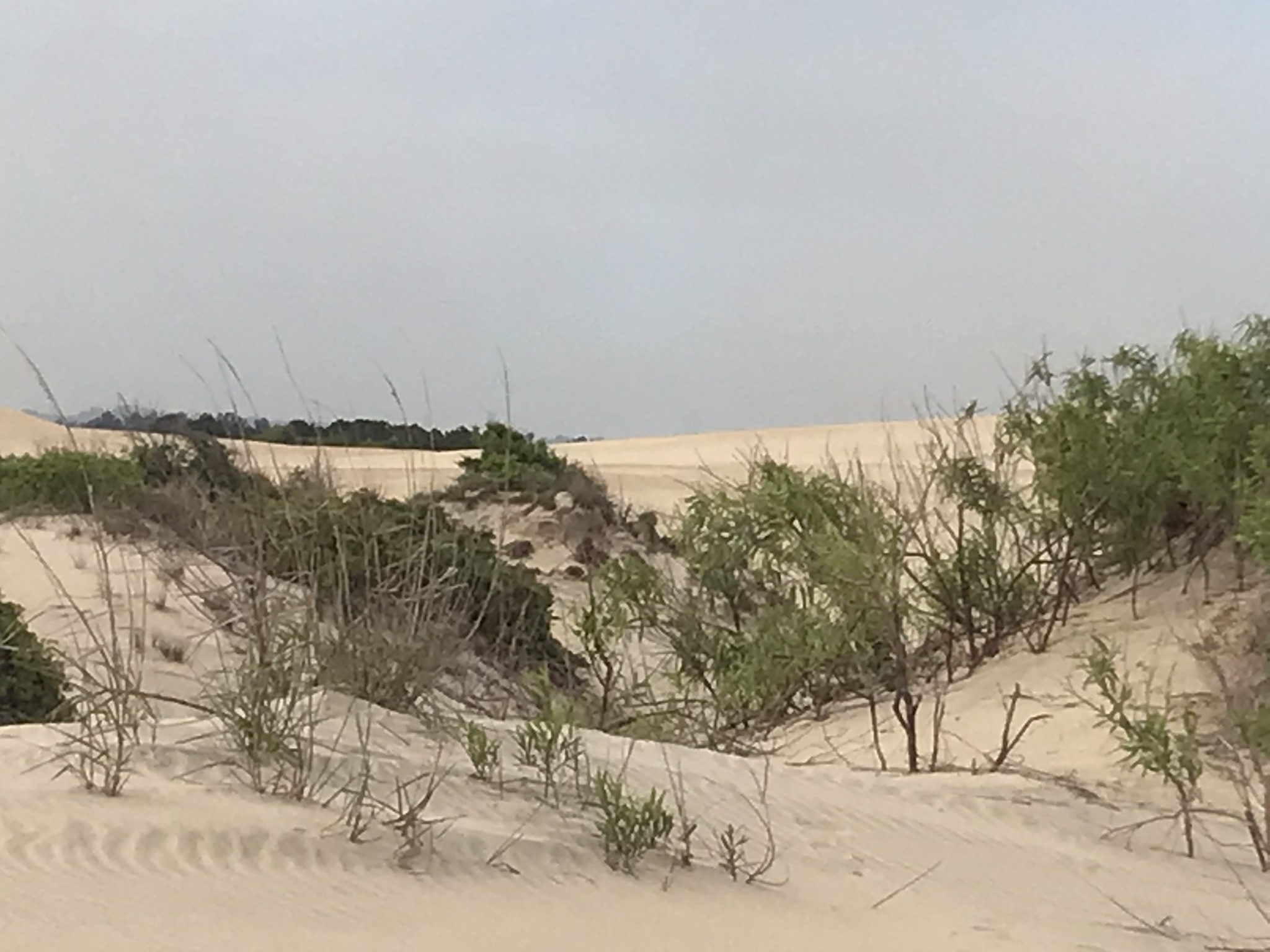
Last Monday I blogged about visiting the northern end of the Outer Banks of North Carolina in mid-May. I failed to illustrate Jockey’s Ridge adequately, so here are a few photos to show you just a little of that massive sand dune.

Amateurs learning to hang glide at Jockey’s Ridge in spite of a control burn being conducted that day.
A view of a small portion of Jockey’s Ridge
Another part of Jockey’s Ridge
Yet another view of Jockey’s Ridge.

Jockey’s Ridge State Park covers 427 acres. It is estimated that the dune contains 30 million tons of sand and has been there for 7,000 years. For more information, visit https://www.ncparks.gov/state-parks/jockeys-ridge-state-park.


The southern end of the Outer Banks

The rest of today’s post covers the sights on the southern part of those barrier islands.

I hope you will be inspired by my blog to add the Outer Banks to your “bucket list” as the 120-mile-long string of barrier islands is a natural treasure everyone should get to see at least once.

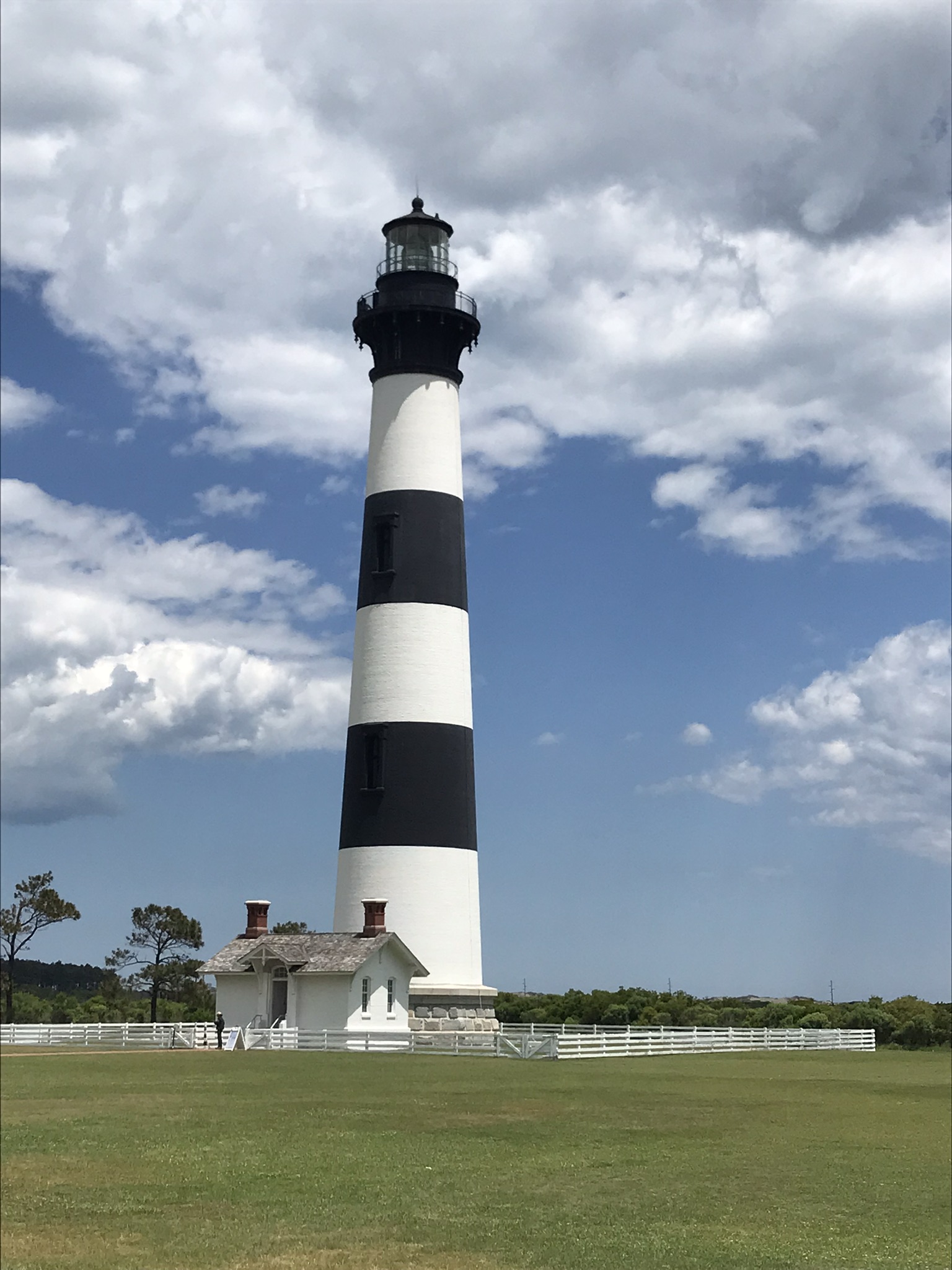
Enjoy the beautiful Bodie Island Lighthouse and adjoining boardwalk trail. https://www.nps.gov/caha/planyourvisit/bils.htm

Bodie Island Lighthouse

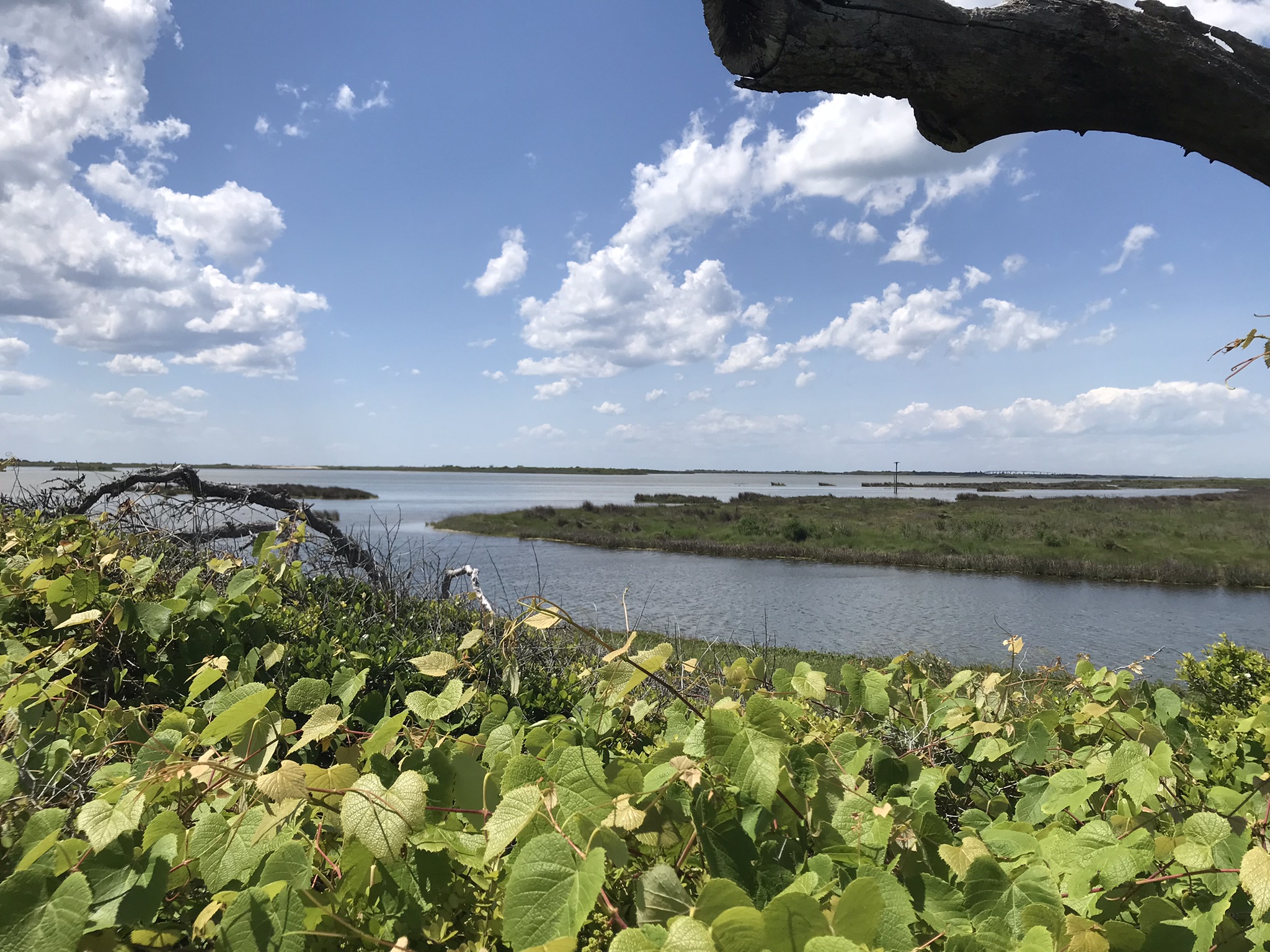
Set aside time to hike in the Pea Island National Wildlife Refuge. https://www.fws.gov/refuge/pea-island

Pea Island National Wildlife Refuge – View from hiking trail

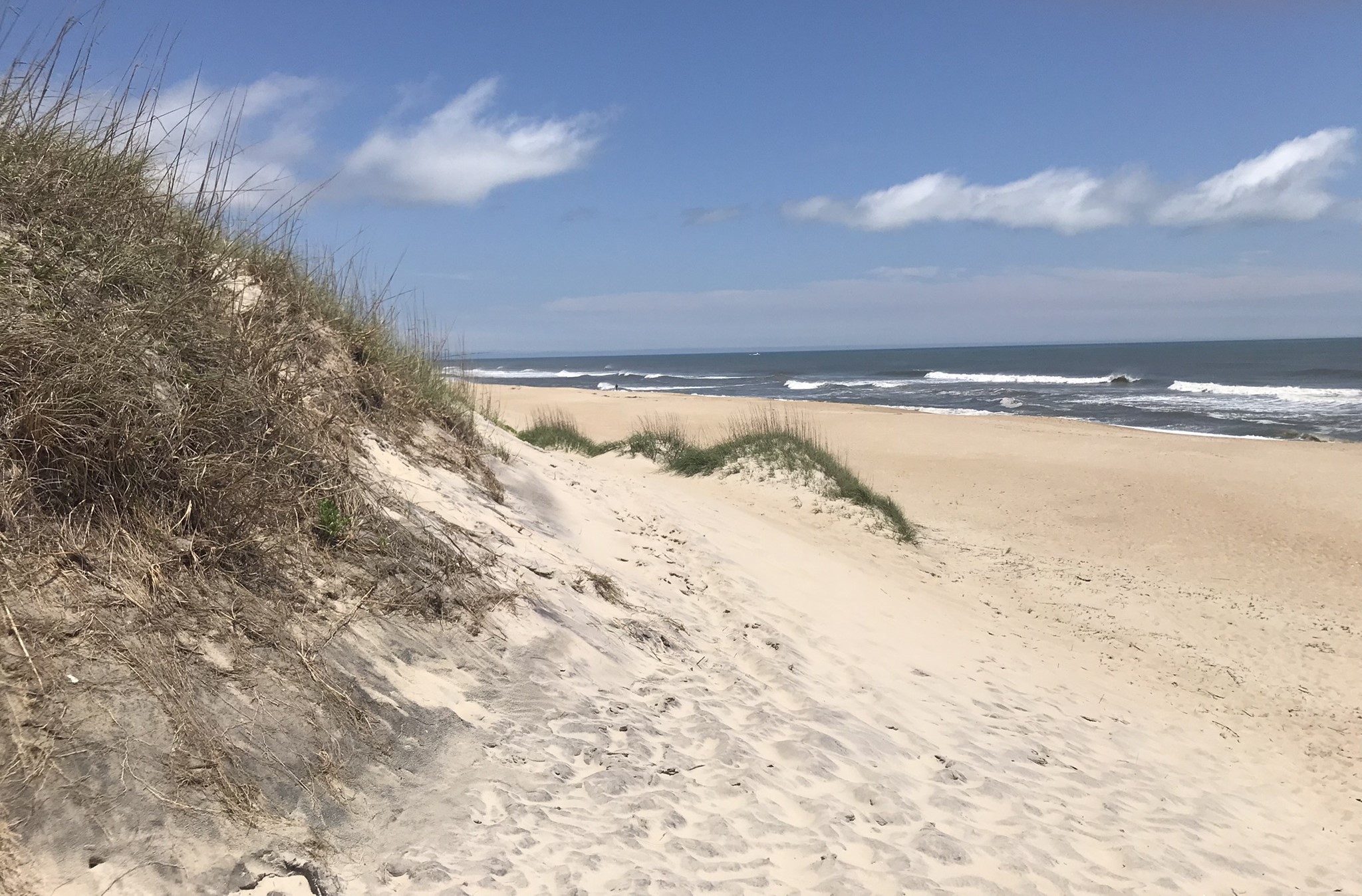
Take advantage of beach access stops along the way to enjoy the sand, the churning Atlantic Ocean, and Pamlico Sound.

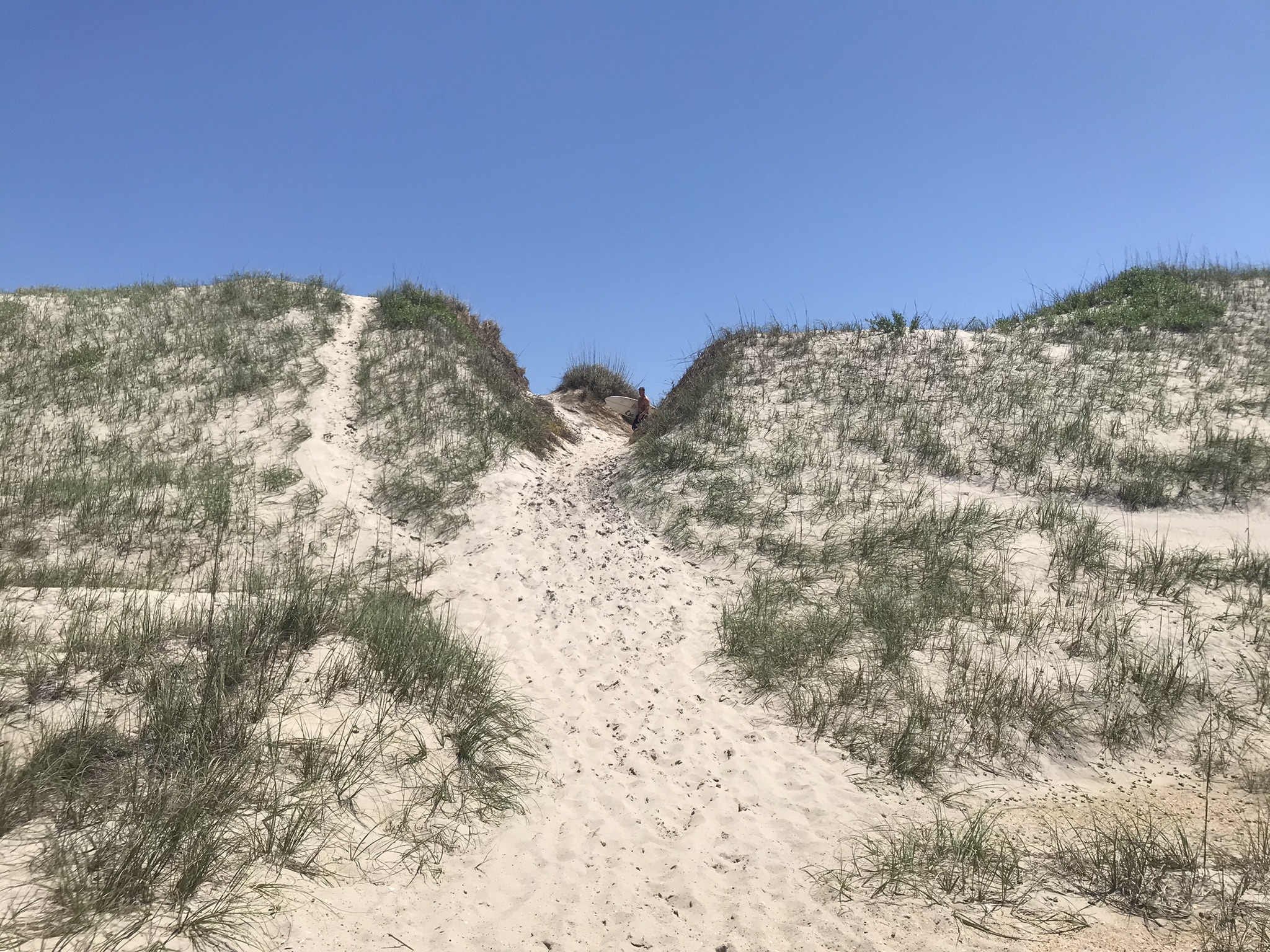
You might have to hike over a sand dune to get to the ocean!
It’s worth the climb!

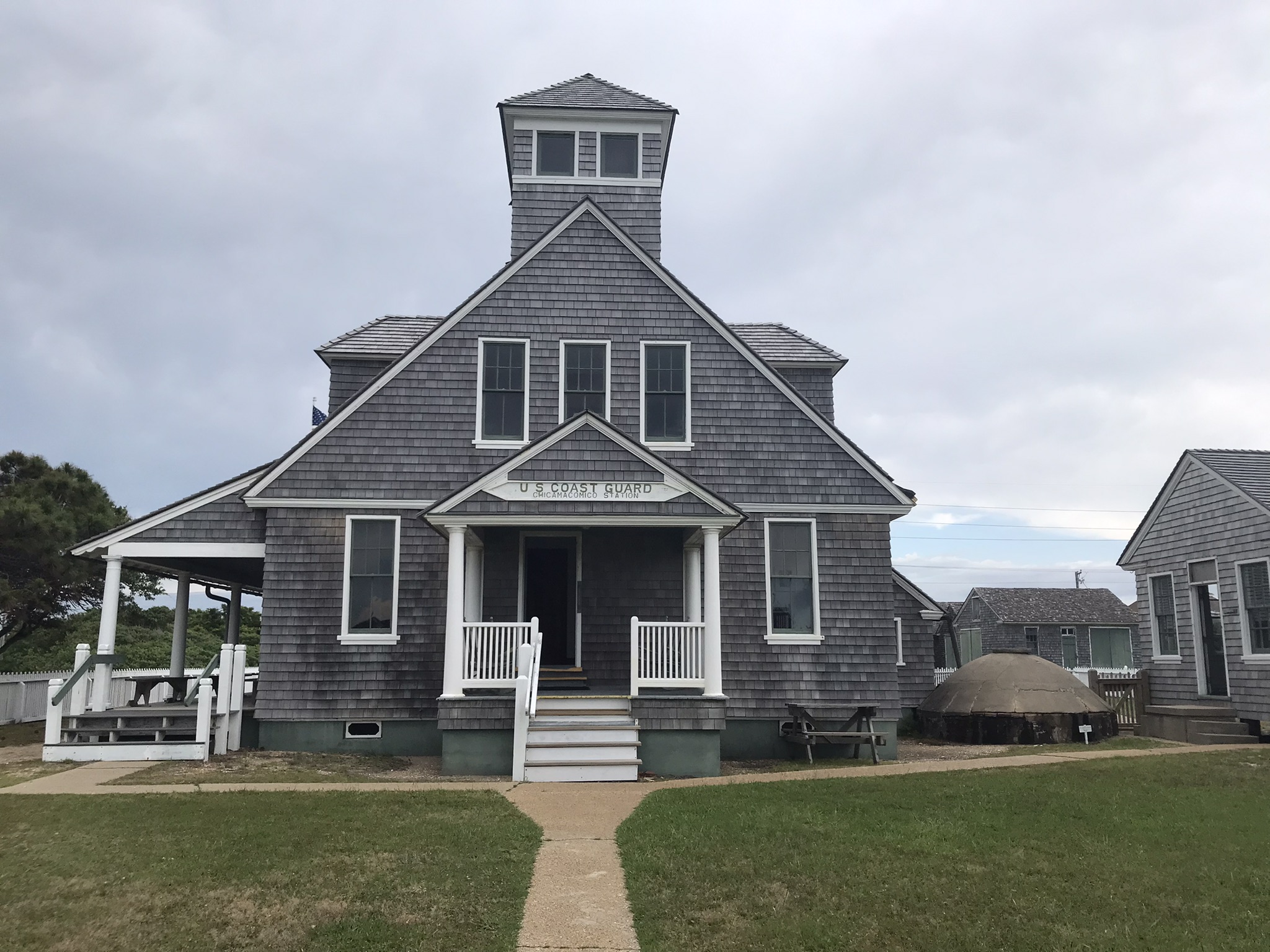
Be sure to visit the Chicamacomico Life-Saving Station in Rodanthe, established 150 years ago, to learn about the bravery of the men who risked their lives for decades to rescue sailors in distress along this “Graveyard of the Atlantic.” The video there is quite informative. For more information to help you plan your visit, this website gives details: https://chicamacomico.org/.

Chicamacomico Life Saving Station

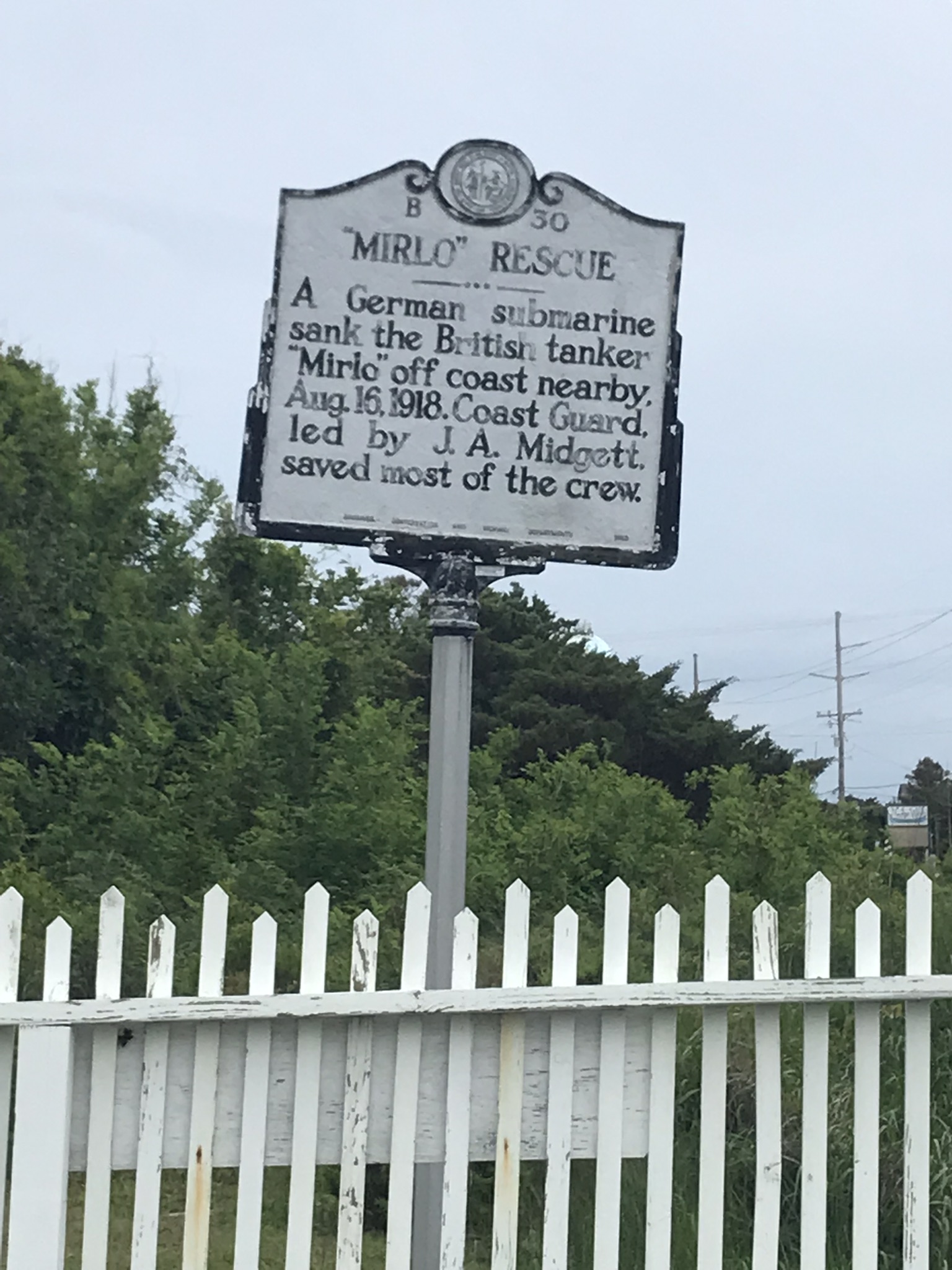
We tend to think of all of World War I taking place faraway in Europe and, indeed, most of it did; however, the Atlantic coast of the US was not immune to attack and the ramifications of sea warfare between Germany and England. Below is a photo of the roadside marker about the nearby sinking of a British tanker, Mirlo, by a German submarine. Coast Guardsmen stationed at Chicamacomico saved most of the tanker’s crew. If you want to read more about the rescue of the Mirlo, I recommend this website: https://www.ncpedia.org/mirlo-rescue.

World War I “Mirlo” Rescue Roadside Marker at Chicamacomico

Rodanthe was in the news again last week because another house fell into the ocean. According to the National Park Service, that’s the sixth privately-owned house to be claimed by the Atlantic in recent years. It makes one wonder why they were allowed to build houses there. Volunteers were sought the following day to clean up pieces of the house and its contents that had been strewn up and down the beach.

I took a picture of several houses the ocean is trying to claim on the beach at Buxton. This situation makes no sense to me.

Looks like some more houses on the Outer Banks are tempting fate!

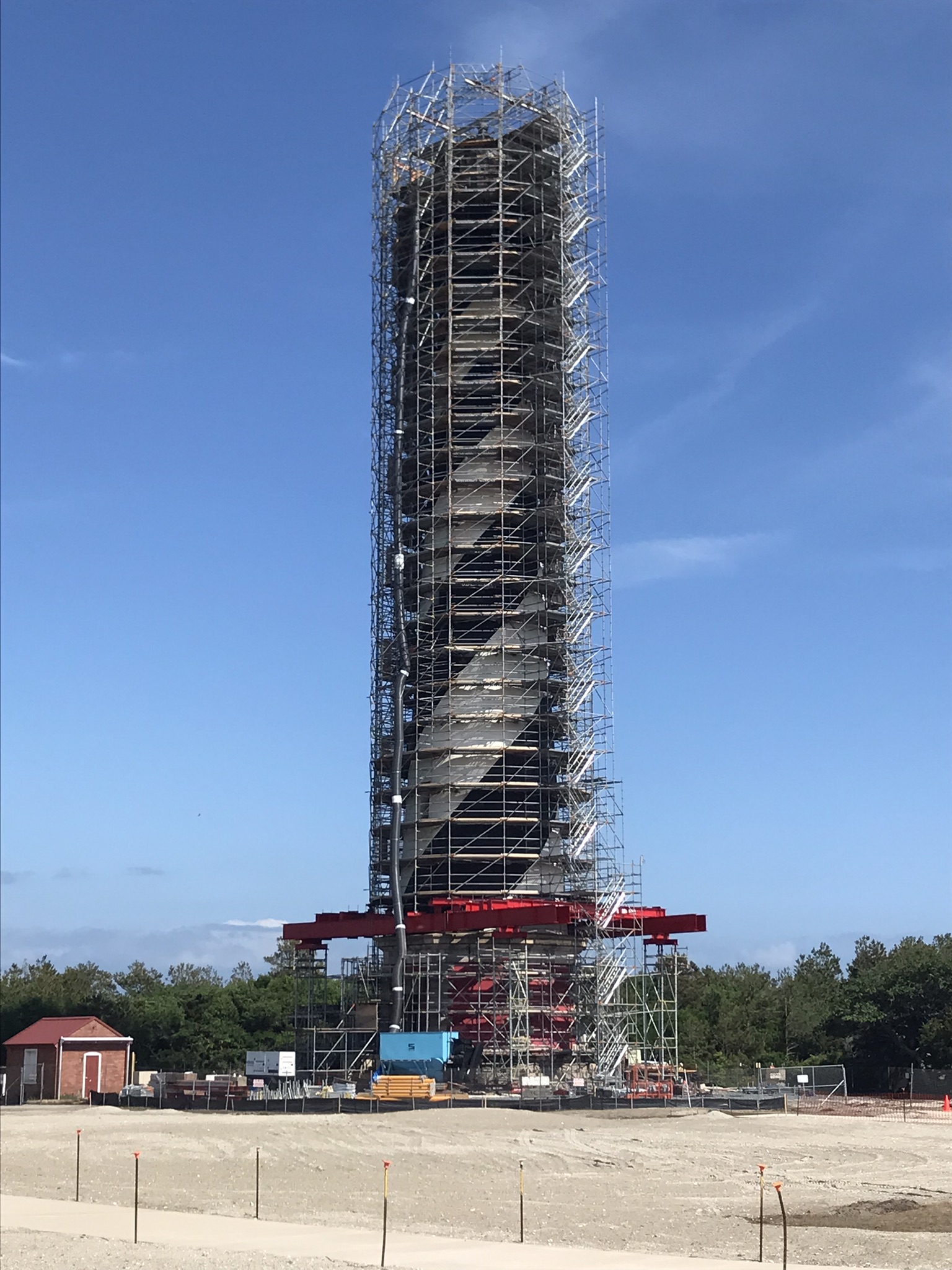
Buxton is home to the glorious Hatteras Lighthouse – at 198.49 feet it is the tallest brick lighthouse in the United States. One word of caution, though: The Hatteras Lighthouse is undergoing two years of restoration and is currently encased in scaffolding.

Cape Hatteras Lighthouse under restoration in May 2024

While it is closed, you can take virtual tour online at http://Cape Hatteras Light Station – Cape Hatteras National Seashore (U.S. National Park Service) (nps.gov). Fortunately, I saw it at its original location before its historic move in 1999 to save it from the ocean. The visitor center is open and you can get close enough to take pictures of the lighthouse during the 18- to 24-month restoration.

The iconic black and white painted swirl just can be seen through the scaffolding, but you might want to wait and visit in the summer of 2026 to see it in all its beauty. If you like lighthouses, you’ll love this one!

(This month’s experience reminded us of our once-in-a-lifetime trip to New York City in the mid-1980s. We rode the Staten Island Ferry so we could see the Statue of Liberty even though it was being restored and was completely encased in scaffolding. We have a knack for seeing national landmarks during their restorations!)

If you go to Hatteras Island now, you can visit the Graveyard of the Atlantic Museum. It has undergone a major remodel and was still closed when I was there on May 16-17. The grand re-opening was held on May 20, so I just missed getting to see the inside of it. Here’s the museum’s website: https://graveyardoftheatlantic.com/. Note that it is not open on weekends or state holidays.

Graveyard of the Atlantic Museum on Hatteras Island

Ocracoke Island

Storms along the Outer Banks wreak havoc with North Carolina Highway 12. Literally! The Department of Transportation constantly must remove sand from the highway, close it due to high water, and – occasionally – relocate the road.

A storm in April 2024 created all kinds of problems along NC-12. It had been restored to good condition down as far as Hatteras Village, but as of three weeks ago the portion on Ocracoke Island (http://First-timers Guide to Ocracoke Island – Visit Ocracoke NC) was still being worked on.

We had planned to take the free NC ferry from Hatteras Island to Ocracoke Island and the fee-supported NC ferry from Ocracoke to the mainland, but due to the one-lane traffic on part of Ocracoke Island we changed those plans and drove back up the Banks to Southern Shores and bridges to the mainland. (Here’s a important website, if you’re planning to use any of the 21 ferries operated by the NC Department of Transportation: https://www.ncdot.gov/travel-maps/ferry-tickets-services/routes/Pages/default.aspx.)

The Outer Banks of North Carolina are truly a national treasure. If you bemoan the fact that you must pay federal income tax, just remember that your hard-earned tax dollars help preserve miles and miles of the Outer Banks of North Carolina.

In fact, I’ve heard it suggested that if you resent paying income tax perhaps you should choose to think that all your tax dollars go to support the national parks, national seashores, and historic sites.

Look for the third and final installment of my blog series about my recent need for a change of scenery next week when I will tell you about the many points of interest we enjoyed on our way to and from the piedmont to the northeastern coastal plain of North Carolina. I think you are in for some surprises!

Until my next blog post

I hope you have a good book to read.

In case you missed the first part of my two-post blog series about the Outer Banks of North Carolina, here’s the link to my May 27, 2024 post: https://janetswritingblog.com/2024/05/27/this-writer-needed-a-change-of-scenery-part-i/.

Remember the people of Ukraine.

Thank you for taking the time to read my blog! When you have a couple of minutes, I invite you to visit my website to see what I was doing prior to my trip and the types of writing I will continue to do: https://www.janetmorrisonbooks.com.

Janet

Do you associate volcanoes with North Carolina?

Now that I have your attention… today’s blog post is about ancient history. This is one of the topics I wrote about in Harrisburg, Did You Know? Cabarrus History, Book 2.

Photo of a volcano by Guille Pozzi on Unsplash.com.
Photo by guille pozzi on Unsplash

Harrisburg, North Carolina sits inside a 22-mile syenite or ring dike. One can get a feel for it from several high points in the area, such as when traveling south from Concord on US-29 near the intersection with Union Cemetery Road. It’s like looking across a gigantic bowl.

Another possible place from which to catch a glimpse of the “bowl” is on NC-49 southbound after you pass Old Charlotte Road. The Charlotte downtown skyline is visible briefly from that location as well as the one referenced above on US-29.

Harrisburg, Did You Know? Cabarrus History, Book 2, by Janet Morrison

What, you may ask, is a syenite or ring dike? I’m no expert on volcanology, but my understanding is that it is a circular dike around a volcano.

According to 2001 Encyclopedia of Earthquakes and Volcanoes, by David Ritchie and Alexander E. Gates, Ph.D.:

“If magma is removed from the magma chamber beneath a volcano, it can undergo caldera collapse. The volcano and the area around it collapse because they are no longer being held up by the liquid. A series of concentric faults and cracks develop around the collapsing volcano. As they do, magma will squeeze up around the cracks and faults forming ring dikes.”

I’ll take their word for it.

In 1966, U.S. Geological Survey geologist Harry E. LeGrand and Henry Bell III led a scientific excursion in Cabarrus County to study our ring dike and other interesting rock and mineral deposits in the county.

You might be able to access a pdf of “Guidebook of Excursion in Cabarrus County, North Carolina, October 22-23,1966” by going to https://www.carolinageologicalsociety.org. Search for “1960s Field Trip Guidebooks” and then scroll down to find that particular guidebook.

The Harrisburg area has experienced a population explosion since 1966. The landmarks noted in the 1966 guidebook are either gone or more difficult to locate today. The concentric rings that were reportedly visible from the air in 1960 by R.G. Ray might not still be intact.

If you’d like to know more about this topic, the 1849 meteorite; Harrisburg’s first organized housing and business development of 100 years ago; the Morrison-Sims Store and Old Post Office; the flood of 1886, the Piedmont Area Development Association (P.A.D.A) of the 1960s; earthquakes that have been felt here; McCachren’s Store; Rocky River bridges in the 1870s; the Sauline Players; a tribute to George L. Govan; Rocky River Academy; the Rocky River Presbyterian Church’s fourth sanctuary which was completed in 1861; a 1777 estate sale; Hugh Smith Pharr and his mill; a 1907 attempted train robbery; 1816 – the year without a summer;

Also: items such as milk, apples, and dry cleaning that were all delivered to homes in the mid-1900s; Blume’s Store; high-speed trains; the boundaries of Township 1; early Harrisburg education; Pharr Grist Mill on Back Creek; how electricity came to Harrisburg; a 1912 church homecoming; Pioneer Mills Gold Mine and Community; a fellow named Collett Leventhorpe; a 1911-1912 debating society; and the tenth anniversary of the Harrisburg Branch of the Cabarrus County Public Library system… please purchase Harrisburg, Did You Know? Cabarrus History, Book 2.

The book also contains nearly 150 pages of my research notes on subjects I didn’t get to write about when I wrote a local history newspaper column from 2006-2012.

Harrisburg, Did You Know? Cabarrus History, Book 1 and Book 2 are available in paperback at Second Look Books, 4519 School House Commons in Harrisburg, NC.

Second Look Books, 4519 School House Commons, Harrisburg, NC

They are also available in paperback and e-Book from Amazon at https://www.amazon.com/dp/B0BW2QMLHC/.

An infographic ad for Harrisburg, Did You Know? Cabarrus History, Books 1 and 2

Until my next blog post

I hope you have a good book to read.

I hope you get to spend quality time with friends and family.

Remember the people of Ukraine.

Janet

P.S. Please visit https://www.janetmorrisonbooks.com and subscribe to my e-Newsletter. Next issue due out the first week of January!

The Other Two Books I Read in May 2023

I love the months in which I get to read so many books that it takes me more than one blog post to tell about them! May was one of those months. Today’s post is about the last two books I read in May. I hope at least one of them will appeal to you.


One Thought Scares Me, by Richard Dreyfuss

In One Thought Scares Me, Richard Dreyfuss presents his thoughts about how democracy has been eroded in the United States by the removal of the study of government (or civics) in our public schools. He pinpoints this quiet removal as happening 50 years ago, so it was after I graduated from high school.

One Thought Scares Me, by Richard Dreyfuss

I remember hearing a few years ago that in North Carolina the high school American History curriculum would begin with the Presidency of George Washington. I’ve wondered since then how the Presidency of George Washington would make any sense to a student who didn’t know that it followed an American Revolution.

If an American knows nothing about the Declaration of Independence – why it was written, who wrote it, when it was written, who we were declaring our independence from — and most importantly, how the signers of it risked their very lives by signing it – then they will not know what political conditions the early American settlers lived under.

If an American knows nothing about the American Revolution – why it happened, when it happened, who we were rebelling against, etc., then that American will not value what it means to be an American citizen. If they don’t know what those who came before us suffered through just to gain the right to vote, they will not value their right to vote. They will feel no obligation to vote.

If an American knows nothing about the Bill of Rights – why those ten rights were spelled out in the United States Constitution and what they are – then they won’t know when a US President or the US Congress or their State Legislature is taking away one or more of those rights.

If an American knows nothing about US history, they won’t know that July 4th is more than just a day off from work when you eat burgers and hotdogs and shoot off fireworks.

In order to be a good citizen of the United States of America, you must know the history of the country. As Mr. Dreyfuss points out in his book, it was the system of public education in the United States in the early 1800s that made it possible for every child to learn to read and write. It made it possible for every child to learn the Pledge of Allegiance, to learn about colonial times, to learn about the American Revolution, to learn about the ugliness of slavery, to learn about the Civil War, and to learn about all the wars American have fought around the world in the name of freedom.

My two-cents’ worth:  If you take that out of the public schools – and if you disrespect public education and public school educators the way the North Carolina General Assembly continues to do – then you lose the level playing field on which our country was built and you lose what binds us together as a nation.


Seeking the Historical Cook: Exploring Eighteenth-Century Southern Foodways, by Kay K. Moss

Reading this book after taking the Open Hearth Cooking Class at Hart Square Village on May 20 was very beneficial. The hands-on class was invaluable to me in writing historical fiction, and the book made a lot more sense to me having had the class.

Seeking the Historical Cook, by Kay K. Moss

The book covers how to interpret historical “receipts” as recipes were called in the American Colonial Era, and the importance of incorporating an 18th century mindset when using the old recipes. Ms. Moss and her books are a goldmine for anyone doing research on frontier life in the Carolinas.

This book is illustrated and very detailed in cooking instructions, including the importance of getting the hot coals just right and judging the heart, cooking/baking time, and always having hot water on-hand.


Cyberspace fiasco since my last blog post

To say it was a frustrating week would be an understatement. My email service was disrupted for about 24 hours Tuesday into Wednesday. My Facebook account was hacked on Thursday. My LinkedIn account was hacked on Saturday. My Evernote account was hacked on Sunday.

Would be writers like me are told we must have a vast social media presence if we want to ever get published. We must have followers in the thousands and tens of thousands.

After what I’ve been through over the last few days, I’ve decided to remove myself from Facebook, LinkedIn, and Evernote. Each of those accounts had unique passwords. It bothers me that hackers can take control of my stuff without any problem; however, when I try to get an account back I must provide all sorts of documentation to prove that I am me. Life is short. I don’t foresee ever having time again for Facebook, LinkedIn, or Evernote. I’ll miss some things about Facebook, but the other two won’t be missed at all. Just for good measure, I’ll no longer be on Twitter either. It was a hassle anyway. I won’t miss it a bit.

If not having 40,000 followers on Facebook, Twitter, LinkedIn, etc. means I’ll never get my novels published, I guess that’s the price I’ll pay.

If you receive notification via Facebook when I’ve posted a blog, you’ll no longer receive those notifications because as of last Thursday, I have no control over my Facebook account. In fact, you won’t be notified about today’s post. Someone else, apparently in Beijing, has control of my account now. Facebook indicated it would take them 48 hours to verify that I am Janet Morrison. It’s been longer than that, so I guess they’re still just playing games with the hacker in Beijing. I regret that I didn’t get to tell my acquaintances on Facebook goodbye.

My blog is protected through a whole different server, etc., so I plan to continue to blog every week and treasure the lifeline it has become.

I envy Harper Lee and her manual typewriter. She got to just hide away in Alabama and write To Kill a Mockingbird with no worries about cyberspace. There’s something appealing about that era.

Speaking of birds… the three neighborhood cats must have miserable home lives because they want to stay in our yard all the time stalking our wild birds. In my spare time last week, I had to construct a barricade to try to prevent the cats from getting to the nest of baby Carolina Wrens in the hanging basket on my porch.

Thank you for the feedback I continue to get since posting To Write or Not To Write Historical Short Stories? What do you think? on May 29. All opinions are welcome!


Until my next blog post

I hope you have at least one good novel or non-fiction book to entertain and educate you.

With the smoke from the wildfires in Canada dissipating, we on the east coast of the US look forward to clear skies and some sunshine.

In case you’re planning a trip to Great Smoky Mountains National Park, Cherokee, or the Blue Ridge Mountains this year, be sure to pick up a copy (paperback or for Kindle) of my vintage postcard book, The Blue Ridge Mountains of North Carolina. I packed as much natural history and human history into the postcard descriptions as Arcadia Publishing would allow. I think you’ll find it entertaining and painlessly educational.

The Blue Ridge Mountains of North Carolina, by Janet Morrison

Don’t forget the people of Ukraine. Believe me… I know my life — even with all my cyberspace problems — is easy compared to their suffering. I truly know that.

Janet

Mecklenburg Declaration of Independence, Revisited

Even though we can’t show you an original copy of this declaration, it is written on our hearts as the descendants of those who whole-heartedly supported it as they prepared for the inevitable war against King George III of Great Britain.

The Americans’ beef wasn’t with the people of Great Britain – many of them were their relatives and friends – their beef was with the King – and they knew their friends and relatives back in Scotland were secretly wishing them well for they were also under the thumb of the King.

The year was 1775. The date was May 20.

The people of Mecklenburg County in the backcountry of North Carolina had had all they could take of King George and the oppressive laws and taxes he and the British Parliament continued to impose on the American colonists. After all, the reason most of them had left Europe was to escape monarchs who had little or no regard for their subjects.

The years leading up to May 20, 1775 had been tense. On May 2, 1771 a group of Mecklenburg County residents had taken matters into their own hands and blown up a shipment of munitions King Charles had ordered to be transported from Charleston, South Carolina to Rowan and Orange counties in North Carolina to put down The Regulator Movement.

The perpetrators of that gunpowder plot had been declared traitors and were still being hunted down by the Royal Government authorities when the county militias sent representatives to a convention in Charlotte to debate political conditions. The result was the writing of the Mecklenburg Declaration of Independence more than a year before the more famous one was written in Philadelphia.

The document set out the citizens’ grievances and declared themselves free and independent of Great Britain. Sadly, the original copy of the declaration was lost in a fire at the home of John McKnitt Alexander on April 6, 1800. The Declaration was reconstructed from the memories of those who had written it and signed it.

A recreation of the Mecklenburg Declaration of Independence.

There are Mecklenburg Declaration of Independence doubters today, but I have no doubt that it existed. It was followed just 11 days later by the Mecklenburg Resolves, which was a similar document.

Captain Archibald McCurdy of the Rocky River Presbyterian Church area of old Mecklenburg County that is present-day Cabarrus County, stood at the Mecklenburg County log courthouse steps and heard the Declaration read. He went home and told his wife, Maggie, they needed to make a list of the people they knew they could trust. There were a few Loyalists in the area.

Whatever you’re doing this Saturday, May 20, take a moment to reflect on what the brave people of Mecklenburg County, North Carolina did 248 years ago. If you live in the United States of America, ponder the stand they took on that day. The King proclaimed them to be in a state of rebellion, and the men who signed the document risked their very lives by proclaiming they were free.

Since my last blog post

Spring is finally in full force here in North Carolina. All I have to do is put a hanging basket of pretty flowers on a hook on the side porch and I can count on “Mama Bird” – a Carolina Wren – to build a nest in it. She’s done is for decades.

Having bronchitis and no set schedule allowed me time to do some reading last week. I have some interesting books to tell you about in my May 22 and June 5 blog posts.

I continue to remind folks on Facebook to purchase my local history books. I’m trying not to be a nuisance.

Until my next blog post

I hope you have a good book to read, including Harrisburg, Did You Know? Cabarrus History, Books 1 and 2, as well as The Blue Ridge Mountains of North Carolina.

Don’t forget to visit my website (https://www.janetmorrisonbooks.com) and subscribe to my newsletter. I have special plans for May 20 and I can’t wait to tell you all about them in my July newsletter!

Make time for family and friends.

Remember the people of Ukraine.

Happy Mecklenburg Declaration of Independence Day on Saturday!

Janet

Taking a look at The Bill of Obligations, by Richard Haass

Once in a while I come across a book that hits on so many points of importance that I decide to devote an entire blog post to it. The Bill of Obligations: The Ten Habits of Good Citizens, by Richard Haass, falls into that category.

The Bill of Obligations: The Ten Habits of Good Citizens, by Richard Haass

Dr. Haass is president of the nonpartisan Council on Foreign Relations. A diplomat and policymaker, he served in The Pentagon, State Department, and White House under four presidents – Democrats and Republicans.

Here’s a quote from the book jacket: “As Richard Haass says, ‘We get the government we deserve. Getting the one we need, however, is up to us.’ The Bill of Obligations gives citizens across the political spectrum a plan of action to achieve it.”

In the chapter titled “Rights and Their Limits,” Dr. Haass states that the aim of his book “… is to focus on another, often overlooked dimension of citizenship. I am speaking here of obligations, of what citizens owe one another and the country,” and not the rights of individuals. The book focuses on what citizens should do, not what they are required to do.

Dr. Haass draws a distinction between responsibilities and obligations. Responsibilities can be shirked. He says, “What makes obligations so important is that the ability of American democracy to endure and deliver what it can and should to its citizens depends on their being put into practice.”

He points out that, “Placing obligations at the core of citizenship is necessary because the protection and promotion of political and economic rights inevitably lead to disagreements.” He likens obligations fueling a democracy to the gasoline that fuels an engine.

Dr. Haass maintains that democracy in the US “has come to focus almost exclusively on perceived rights and is breaking down as a result.”

This book was being written during our time of transition from the Trump Administration to the Biden Administration, and the “peaceful transition of Power” enjoyed by the US for more than 200 years was in question. He wrote, “What we don’t yet know is whether what happened in late 2020 and early 2021 was an aberration or a precedent.”

Although some Americans have predicted that we’re heading for a second civil war, Dr. Haass is of the opinion that the more likely scenario is something similar to “The Troubles” in Northern Ireland where paramilitary groups target public places frequented by those people they oppose. Unlike a civil war, such violence has no set beginning and no set end because no one is in charge.

Dr. Haass reminds us that democracy is difficult. It requires informed participation from its citizens. From its leaders “it asks for good faith and restraint, and a willingness to put the collective interest before politics, party, or personal gain.”

My take on that

In my opinion, we’ve lost all of that. Too many people refuse to watch the news on TV “because it’s all bad” and few people read a newspaper now or seek out alternative news sources such as National Public Radio. Too many people say they aren’t interested in politics. It’s too easy to just say all politicians and government employees are bad people or lazy.

I’ve worked in the business world and in the government. It was my experience that government employees were more dedicated and conscientious than the ones I worked with in the business world. Let’s just stop jumping on the bandwagon of throwing everyone and everything associated with our democracy “under the bus.”


Back to Dr. Haass’ book

Dr. Haass writes about how technology has changed politics in an important way. It happened without our even being aware. Whereas political parties used to have some control over who ran for office, now anyone with enough money and technical communications savvy can run for office.

Extremists can rally vocal followers and spread their views (and their lies) through social media in ways unheard of or imagined just a couple of decades ago. The person with the loudest voice gets the attention, even if that person holds narrow or extreme views.

The book talks about how, like me, the author grew up in the 1950s and 1960s. We were taught in school that America was “a melting pot.” More and more, though, Dr. Haass says instead of a melting pot, we’re “a loose collection of separate pots” now. We live in “Red” states or “Blue” states, and few live in “Purple” states. There are divisions on every turn.

He goes on to write about history, values, and obligations not being taught in school.

The second part of Dr. Haass’ book addresses what he calls The Bill of Obligations. He writes about what he means by each one, but I’ll just list them for you here:

  1. Be Informed
  2. Get Involved
  3. Stay Open to Compromise
  4. Remain Civil
  5. Reject Violence
  6. Value Norms
  7. Promote the Common Good
  8. Respect Government Service
  9. Support the Teaching of Civics
  10.  Put Country First

Dr. Haass’ Conclusion

Quoting from the “Conclusion” chapter of the book: “The central argument of this book is that American democracy will endure only if obligations join rights at the core of a widely shared understanding of citizenship.” It won’t happen overnight, but the rewards will be reaped years from now.

Dr. Haass proposes that we turn our attention to making the ten obligations a priority because all the “hot button” issues vying for our attention will not be solved or resolved if they aren’t debated in a vibrant democracy.

In the end, Dr. Haass sounds the alarm: “The reality that January 6, and the subsequent revelations about efforts to impound voting machines and discount legally cast ballots, has failed to shock the body politic into its senses, has failed to stir us into action to protect and preserve this democracy, challenges the conventional wisdom that crises are automatic precursors of change. We get the government and the country we deserve. Getting the one we need, however, is up to us.”

My Conclusions

Regardless of your political leanings, I hope you’ll take the opportunity to read The Bill of Obligations. There’s much food for thought in this small book. My hope is that reading it will prompt each of us in the US to be better citizens and more-informed about our democracy.

For the most part, I agree with Dr. Haass’ Bill of Obligations. I’m not as optimistic as he is, though. I recently said something to a university sophomore about January 6. She didn’t know what I was talking about!


Since my last blog post

I’ve been diagnosed as having bronchitis and asthma. Instead of sending out my newsletter on Monday, I finally got it together and emailed to my subscribers on Thursday. I’ve fallen woefully behind in reading the posts by the bloggers I follow.

My illness forced me to miss an author event by John Hart. I didn’t think Mr. Hart should have to compete with my hacking and coughing.


Until my next blog post

I hope you have a good book to read.

Don’t take good health and supportive friends and family for granted.

Remember the brave people of Ukraine.

Thank you for dropping by my blog.

Janet

Local History is Revealed in National Archives Holdings

The first documented gold discovery in the United States was here in present-day Cabarrus County, North Carolina in 1799. The discovery by a little boy playing in Little Meadow Creek led to gold fever in the area. Numerous gold mines were dug and mined to various levels of success.

In fact, there was enough gold found in the southern piedmont of North Carolina that a branch of the United States Mint was built in Charlotte in 1836 and 1837. It opened for the production of gold coins in 1837.

A trip to the National Archives at Atlanta (which is in the Atlanta suburb of Morrow, Georgia) a few years ago gave me the opportunity to look at ledger books from the Mint in Charlotte. Within those pages I recognized names from my community.

Register of Gold – Branch Mint – Charlotte

I’m blogging about some of that information today to give you an example of the type of documented local history I included in Harrisburg, Did You Know? Cabarrus History, Book 2. Although the book (and Harrisburg, Did You Know? Cabarrus History, Book 1) concentrate on Harrisburg, both books do include articles about other communities in Township One.

One of the communities rich in history in the township is Pioneer Mills. Little more than a quiet crossroads now, it was a center of activity in the mid-1800s after the discovery of gold and the opening of Pioneer Mills Gold Mine.

I recognized names such as John C. Barnhardt from the Pioneer Mills community as taking 123 ounces of amalgam to the Charlotte Mint on August 31, 1843, for which he was paid $2,340.33. That was no small sum of money in 1843!

Robert Harvey Morrison, on whose land the Pioneer Mills Gold Mine was located, was paid more than $4,000 for the gold bars and amalgam he took to the Mint from late in 1846 into early 1850.

Other names I recognized in the Mint ledgers included two other Barnhardts,  Robert R. King, three men with the surname Treloar, and R.B. Northrop.

Comparing US Census records, Charlotte Mint records, and various years of Branson Business Directories helped me get a better idea of what the Pioneer Mills Community must have looked like 150 to 180 years ago. There was a general store, a dry goods store, a blacksmith, a school, and a post office, In 1869, Pioneer Mills Community had three physicians.

Gold mining brought people from Canada, Great Britain, and New York to Pioneer Mills. Gold mining, no doubt, brought some undesirable people into the community, which led the wife of the pastor of Rocky River Presbyterian Church to say in the early 1870s that Pioneer Mills “is no place for a preacher’s son!”

If you’d like to read more about the history and people of Cabarrus County, North Carolina, you might enjoy Harrisburg, Did You Know? Cabarrus History, Books 1 and 2. They are available in paperback at Second Look Books in Harrisburg and in paperback and for Kindle from Amazon.

By the way, you can visit the research room at the National Archives at Atlanta (in Morrow, Georgia) by appointment only. Visit the website for more information:  https://www.archives.gov/atlanta.

Until my next blog post

I hope you have a good book to read.

I hope you spend time with family and good friends.

And, as always, remember the people of Ukraine and count your blessings.

Thank you for taking the time to read my blog.

Janet

#OnThisDay: The US Constitutional Amendment that Put an End to Poll Taxes

I majored in political science in college, but I’d be hard pressed off the top of my head to tell you  what the 24th Amendment to the United States Constitution is about. Its ratification was completed on January 23, 1964 when South Dakota became the 38th state to ratify it. The 59th anniversary of its ratification prompted me to blog about the amendment today.

What the 24th Amendment prohibits

It prohibits the United States Congress and any state in the union from basing a person’s right to vote for US President, US Vice President, US Senate, or US House of Representatives in a primary or other election based on the payment of any tax.

Photo by The New York Public Library on Unsplash

Why the 24th Amendment came about

In the late 1890s and until just after the turn of the 20th century, former Confederate States adopted so-called poll taxes. The laws varied from state to state, but they were created as a way to prevent many black people and poor white people from voting. This was a way the states circumvented the 15th Amendment to the US Constitution, which prohibits a person being prevented from voting based on “race, color, or previous condition of servitude.” The 15th Amendment said nothing about taxes.

The constitutionality of poll taxes was upheld by the US Supreme Court in Breedlove v. Suttles in 1937. In that case, Nolan Breedlove, a 28-year-old white man refused to pay the $1.00 per year poll tax in Georgia. By not paying the poll tax, Mr. Breedlove was not allowed to register to vote in any election in the state.

Mr. Breedlove filed a lawsuit against Mr. T. Earl Suttles, the Fulton County, Georgia Tax Collector, arguing that the poll tax was in violation of the 14th and 19th Amendments to the US Constitution. Hence, the name of the US Supreme Court case. The Breedlove v. Suttles decision was eventually overturned, but the case serves as an example of the US Supreme Court making wrong decisions sometimes

The Breedlove v. Suttles decision was unanimous! The Court concluded that the “privilege of voting is not derived from the United States, but is conferred by the state, and, save as restrained by the Fifteenth and Nineteenth Amendments and other provisions of the Federal Constitution, the state may condition suffrage as it deems appropriate.”

It was a case, like we’ve seen in other cases as recently as 2022, where the US Supreme Court took the easy way out and clung to the “states’ rights” doctrine.

How the 24th Amendment became the law of the land

After decades of some politicians ignoring the issue of poll taxes and a few politicians pushing for the abolishment of such taxes, Congress finally proposed the 24th Amendment at the prompting of President John F. Kennedy. The amendment was submitted to the states on September 24, 1962 after a vote of 295 to 86 in the US House of Representatives and a vote of 77 to 16 in the US Senate.

Illinois was the first state to ratify the amendment in November 1962 and South Dakota was the 38th state to ratify it on January 23, 1964. That 38th vote was all that was needed.

The aftermath of ratification of the 24th Amendment

Some states were slow to ratify the amendment even after its national ratification was final in 1964. Some states were slow to amend their constitutions to be in compliance with the federal amendment. Always looking for ways to get around the law, some states continued to require racial minority citizens to pass senseless tests in order to earn the right to vote.

People who want to keep other US citizens from voting have turned to more subtle (and some not-so-subtle) forms of voter intimidation. They’ve felt emboldened over the last seven years and the pendulum is swinging toward bolder attempts to scare certain people away from the voting booth. This is an attack on our democracy.

Our democracy depends on each of us defending the right of all citizens to vote.

Since my last blog post

As my new website has transitioned from the design phase to the development phase, I continued to write new content for the site.

It seemed like I had to learn some new technology every day. There is still more I will have to learn. I hope this is good for my brain cells. It isn’t good for my emotional stability or my disposition.

It’s been gratifying to see how well received my local history book, Harrisburg, Did You Know? Cabarrus History, Book 1 has been on Amazon and in the local bookstore, Second Look Books. Thank you to everyone who has purchased it! Don’t be shy about rating it or even leaving a short review of it on Amazon!

My sister and I took a much-needed break on Saturday afternoon and went to see the movie, “A Man Called Otto.” Tom Hanks was perfect in the role of Otto. The movie is based on the book, A Man Called Ove, by Fredrik Backman. I read the book back in 2017 and I’ve remembered it ever since. Here’s the link my June 2, 2017 blog post in which I wrote about the book: You Need to Read These Books!  I recommend the book and the movie.

Until my next blog post

I hope you have a good book to read. While you’re at it, please read one for me. I haven’t had much time to read lately.

Thank you for taking the time to read my blog.

Remember the brave people of Ukraine.

Janet

#OnThisDay: 8 Valley Forge facts that will actually surprise you on this 245th anniversary

The encampment of the Continental Army at Valley Forge began 245 years ago today. We’re all familiar with the image of George Washington leading his troops across the frigid Delaware River. We know that it was a bitterly cold winter, but there are some interesting facts I hope to surprise you with today.

            1,700 to 2,000 soldiers died of disease at the six-month encampment.

            Food for the troops was scarce. The Oneida delegation, allies of the Patriots, arrived in May 1778 with white corn. Polly Cooper of the delegation instructed them on how to safely prepare the corn for consumption and stayed after most of her fellow Oneidans had left. She received a shawl from Martha Washington in thanks for her assistance.

            In December it went down to 6 degrees F., 12 degrees F. in January, 12 degrees F. in February, and 8 degrees F. in March.

            It was the last time United States soldiers served in a racially-integrated army until the Korean War in the 1950s.

            The volunteer drill master was Baron von Steubon, a Prussian military commander. The Prussian military drills and tactics he taught the troops were used by the United States military for the next 30 years.

            It is thought that 250 to 400 women were in the encampment, serving as cooks, nurses, laundresses, and menders of clothing.

            Mary Ludwig Hayes, a.k.a., Molly Pitcher, was at Valley Forge with her husband. She is remembered for jumping into service to help load a cannon at the Battle of Monmouth Courthouse after her husband was wounded.

            Hannah Till was an enslaved cook for George Washington at Valley Forge. She purchased her freedom a few years later and became a salaried cook.

            We hear a lot about our “forefathers” but not enough about our “foremothers!”


Since my last blog post

Look who’s reading my book! He must have found it on Amazon or in Harrisburg, NC at Second Look Books or Gift Innovations! It’s in short supply in Harrisburg until I get my next shipment. If you prefer an e-book, remember it’s available for e-book and in paperback from Amazon.

Until my next blog post

I hope you have a wonderful Christmas or whatever holidays you are celebrating.

I hope you enjoy time with family and friends.

Remember the suffering people of Ukraine.

I’ll see you again here at my blog on December 26 – the last Monday in 2022!

Janet